
Unintentional cross-contamination is a scenario no facility manager wants to consider: a professional cleaning service, hired to protect team health, inadvertently spreading illness. This is the hidden danger of cross-contamination.
At its core, cross-contamination is the invisible transfer of microorganisms from a high-risk area, like a restroom, to a cleaner one, like an office kitchen. It happens when cleaning tools—cloths, mops, or even gloves—become vectors for spreading bacteria and viruses instead of removing them. Understanding how this occurs is the first step toward ensuring a cleaning program is a solution, not a source of risk.
Key Takeaways
- Definition: Cross-contamination is the transfer of harmful microorganisms from one surface to another via contaminated cleaning tools, such as cloths, mops, and gloves.
- High-Risk Zones: Restrooms, kitchens, and high-touch points like doorknobs and elevator buttons are the primary sources of cross-contamination in commercial spaces.
- Prevention Protocols: Effective prevention relies on strict protocols, including color-coded cleaning tools, cleaning from cleanest to dirtiest areas, and using the correct products with appropriate contact time.
- True Cost: The impact of cross-contamination includes increased employee absenteeism, reduced productivity, and potential reputational damage, affecting the business's bottom line.
- Accountability: Rigorous staff training (including WHMIS), documented procedures, and consistent quality assurance inspections are essential for preventing protocol decay and ensuring safety.
What Is Cross-Contamination in Commercial Cleaning?
In practical terms, imagine a cleaner wipes down a toilet in a busy office washroom and then, without changing cloths, moves on to wipe the handle of the breakroom microwave. In that single action, harmful pathogens have just been transported from a high-risk surface directly to a high-touch point where people handle food.
That is the reality of cross-contamination in office cleaning and janitorial services. It is not about a lack of effort; it is about a lack of proper procedure.
Definition: Cross-Contamination
The process by which microorganisms like bacteria and viruses are unintentionally transferred from one surface or object to another, with the potential to cause harm. In a cleaning context, this often happens when contaminated tools (e.g., cloths, mops) are reused in different areas.
This procedural mistake undermines the entire purpose of cleaning. The effectiveness of the work is compromised if the methods actively spread germs throughout a facility, whether it’s a dental office in Richmond Hill or a corporate headquarters in downtown Toronto.
Because germs are invisible, this threat can go unnoticed until staff begin calling in sick. Professional commercial cleaning services do not just clean—they clean with a systematic approach, using strict, proven protocols to stop germs from spreading. This means prioritizing a documented methodology over simple physical effort.
Common Pathways for Cross-Contamination in the Workplace
Understanding how germs travel is key to stopping them. The risk exists in all commercial environments, from schools in Markham to manufacturing plants in Mississauga. Without the right procedures, even diligent cleaners can inadvertently spread contaminants.
This table breaks down some of the most common ways this happens when proper protocols are not followed.
| Source of Contaminants | Method of Transfer (Vector) | Contaminated Destination Surface | Potential Impact |
|---|---|---|---|
| Restroom Toilet/Urinal | Single microfiber cloth used for multiple areas | Office desk, phone, keyboard | Spread of E. coli, Norovirus |
| Raw Meat Juices in Kitchen | Contaminated sponge or cloth | Coffee pot handle, cabinet knobs | Salmonella, Campylobacter outbreak |
| Dirty Mop Water | Mop used throughout entire facility without changing water | Reception area floor, office floors | Widespread distribution of soil and germs |
| Elevator Buttons | Contaminated gloves or cloth | Boardroom table, light switches | Transfer of cold/flu viruses |
As the table shows, a single lapse in procedure can have a significant ripple effect across an entire facility. Preventing this requires more than just standard equipment; it demands a professional, systematic approach grounded in microbiology. This commitment to health and safety is what distinguishes basic janitorial work from professional commercial office cleaning services.
The True Cost of Cross-Contamination in Ontario Workplaces
It is easy to view cross-contamination as a minor hygiene slip-up, but that perspective overlooks the significant business risks. This hidden danger creates tangible consequences that affect a company's bottom line. When germs are spread through a facility, the results manifest as increased sick days, decreased productivity, and potential liability concerns.
Consider the effect of a single norovirus or influenza outbreak spreading through a workforce, often traceable to improper cleaning. The immediate impact is a spike in employee absences. Projects are delayed, workflows are disrupted, and remaining staff are stretched thin. Every empty desk represents a direct operational and financial cost.
Beyond immediate expenses, a workplace perceived as unsafe or unhealthy can suffer from low morale and a tarnished reputation. In today’s competitive market, attracting and retaining top talent requires providing an environment where people feel protected and valued.
The Financial and Legal Implications
The costs of cross-contamination are not just operational—they can become legal and regulatory issues. Failing to maintain a safe workplace can lead to serious consequences for any business.
- Increased Absenteeism: Illness spreading through the workplace is a top driver of unscheduled absences, costing Canadian businesses billions each year in lost productivity.
- Reputational Damage: News of an outbreak linked to poor hygiene can damage a company’s brand, eroding client trust and public confidence. This is especially harmful for public-facing businesses like medical labs, private schools, and entertainment venues.
- Liability Concerns: In certain situations, illnesses acquired at work could escalate into liability issues. Understanding the full impact of cross-contamination also means considering potential legal ramifications and navigating systems like Ontario Work Comp Benefits in cases of employee illness or injury.
An investment in professional, protocol-driven commercial cleaning services is an investment in business continuity. It is a proactive measure to protect employee well-being, safeguard productivity, and mitigate financial risk.
Investing in a Healthier Ontario Workplace
Awareness of these risks is growing among businesses across the province. The Ontario facilities cleaning market, valued at over C$3 billion, has seen significant growth fueled by a stronger focus on hygiene. This is not just a trend; it is a clear signal that professional cleaning is now viewed as essential for complying with regulations like the Occupational Health and Safety Act and managing the risks of cross-contamination.
The Greater Toronto Area (GTA), from Mississauga to Markham, represents the largest portion of this market. Here, intense competition drives a focus on quality and compliance, as businesses recognize that a clean facility provides a competitive advantage.
Ultimately, the true cost of cross-contamination is the sum of these direct and indirect expenses. By prioritizing high standards in commercial office cleaning, businesses in Ontario are not just maintaining their buildings; they are protecting their most valuable asset—their people—and securing the long-term health of their organization. This is why a thorough office cleaning plan is a cornerstone of modern business management.
Proven Protocols to Stop Cross-Contamination
Knowing the risks of cross-contamination is one thing; stopping it requires a disciplined, systematic plan. Professional janitorial services do not just wipe surfaces; they follow proven, evidence-based protocols to ensure they are removing germs, not just redistributing them. These methods are the foundation of any effective commercial office cleaning service.
These protocols are not complex, but they demand absolute consistency. When implemented correctly, they create a system that protects the health of everyone in a building, whether it's a daycare in Vaughan or a law firm in downtown Toronto.
The Power of Color-Coding
One of the simplest yet most effective strategies in a professional cleaner’s toolkit is a color-coded system. This visual guide prevents the common error of a cloth used in the restroom ending up in the kitchen.
While specific colors may vary slightly between companies, the principle is universal. A standard system looks like this:
- Red: For high-risk areas only, such as toilets and urinals—surfaces that must be isolated from everything else.
- Yellow: Used for other restroom surfaces, like sinks, counters, and soap dispensers.
- Blue: Designated for general office cleaning—desks, windowsills, glass, and other common surfaces.
- Green: Strictly for food-prep and handling areas, such as office kitchens and breakrooms.
This method creates an unmistakable boundary that even new team members can follow, dramatically reducing the chance of a dangerous error. It transforms a complex problem into a simple, visual solution.
Strategic Cleaning Sequence
Effective office cleaning is not random; it follows a precise order of operations designed to contain and eliminate contaminants. Professionals are trained to move through a facility in a way that prevents dragging germs from dirty areas into clean ones.
This comes down to two core principles:
- Cleanest to Dirtiest: Cleaning always begins in the lowest-risk areas (like general office spaces) and finishes in the highest-risk zones (restrooms). This simple rule ensures that germs from the washroom are not carried out into the workspace on cleaning equipment.
- High to Low: Within any given room, work is done from top to bottom. Cleaners start with high surfaces like shelves and light fixtures, allowing dust and particles to fall before the floors are cleaned last.
This structured approach makes cleaning efficient and, more importantly, effective. It stops the chain of contamination before it can begin, a hallmark of a professional cleaning company for offices.
Product and Tool Discipline
The right tools are only half the battle; how they are used is what truly matters. The most important rule is to never reuse a cleaning cloth on a different type of surface. A cloth that wipes a desk should never touch a doorknob and has no place in another room. Professional crews should arrive with a large supply of fresh, properly laundered microfiber cloths for every job.
Equally critical is using the right disinfectant. Reputable commercial cleaning services use products that carry a Drug Identification Number (DIN) from Health Canada. This number confirms the product is approved for use in Canada and is proven effective against the pathogens listed on its label.
Just as important is respecting the product's required contact time, also known as "dwell time." This is the minimum duration a disinfectant must remain wet on a surface to kill germs. If a surface is sprayed and wiped dry immediately, the product has no time to work. For a deeper look at this crucial step, a guide on commercial disinfection and sanitizing can be helpful.
To ensure these protocols are followed consistently, it is essential to have solid Standard Operating Procedures (SOPs) in place. Resources that detail Standard Operating Procedures best practices can offer valuable frameworks for ensuring every cleaner adheres to the same high standards on every shift.
How to Build a Cleaning Checklist That Prevents Contamination
An effective cleaning protocol is only useful if it is followed consistently. To truly prevent the hidden danger of cross-contamination, a detailed, facility-specific checklist is not just a guide—it is a core system for quality control. It translates abstract safety principles into concrete, daily actions for an office cleaning team.
Building a functional checklist is a strategic exercise. It requires a clear understanding of your environment, whether it's a high-traffic logistics center in Woodbridge or a quiet law firm in downtown Toronto. A generic, one-size-fits-all list is insufficient; the plan must be tailored to the unique risks of the space. This is why professional commercial office cleaning services treat these documents as the blueprint for safe, consistent, and high-quality work.
The process involves breaking a facility down into zones, defining specific tasks and frequencies, and spelling out the exact tools and procedures required. This creates a clear roadmap for cleaners and a transparent accountability tool for facility managers.
Step 1: Identify High-Risk Zones
First, walk through the facility with a critical eye to pinpoint areas where germs are most likely to be transmitted. These "hot spots" are the top priority and demand the most rigorous cleaning protocols.
Key high-risk zones almost always include:
- Restrooms: This is ground zero for pathogens like E. coli. Every surface—from toilets and flush handles to sinks, faucets, and door plates—must be treated as a high-risk touchpoint.
- Kitchens and Breakrooms: Communal eating and food prep areas are notorious breeding grounds for bacteria like Salmonella. Sinks, countertops, microwave handles, and coffee machines are all major cross-contamination risks.
- High-Touch Points: This category covers all surfaces that numerous people touch throughout the day, such as elevator buttons, reception desks, door handles, light switches, and shared equipment.
Once these zones are clearly mapped, a plan with specific tasks and frequencies can be built, ensuring efforts are focused where they matter most.
Step 2: Define Frequencies and Protocols
With high-risk zones identified, the next step is to assign specific cleaning tasks and decide how often they need to be performed. This is where a janitorial service checklist transforms from a simple to-do list into a powerful tool for stopping cross-contamination. It moves the scope from just "cleaning" to detailed "disinfection" and "sanitizing."
The checklist must clearly connect each task to the color-coded system. For instance, it should state that only red cloths are to be used on toilets and only green cloths are permitted in the kitchen. To get a complete picture of the products involved, learning more about different types of professional cleaning supplies can be useful.
An effective checklist does not just say, "clean the restroom." It specifies, "Disinfect all toilets and urinals using red cloths and an approved disinfectant, ensuring a 5-minute contact time." This level of detail removes guesswork and promotes compliance.
Comparing Cleaning Protocols for Key Facility Zones
This table shows how tasks, tools, and frequencies are typically assigned to different zones in a commercial building in a city like Toronto or Mississauga. This structured approach ensures that cleaning efforts are concentrated where they are most needed.
| Facility Zone | Key Anti-Contamination Tasks | Recommended Tool Color Code | Frequency Guideline |
|---|---|---|---|
| Restrooms | Disinfect toilets, urinals, sinks, and door handles. | Red (toilets) & Yellow (sinks/counters) | Daily (minimum) |
| Kitchen/Breakroom | Sanitize countertops, sinks, and appliance handles. | Green | Daily |
| Reception Area | Disinfect reception desk, phones, and door handles. | Blue | Daily |
| General Office Space | Wipe down desks, chairs, and light switches. | Blue | 2-3 times per week or daily |
By creating a system like this, a clear, defensible standard of care is established that protects everyone who enters the facility. It is the cornerstone of any quality-focused commercial cleaning service.
Beyond the Checklist: Ensuring Your Cleaning Team Is Trained and Accountable
Even the most thoughtfully designed checklists and protocols are only as good as the people implementing them. To truly address the hidden danger of cross-contamination, the focus must extend beyond procedures to the human element: rigorous training and unwavering accountability.
Without both, even the best intentions in an office cleaning program can fail, leading to serious hygiene lapses.
Professional commercial cleaning providers understand that preventing "protocol decay"—the natural tendency for standards to slip over time—requires a system of continuous reinforcement and oversight. This is what separates a basic janitorial service from a professional partner genuinely invested in a facility's health and safety.
What to Look for in a Provider’s Training Program
When evaluating a commercial cleaning company near you, its training program should be a major point of discussion. A brief overview of tasks is insufficient. A professional training curriculum is structured, documented, and ongoing.
A robust training program must include these key components:
- WHMIS Certification: Every cleaner must be trained in the Workplace Hazardous Materials Information System (WHMIS). This ensures they know how to safely handle, store, and dispose of cleaning chemicals.
- Hands-On Protocol Practice: Theory is not enough. Cleaners need practical, supervised training on cross-contamination protocols, including the company’s specific color-coding system and the proper sequence for cleaning different zones.
- Product and Equipment Knowledge: Effective training covers the proper use of disinfectants—especially the critical importance of achieving correct contact times—and the safe operation of all cleaning equipment.
- Health and Safety Procedures: This extends beyond chemicals to cover everything from wearing the right Personal Protective Equipment (PPE) to procedures for reporting spills or on-site incidents.
This foundational knowledge ensures every team member, whether servicing a medical lab in North York or a school in Barrie, operates from the same high standard of safety.
The Critical Role of Quality Assurance and Audits
Training sets the foundation, but accountability maintains quality. This is where quality assurance (QA) inspections and audits become non-negotiable.
A reputable commercial cleaning service will have a formal system for regularly inspecting their team’s work. These audits are not for penalizing staff but for reinforcing standards, providing coaching, and catching minor issues before they become major health risks.
The consequences of failing to audit cleaning practices are significant. During the COVID-19 pandemic, a summary of infection prevention and control assessments in Ontario long-term care homes revealed a common failure: staff reusing the same wipe across multiple surfaces. This dangerous issue was exacerbated by a lack of formal auditing processes to monitor cleaning practices, highlighting the necessity of systematic, documented oversight.
A structured QA program is your guarantee that the safety protocols you agreed to are being followed consistently. It is proof that an investment in a professional cleaning company for offices is delivering real protection.
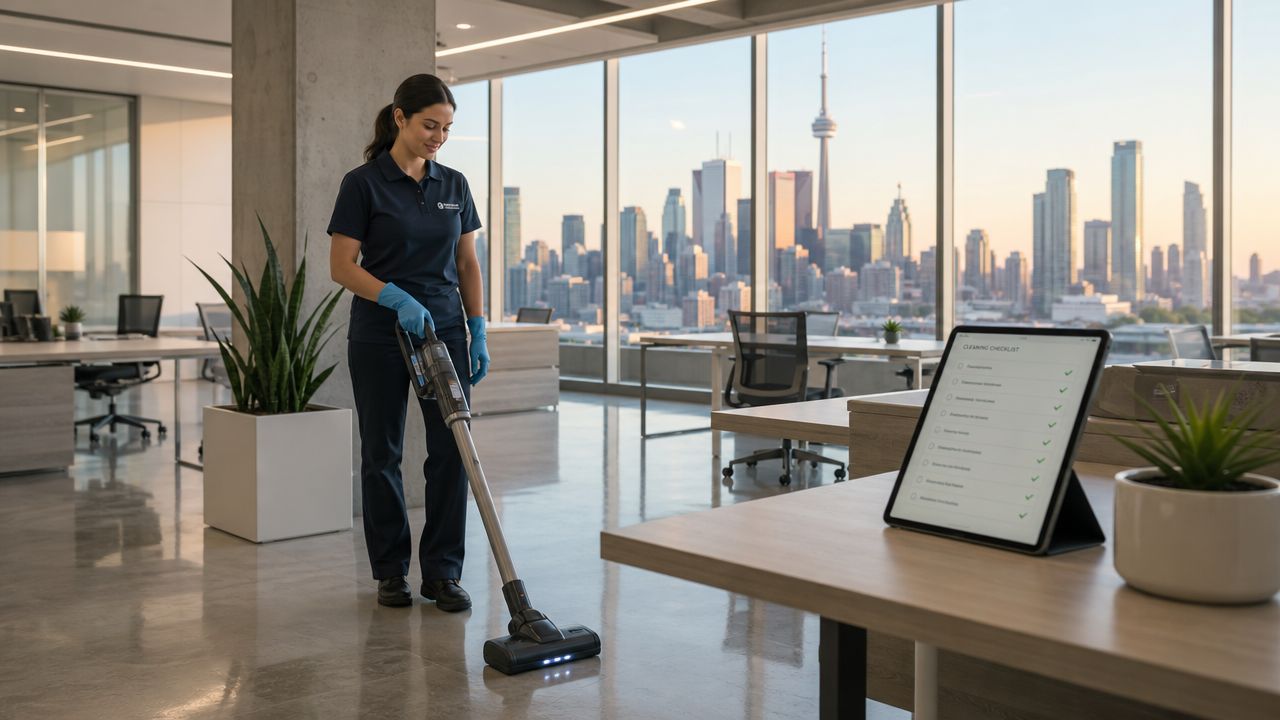
Modern commercial cleaning companies now use technology to create a new level of accountability. Leading providers equip their teams with mobile apps for real-time reporting, photo verification of completed tasks, and instant communication between cleaners, supervisors, and clients. This transparency ensures that any issues are documented and corrected immediately, giving facility managers true peace of mind. When searching for commercial cleaners near me, asking about a provider's QA technology is a good way to gauge their commitment to accountability.
How to Evaluate a Commercial Cleaning Service on Safety Standards
When vetting a new cleaning partner, it is easy to get lost in competing quotes. But choosing a commercial cleaning service is an investment in the health and safety of your workplace, not just its appearance. The real test is finding a partner who can protect your facility from unseen threats.
Evaluating a company's approach to cross-contamination prevention is the most critical step. A professional provider will not just talk about safety; they will have clear, documented standards ready for review. This shifts the conversation from cost to genuine value. When looking for an office cleaning provider in a competitive market like Toronto or Vaughan, a method is needed to cut through sales pitches.
Asking the right questions reveals whether safety protocols are deeply ingrained in a company's operations or are just a superficial talking point.
A Decision Framework: Questions to Ask a Potential Cleaning Provider
To gauge a company’s expertise, it is necessary to examine the details. A reliable commercial cleaning service will welcome scrutiny and should be able to answer these questions confidently.
What to Ask:
-
Can you provide documentation proving your team holds current WHMIS certification?
-
What specific, hands-on training do they receive on your cross-contamination protocols?
-
Can you describe your color-coding system for cleaning tools?
-
How do you ensure your team follows it correctly on every shift?
-
What Health Canada-approved (DIN) disinfectants do you use?
-
How are your staff trained to achieve the correct contact time for each product?
-
What does your quality assurance process look like?
-
How often are inspections performed, and how are findings reported to the client?
What to Look For:
- Good Answer: Clear, confident responses with offers to provide documentation (e.g., training manuals, inspection templates).
- Red Flag: Vague answers ("We handle it," "Our people are experienced"), hesitation, or an inability to provide documented proof.
A key differentiator among modern commercial cleaning companies is the use of technology for quality assurance. Buyer-friendly policies some companies offer include mobile apps that allow for real-time inspection reports, photographic verification of tasks, and instant communication. For example, some companies, like Arelli Cleaning, provide clients with access to a dedicated app for this purpose, offering a high level of transparency and accountability.
By asking detailed questions and demanding proof of protocols, you can confidently choose a partner who treats the hidden danger of cross-contamination with the seriousness it deserves.
Frequently Asked Questions (FAQ)
Here are answers to common questions about cross-contamination in commercial cleaning, building on the strategies in this guide. For additional information, the main Frequently Asked Questions page is a useful resource.
What is the single most important step to prevent cross-contamination?
The most crucial step is the strict enforcement of a color-coded system for all cleaning tools, ensuring dedicated microfiber cloths, mops, and buckets are used for different areas (e.g., restrooms vs. kitchens). Paired with a "one cloth, one surface" rule, this protocol creates a physical barrier that stops germs from traveling between high-risk and low-risk zones.
Why is "contact time" so important when using disinfectants?
Contact time, or dwell time, is the minimum duration a disinfectant must remain visibly wet on a surface to kill the microorganisms listed on its label. If a cleaner sprays and immediately wipes a surface dry, the product likely did not have enough time to work. This can range from 30 seconds to 10 minutes, depending on the product. Ignoring contact time leaves pathogens behind and creates a false sense of security.
How often should high-touch surfaces be cleaned in an office?
In a typical commercial office, high-touch surfaces should be disinfected at least once daily. This includes doorknobs, light switches, elevator buttons, and shared kitchen appliance handles. For facilities with higher foot traffic, such as medical clinics, daycares, or busy retail stores, frequency should increase to several times a day to effectively break the chain of germ transmission.
Who is responsible for ensuring cleaning protocols are followed?
This is a shared responsibility. The professional cleaning team is on the front line, accountable for executing tasks correctly. The commercial cleaning provider is responsible for properly training, equipping, and supervising their staff. The facility manager is responsible for hiring a qualified provider and verifying that the agreed-upon safety protocols are consistently met through clear communication and quality checks.
Where is cross-contamination most likely to occur?
Cross-contamination is most likely to originate in high-risk zones and spread to other areas. The most common high-risk zones in a commercial setting are restrooms (toilets, sinks), kitchens/breakrooms (sinks, countertops, appliance handles), and high-traffic common areas with numerous shared touchpoints (entrances, elevators).
How can I find a reliable commercial cleaner near me?
When searching for a reliable commercial cleaner near you, look beyond price. Challenge potential companies to detail their documented protocols for preventing cross-contamination. Ask for specifics on staff training (like WHMIS), their color-coding system, and their quality assurance process. A reputable provider will be transparent and proud to explain their methods. It is always wise to get quotes from at least two or three companies to compare their safety standards and overall approach to office cleaning.
Conclusion and Next Steps
Understanding and preventing cross-contamination is not merely about appearances; it is a critical component of workplace health and safety. By implementing structured protocols like color-coding, strategic cleaning sequences, and proper disinfectant use, a commercial cleaning service can effectively mitigate this hidden danger.
The most reliable way to ensure your facility is protected is to partner with a professional cleaning provider that prioritizes documented training, consistent execution, and transparent quality assurance.
Use the checklists and questions in this guide to evaluate potential partners. Request 2–3 detailed quotes and compare not just the price, but the substance of their safety protocols.
If you are located in Ontario—including Toronto, Mississauga, Vaughan, and surrounding areas—and want a quote that includes a free 45-minute sample clean to evaluate services firsthand, Arelli Cleaning is one option to consider. To see a full list of service areas, please visit our locations page.