Oops! Something went wrong while submitting the form
Blog
January 26, 2026
January 26, 2026
The Art of Cleaning Corporate Offices: A Professional Guide
The art of cleaning corporate offices is a strategic discipline that goes beyond simple tidying. It involves a skilled combination of systematic processes, trained professionals, and health-focused standards, all working together to create a workplace that is not just clean, but productive and safe. Professional office cleaning is a critical investment in team well-being, brand image, and operational strength.
Key Takeaways
Strategic Discipline: Professional office cleaning is a systematic service that enhances health, safety, and productivity, making it a valuable business investment.
Clear Definitions: Understanding terms like "commercial cleaning," "janitorial services," and "scope of work" is crucial for setting clear expectations with a service provider.
Customization is Key: A high-quality cleaning program is tailored to a facility's unique zones, such as reception areas, washrooms, and kitchens, with tasks and frequencies adjusted to match foot traffic and hygiene requirements.
Value Beyond Price: When comparing providers, evaluate factors like staff training (WHMIS), quality assurance systems, insurance coverage, and client-friendly contract terms, not just the final cost.
Structured Checklists: Creating a detailed cleaning checklist by zone and frequency is the most effective way to communicate needs and ensure consistent service delivery.
Understanding the Foundations of Professional Office Cleaning
The "art of cleaning corporate offices" means looking past the surface to address the invisible elements that impact a modern workspace. This professional service is grounded in science and executed with precision. Unlike basic housekeeping, professional commercial office cleaning is built on a structured framework designed to uphold the health, safety, and productivity of an entire business.
A solid grasp of a few core concepts forms the backbone of any professional cleaning agreement.
Key Terminology Defined
To appreciate what goes into commercial cleaning, it helps to understand the language industry professionals use:
Commercial Cleaning: This is the broad term for professional cleaning services provided to businesses rather than residences. It covers a wide range of facilities, from offices and medical labs in Toronto to industrial sites in the surrounding GTA.
Janitorial Services: A subset of commercial cleaning, janitorial services refer to the routine, often daily, tasks required to maintain a facility's cleanliness and functionality. This includes duties like emptying trash, sanitizing washrooms, vacuuming, and dusting.
Scope of Work (SOW): This is a critical document in any cleaning agreement. The SOW provides a detailed breakdown of all tasks to be performed, their frequency, and the specific areas covered. A clear SOW prevents misunderstandings and ensures accountability.
A professional cleaning service is fundamentally a health service. It reduces the presence of germs and allergens, which in turn can lead to fewer sick days, improved employee morale, and enhanced focus.
Understanding modern corporate cleaning also means seeing the "why" behind certain tasks, such as the reasons why clean the ductwork of a commercial building, office or warehouse. At its core, mastering the art of cleaning is about creating a reliable system that consistently delivers a clean, safe, and welcoming environment.
You can learn more about the specifics in this guide to office cleaning services. By understanding these foundational concepts, facility managers and business owners can better define their needs and select the right cleaning partner.
The Anatomy of a High-Quality Cleaning Program
A top-tier commercial office cleaning program is not a simple to-do list; it is a dynamic system designed to keep a workspace healthy, professional, and productive. Understanding its anatomy reveals the real art behind cleaning corporate offices, where every task has a purpose and a rhythm. This systematic approach ensures critical zones receive the attention they need, protecting both team well-being and client impressions.
This intense focus on health and safety fuels the professional cleaning industry. The Canadian commercial cleaning sector was valued at approximately CAD 6.5 billion in 2020, with its growth driven by heightened awareness of workplace hygiene. Projections show this trend continuing, with office cleaning leading as the largest service segment. You can explore the growth of Canada's commercial cleaning industry and its key drivers to see the full picture.
The Rhythm of Cleaning: Daily Essentials
Daily tasks are the bedrock of any solid cleaning program. These are the high-frequency duties that address the everyday buildup of germs, dirt, and waste, ensuring the office gets a fresh start each morning.
High-Touch Point Disinfection: This is one of the most critical daily tasks. It involves wiping down doorknobs, light switches, elevator buttons, and shared equipment with an appropriate disinfectant to reduce the risk of germ transmission.
Washroom Sanitization: Toilets, sinks, and countertops are cleaned and sanitized daily to uphold hygiene standards and prevent odours. Consumables like soap and paper towels are also restocked.
Waste Removal: All trash and recycling bins are emptied to prevent pests and maintain a tidy, professional appearance.
Spot Cleaning: Entrances, lobbies, and glass doors are spot-cleaned to remove fingerprints and smudges, maintaining a positive first impression.
Weekly and Periodic Deeper Cleaning
While daily cleaning maintains standards, weekly and periodic tasks go deeper to address built-up grime in less-trafficked areas. This layered strategy prevents the gradual decline of the office environment.
A professional cleaning schedule is proactive, not reactive. It addresses dirt and wear before they become visible problems, preserving asset value and ensuring a consistently high standard of cleanliness.
Weekly duties typically involve a thorough dusting of all surfaces, including ledges and fixtures, and a comprehensive vacuuming or mopping of all floors. On a monthly or quarterly basis, the plan might call for deep cleaning kitchen appliances, wiping down baseboards, or cleaning interior windows. These less frequent but vital jobs are what separate a basic service from a professional one. You may be interested in this guide on commercial disinfection and sanitizing services for more details.
Customizing for High-Impact Zones
Not all areas in an office are created equal. A high-quality cleaning program recognizes this and tailors its focus based on the function and foot traffic of each zone.
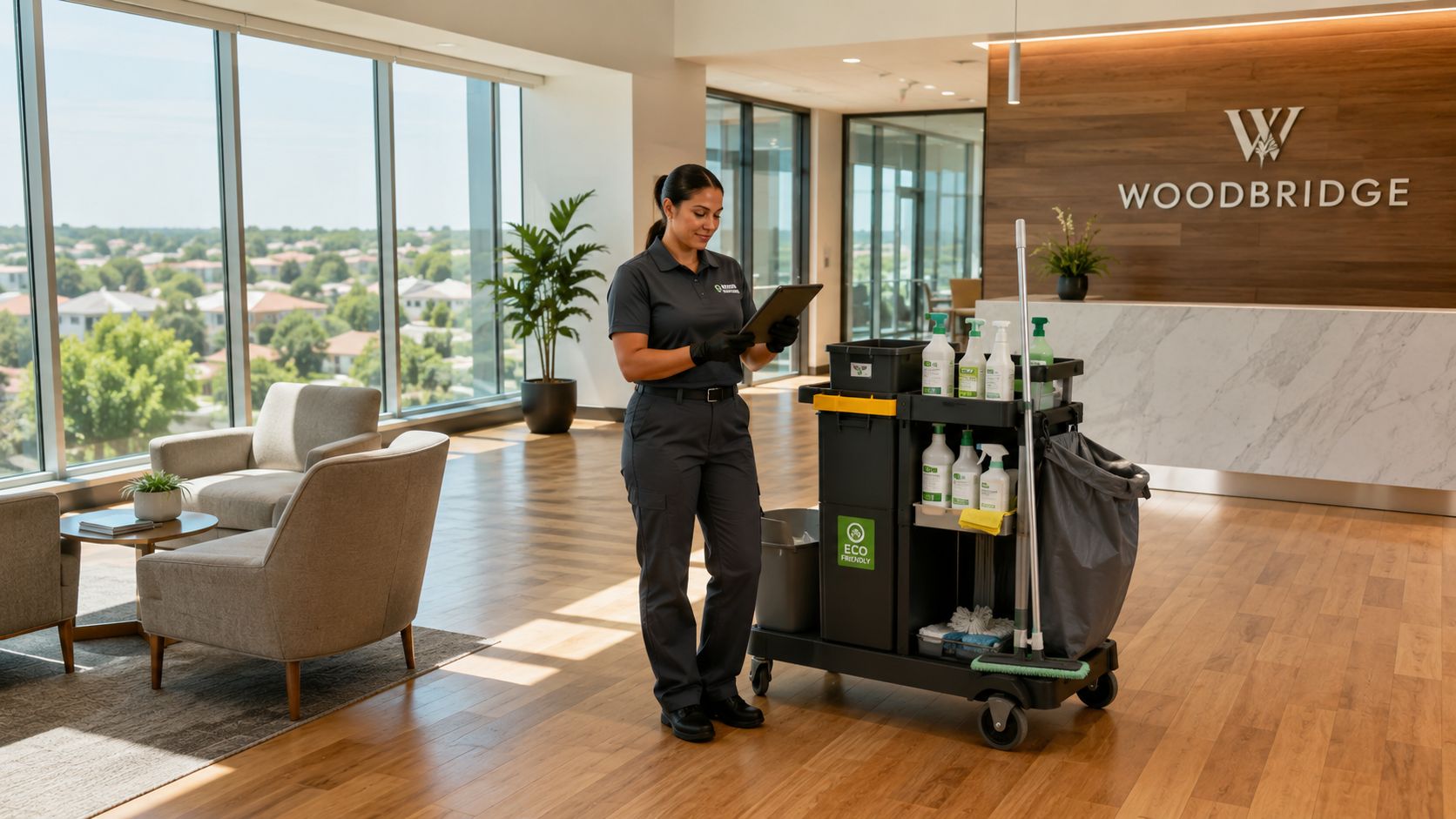
1. Reception and Lobby Areas: As the face of the company, these areas demand meticulous daily attention to create a welcoming atmosphere with spotless glass, pristine floors, and organized seating.
2. Kitchens and Break Rooms: These are hotspots for cross-contamination. Daily sanitization of countertops, sinks, and appliance handles is non-negotiable. Floors are also mopped daily to handle spills and foot traffic.
3. Washrooms: Perhaps the most scrutinized area in any facility, washrooms require rigorous daily sanitization. A deep clean is typically scheduled weekly to address tile grout, partitions, and fixtures.
4. Meeting Rooms and Offices: While individual offices may need less intensive daily work, meeting rooms must be reset daily. This means tables are wiped, chairs are organized, and whiteboards are cleaned for the next team.
By adapting cleaning frequency and intensity to each zone—from a busy office in Toronto to a professional firm in Mississauga—a cleaning program delivers maximum impact where it matters most. This customized approach is the essence of effective commercial cleaning.
How to Build Your Custom Office Cleaning Checklist
Creating a detailed cleaning checklist is the single most effective action you can take to achieve the precise level of cleanliness your office requires. It transforms vague requests into a clear, actionable guide that any professional commercial cleaning service can follow. This document ensures expectations are clear, from the high-traffic reception area in a downtown Toronto office to the quietest corners of a firm in Vaughan.
A well-crafted checklist serves as the foundation for your Scope of Work. It eliminates guesswork and establishes a consistent standard for quality. More importantly, it empowers you to communicate your needs with clarity, so the cleaning company for your office understands exactly what success looks like.
Step 1: Assess Your Facility By Zone
Before listing tasks, walk through your facility with a critical eye. The goal is to break down the space into logical zones based on function, foot traffic, and specific cleaning needs.
A typical office can be divided into zones like these:
Entrances & Reception: The first impression of your business.
Open-Plan Workstations: The hub of daily employee activity.
Private Offices: Lower traffic but requiring consistent attention.
Meeting & Conference Rooms: Client-facing areas that must be reset after each use.
Kitchen & Break Room: High-risk areas for germs and spills.
Washrooms: The most critical zone for hygiene and health.
Hallways & Common Areas: Connective spaces with constant movement.
For each zone, get specific. Does your reception area have large glass doors prone to fingerprints? Does the kitchen have appliances requiring a regular deep clean? This detailed assessment is the first step in mastering the art of cleaning corporate offices.
Step 2: List Specific Tasks for Each Zone
With your zones defined, list every task needed for that area. Be specific. "Clean the kitchen" is too vague. Break it down into clear, actionable items.
For your Kitchen & Break Room zone, the task list might include:
Wipe and sanitize all countertops and tables.
Clean and sanitize the sink and faucet handles.
Wipe down the exterior of the microwave, coffee maker, and refrigerator.
Restock paper towels and hand soap. (You can find more information about sourcing and managing cleaning supplies to ensure you're always prepared.)
Empty all trash and recycling bins, replacing liners.
Your task list should focus on outcomes, not just actions. For instance, specify "glass cleaned to a streak-free finish" rather than just "clean glass." This level of clarity helps your cleaning provider understand the quality standard you expect.
Step 3: Assign Frequencies to Each Task
Not every task needs to be done daily. Assigning a logical frequency—Daily, Weekly, or Monthly—to each item is crucial for creating a cleaning program that is both balanced and cost-effective.
Daily tasks should focus on high-touch surfaces, hygiene, and immediate appearance (e.g., sanitizing doorknobs, emptying trash, cleaning washrooms).
Weekly tasks are for more thorough cleaning to address accumulated dust and grime (e.g., dusting all surfaces, deep cleaning washroom fixtures).
Monthly tasks cover periodic deep cleaning and maintenance jobs (e.g., wiping down baseboards, cleaning interior windows, dusting high fixtures).
This structured approach ensures resources are used efficiently. Daily efforts are focused where they matter most, while the overall cleanliness of the facility is maintained over the long term. Any office cleaner service will understand this rhythm and deliver superior results.
An Office Cleaning Checklist Template
Use this customizable framework to organize your thoughts and ensure you cover all bases when you speak with potential commercial cleaners.
Office Cleaning Checklist Template by Zone and Frequency
Area/Zone
Task Description
Daily
Weekly
Monthly
Notes/Special Instructions
Reception Area
Clean glass on entrance doors (interior & exterior)
✓
Remove all fingerprints and smudges.
Vacuum all carpeted areas and entrance mats
✓
Dust reception desk, tables, and lamps
✓
Kitchen/Break Room
Sanitize countertops, tables, and sinks
✓
Spot clean cabinet fronts
✓
Clean inside of microwave
✓
Washrooms
Clean & sanitize toilets, sinks, and countertops
✓
Restock toilet paper, paper towels, and soap
✓
Deep clean and scrub all fixtures and partitions
✓
Workstations
Empty all waste and recycling bins
✓
Replace liners as needed.
Thoroughly dust all surfaces (desks, shelves)
✓
Do not disturb papers on desks.
Meeting Rooms
Wipe down conference table and chairs
✓
Erase whiteboards and clean trays
✓
Dust all baseboards and window sills
✓
This checklist is your roadmap to a consistently clean and healthy office. Taking the time to fill it out thoughtfully provides a powerful tool for communicating your needs and ensuring you receive the service you expect.
Comparing Commercial Cleaning Quotes: A Fair Approach
Obtaining quotes for office cleaning is straightforward; the skill lies in interpreting them correctly. Looking only at the final price means missing the larger picture of what each company offers. An informed decision is what separates a strong long-term partnership from recurring issues and hidden costs.
A quote is more than a price—it reflects a company's understanding of your needs, their professional standards, and their commitment to quality. A suspiciously low bid may be a red flag, potentially indicating a misunderstanding of the work, untrained staff, or a lack of proper insurance—all of which can create risks for your business.
Demystifying the Key Cost Drivers
To compare proposals fairly, you first need to understand what influences the price. Several key factors shape the final cost of any professional cleaning service.
Square Footage: The total area to be cleaned is the primary cost driver.
Service Frequency: Daily cleaning will naturally cost more than a weekly or bi-weekly service.
Facility Complexity: The number of washrooms, kitchens, private offices, and busy common areas impacts the time and resources needed.
Scope of Work: A detailed plan that includes disinfecting high-touch points or restocking supplies will be priced higher than a basic service.
Understanding these elements helps explain why two quotes for the same office in Markham or Mississauga might differ significantly. The difference often lies in the depth and quality of the service being offered.
What to Scrutinize in a Cleaning Proposal
Once quotes from various commercial cleaners arrive, it is time for a detailed review. A professional provider will be transparent about what’s included and, just as importantly, what is not.
A great quote provides a clear roadmap for service delivery. If a proposal is vague, it’s a red flag that the service itself may be inconsistent. A detailed scope of work is your best insurance against future misunderstandings and unexpected costs.
Here are the critical questions to ask when reviewing each proposal:
Is the Scope of Work itemized? Does it break down specific tasks for each area (reception, washrooms, offices) and define their frequency?
Are Consumables Included? Does the price cover supplies like toilet paper and hand soap, or will that be a separate, variable cost?
What is the staffing plan? Does the quote specify how many cleaners will be on-site and for how long?
Is Proof of Insurance Provided? Any legitimate proposal should include evidence of liability insurance and WSIB coverage to protect your business.
Are there any hidden fees? Look for mentions of administrative fees, fuel surcharges, or extra costs for after-hours access.
Comparing these details side-by-side will reveal which offer provides the best value. It also helps to have a sense of market averages. For example, a guide on the average cost of window washing can provide a benchmark for how specialized services are priced.
Market rates can also vary by location. In a competitive market like Toronto, basic janitorial services might range from CAD $30-$50 per hour. Monthly contracts for a medium-sized office can range from CAD $700 to over CAD $3,500, depending on frequency and scope. This knowledge positions you to make a choice that is both fair and sustainable for your business.
How to Evaluate a Cleaning Company Beyond Price
When reviewing cleaning proposals, it is tempting to let the bottom line guide the decision. However, the lowest bid is rarely the best value. A great commercial office cleaning service is defined by reliability, professionalism, and consistent results, not its price tag.
To find a true partner, you must look deeper at the operational systems that turn promises into a consistently clean and healthy workspace.
This deeper dive is especially critical in a competitive market. Ontario's facilities cleaning market is a CAD $3 billion industry, comprising about 38% of contract cleaning revenue in Canada. In a fragmented landscape like the Greater Toronto Area, high-quality providers thrive by delivering superior service, not just by being the cheapest option. You can explore more insights into Ontario’s dynamic facilities cleaning market.
Training and Professionalism
The quality of the service you receive is a direct reflection of the cleaning team's skill. A professional company invests in its people, developing them into skilled technicians who understand the art of maintaining corporate offices.
Look for proof of structured training programs covering:
WHMIS (Workplace Hazardous Materials Information System): This is non-negotiable in Canada and ensures staff can handle cleaning chemicals safely.
Proper Use of Equipment: Training on vacuums, buffers, and other machinery prevents damage to your facility and ensures efficiency.
Health and Safety Protocols: This includes understanding cross-contamination, bloodborne pathogen awareness, and correct PPE usage.
A well-trained team is a clear sign of a company that respects its employees and takes its commitment to clients seriously.
Quality Assurance Systems
How does a cleaning company ensure the job is done right every time? The answer is a solid quality assurance (QA) system. Without a formal process for inspecting work and acting on feedback, service quality can decline quickly.
A robust QA program isn't about catching mistakes; it's about preventing them. It’s a proactive commitment to excellence and accountability.
A strong QA system should include:
Regular Inspections: A supervisor or manager conducting scheduled site visits to score cleaning quality against the agreed-upon scope of work.
Client Feedback Channels: Simple ways for you to report issues or give feedback, such as a dedicated app, phone line, or email.
Documented Resolution Process: A clear, transparent procedure for addressing and resolving service issues quickly.
When evaluating a cleaning company for offices, ask them to describe their QA process. A detailed and systematic answer often indicates a more reliable service.
Buyer-Friendly Policies and Trust Signals
Certain business policies can make a provider easier and safer to work with. These buyer-friendly terms often signal a confident, client-focused company that stands behind its work.
Look for providers that offer:
No Long-Term Contracts: Flexible, month-to-month agreements show a company is confident in its ability to earn your business repeatedly.
Free Sample Clean: Some companies offer a complimentary clean of a specific area, allowing you to see their work quality firsthand before commitment.
Transparent Communication: Easy access to support through multiple channels (phone, app, on-site) ensures you can always reach someone when needed.
The table below provides a simple framework to compare potential providers on these crucial, non-price factors.
Provider Evaluation Criteria Checklist
This checklist is a useful tool for systematically comparing commercial cleaning providers, helping you focus on the operational details and service quality metrics that truly matter.
Evaluation Criterion
What to Look For
Provider A Notes
Provider B Notes
Staff Training
Evidence of formal training programs (e.g., WHMIS certification).
Insurance & Vetting
Proof of liability insurance, WSIB, and staff background checks.
QA Process
Regular, documented inspections and a clear issue resolution system.
Communication
Multiple, easy-to-use channels for client support (e.g., app, phone).
Contract Terms
Flexible, no-term contracts with no cancellation fees.
Trust Signals
Industry awards, positive online reviews, offer of a sample clean.
Using this checklist helps you move past the price tag to find a true partner dedicated to maintaining a pristine, healthy, and professional environment for your business.
The Lasting Impact of a Professionally Clean Office
Ultimately, the art of cleaning corporate offices is not just a routine task; it is a strategic investment in your people, your productivity, and your professional brand.
A genuinely clean environment directly impacts employee health, reducing sick days and boosting morale. It creates a space where teams can thrive. It also sends a powerful message to clients and visitors about your company’s high standards and attention to detail.
This guide has provided a framework for identifying your needs, building a custom checklist, and evaluating commercial cleaners fairly. By focusing on proven value and operational excellence instead of just the lowest price, you can find a partner dedicated to maintaining a consistently healthy and professional workspace.
We encourage you to use these tools and insights to obtain two or three competitive quotes. Ask pointed questions about training, quality assurance, and communication protocols. A methodical approach ensures you find a reliable provider who understands the unique needs of your facility.
If your business is located in Ontario—from Toronto and Mississauga to the broader York Region—and you would like a quote that includes a free 45-minute sample clean, Arelli Cleaning is one option to consider. To learn more or request an estimate, visit our Service Areas page.
Frequently Asked Questions (FAQ) About Office Cleaning
What is the difference between commercial cleaning and janitorial services?
Direct Answer: Janitorial services refer to routine, daily cleaning tasks like emptying trash and sanitizing restrooms. Commercial cleaning is a broader term that includes janitorial services as well as less frequent, more intensive tasks like deep carpet cleaning or floor stripping and waxing. In essence, janitorial services are a subset of commercial cleaning focused on everyday upkeep.
How often does our office need professional cleaning?
The ideal cleaning frequency depends on several factors, including employee count, client foot traffic, and facility type (e.g., a medical office versus a tech startup). A small office with low traffic in Milton or Oakville might only need service 2-3 times a week, while a large, busy corporate office in downtown Toronto with 50+ employees would benefit from daily cleaning to maintain hygiene and appearance.
What should a standard office cleaning contract include?
A professional cleaning contract should clearly outline the detailed Scope of Work (SOW), service schedule, pricing and payment terms, proof of liability insurance and WSIB coverage, a clear issue resolution process, confidentiality clauses, and fair cancellation terms. This document ensures accountability and prevents misunderstandings.
How do I find a reliable commercial cleaner near me?
To find a reliable commercial cleaner near you, start by asking for referrals from other businesses in your area, whether in Barrie, Kitchener, or North York. Check online reviews to assess consistency and customer service. It is recommended to get detailed quotes from at least three different commercial cleaning companies to compare their scope, value, and professionalism before making a decision.
Why is a quality assurance (QA) program important?
A quality assurance program, which includes regular inspections and client feedback channels, is crucial for maintaining consistent service standards. It demonstrates a cleaning company's commitment to accountability and proactive problem-solving, ensuring that the agreed-upon scope of work is met consistently over time.
Are cleaning supplies typically included in the price?
This varies by provider. Some commercial cleaning services include the cost of all cleaning chemicals and equipment in their quote, while others bill for consumable supplies like toilet paper, paper towels, and hand soap separately. It is important to clarify this when reviewing a proposal to avoid unexpected costs.








.webp)