
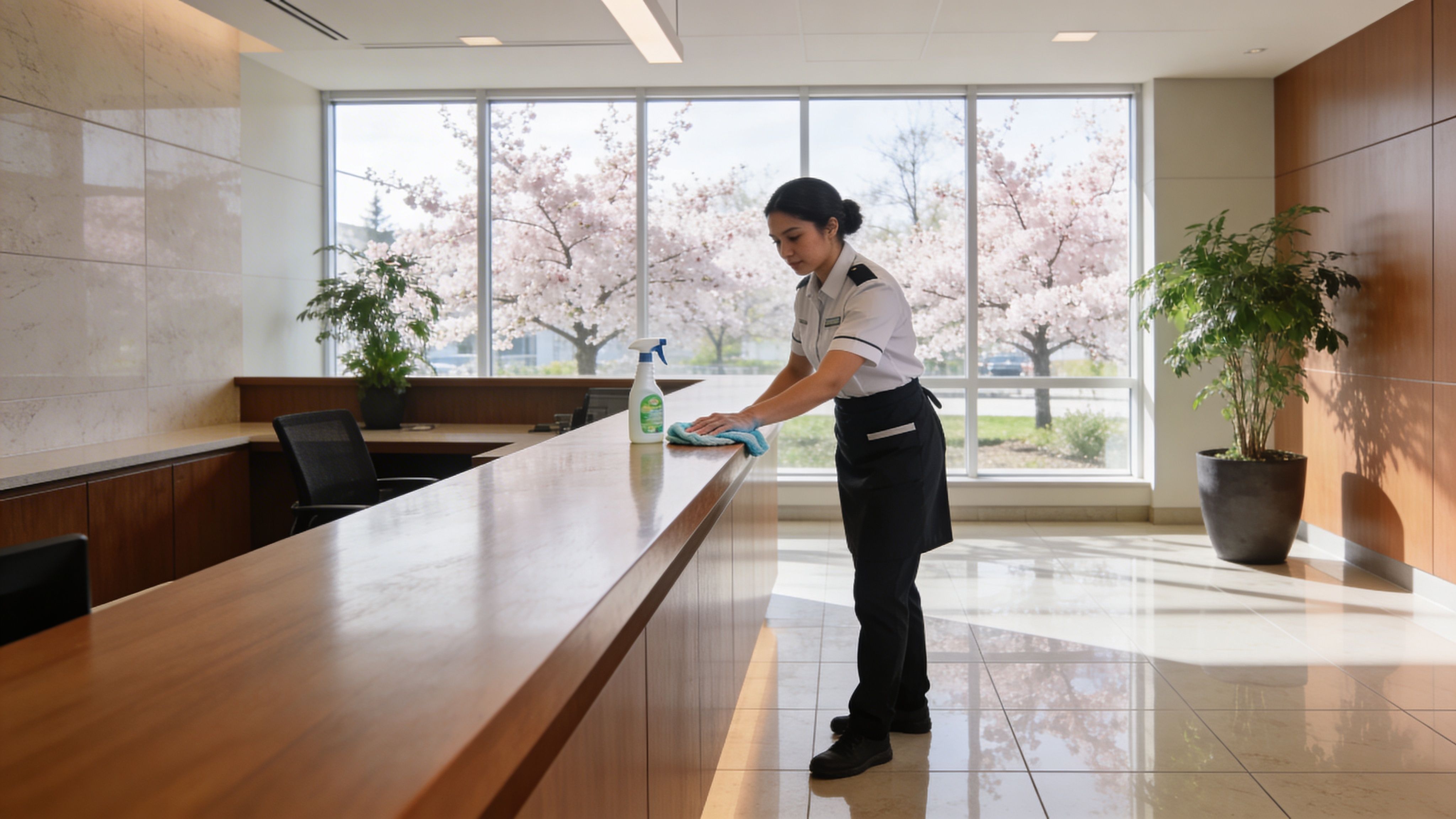
A Vaughan office in late March usually looks functional at first glance. The lights are on, the carpets are vacuumed, and the reception desk is tidy enough for the day ahead.
Then the details start to show. Salt haze sits along entry flooring. Dust has collected on vents and ledges while windows stayed shut all winter. Storage rooms have become holding zones for old boxes, broken equipment, and extra supplies that no one has reviewed in months. That is the point when spring office cleaning in vaughan stops being a cosmetic task and becomes an operational one.
For a business owner or facility lead, spring cleaning means resetting the workplace after winter stress. It is about protecting floors, improving indoor conditions, reducing slip and dust issues, and dealing with the buildup that regular nightly service does not always address.
Defining Spring Cleaning for Your Vaughan Business
By April, many Vaughan offices are clean enough to operate but not clean enough to recover from winter. The lobby may look presentable at 8 a.m., yet salt film is still grinding into floor finishes, fine grit is sitting in carpet backing, and local pollen is about to add a second layer of buildup on sills, glass, and intake areas.
For a Vaughan business, spring cleaning is a targeted post-winter reset. It deals with residue that routine nightly service is not built to remove, especially in buildings exposed to parking lot runoff, sidewalk salt, loading traffic, and weeks of sealed-window air circulation.
Local conditions shape the job. Post-winter salt residue attacks floor finishes and leaves hard edges along baseboards and entry tile. Early spring pollen starts settling before many offices have finished their winter recovery. Municipal cleanup also affects results. As the City of Vaughan reported removing approximately 17,800 bags of litter and 1,058 tonnes of debris from public lands in 2025, that municipal volume reflects the scale of seasonal residue moving through the local environment. Commercial buildings absorb part of that load at every entrance.
What spring cleaning means in an office
In practice, this work usually includes:
- Restorative floor care to remove salt film, embedded grit, and finish wear
- High dusting on diffusers, vents, ledges, light fixtures, and partition tops
- Detailed cleaning of shared spaces such as reception areas, kitchens, meeting rooms, and washroom touch zones
- Glass and interior window cleaning to clear winter haze and early pollen buildup
- Storage and back-room review so blocked areas can be cleaned
- Spot treatment of neglected surfaces such as chair bases, door frames, kick plates, and corners around millwork
The scope should match the building type. A medical office, professional suite, warehouse office, and multi-tenant administrative space do not carry the same winter load, and they should not receive the same spring plan.
A proper spring clean is also a facilities decision, not a courtesy task for staff.
Assigning employees to wipe desks and sort clutter can help with access, but it does not recover flooring, address dust above eye level, or remove buildup from ventilation grilles and entry sequences. Those items require the right equipment, enough labour hours, and a clear scope.
Where owners often under-scope the work
The common mistake is treating spring cleaning as a longer version of regular janitorial service. That usually leaves three expensive problems behind. Salt remains in grout lines and carpet edges. Dust stays on high surfaces and drops back into occupied areas later. Floor finishes fail early because abrasive residue was never fully removed before fresh product was applied.
The trade-off is simple. A lighter clean costs less upfront, but it often leads to repeat callouts, shorter floor life, and a workplace that still feels tired after the invoice is paid.
Practical rule: If the plan does not include entry recovery, high dust removal, detailed shared-space cleaning, and access to storage or blocked zones, it is not a real spring clean.
Why businesses treat it as an investment
Well-executed spring cleaning protects assets and reduces avoidable wear. It helps custodial teams maintain results through the rest of the season instead of fighting old buildup. It also improves presentation at the point in the year when more client visits, brighter daylight, and open-window days make neglected surfaces easier to spot.
In Vaughan, timing adds value. A business that lines up spring cleaning with the tail end of heavy salt tracking and the city’s outdoor cleanup cycle gets better staying power from the work.
Building Your Spring Cleaning Timeline and Strategy
A Vaughan office can look clean on a Friday night and still feel dirty again by Tuesday morning in early spring. Staff track in leftover salt from parking lots, dry grit keeps working out of entry mats, and local pollen starts settling on sills and horizontal surfaces as soon as windows and doors open more often. A useful spring cleaning plan accounts for that cycle instead of forcing all the work into one visit.
For most Vaughan businesses, the right schedule has two goals. Remove winter residue before it keeps grinding into floors and carpet. Finish detail work after the heaviest outside dust and debris have tapered off through the city's spring cleanup period.
That timing matters. If you strip, scrub, or extract too early, your team can spend money restoring surfaces that get re-contaminated within days. If you wait too long, salt and grit keep wearing finish, grout, and carpet backing.
Phase 1. Assess the building and set the order of work
Start with a site walk at the end of winter, before booking labour. I recommend doing it with operations or facilities staff, not only office administration, because they know which doors are used, which rooms collect dust, and where access problems will slow the crew down.
Check the building in the same sequence people use it:
- Exterior-to-interior entry path, including sidewalks at the door, vestibules, matting, tile, and nearby carpet
- Main traffic routes from parking areas, warehouse access points, or loading doors
- South-facing windows and ledges where spring pollen and visible dust build up first
- Shared spaces such as lunchrooms, washrooms, meeting rooms, and reception
- High surfaces and neglected edges including vents, tops of cabinets, frames, and partition caps
- Blocked or overfilled storage rooms that prevent proper access
The point is to separate cosmetic work from asset-protection work. Dirty glass can wait a week. Salt in grout lines and abrasive grit in floor edges should not.
Phase 2. Match the cleaning window to Vaughan conditions
In Vaughan, spring cleaning works best as a short sequence, not a one-day event. Early phase work usually starts once the worst winter tracking has eased. Final floor restoration, interior glass detailing, and fine dust cleanup often hold until outdoor conditions settle down and less debris is being pulled back inside.
A practical schedule often looks like this:
- Late winter to early spring: inspect damage, confirm scope, and clear storage or workstation obstacles.
- Early spring: handle high dusting, washrooms, kitchenettes, and detailed surface cleaning.
- Mid-spring: complete carpet extraction, machine scrubbing, or floor finish work once salt tracking drops.
- After the main outdoor cleanup period: finish interior windows, touch-up detailing, and final inspection.
That sequence reduces rework. It also helps managers spread cost across a few weeks instead of loading every task into one shutdown.
Phase 3. Prepare access before the crew arrives
Deep cleaning slows down fast when teams have to work around boxes, archived files, spare furniture, and unsecured documents. The cleaning contractor is then billing for moving obstacles instead of cleaning productive square footage.
Set expectations by zone before the start date:
- Assign each department a clearance deadline
- Tag sensitive materials such as HR files, client records, prototypes, and electronics
- Decide what stays and what gets removed from storage rooms and under-desk areas
- Confirm disposal procedures for confidential paper, e-waste, and bulky items
- Approve after-hours access needs for locked rooms, alarms, elevators, and loading areas
This step often decides whether the final result feels thorough or partial.
Phase 4. Sequence the work to avoid repeat dust and repeat labour
Order matters. If high dusting happens after floor work, fine debris lands on finished surfaces and your team pays for touch-ups. If washroom and kitchenette detailing happen before nearby dust removal, residue can settle back onto disinfected areas.
Use a sequence that limits contamination:
- High dusting and vent detailing
- Vertical surfaces, ledges, partitions, and fixtures
- Washrooms, lunchrooms, and touchpoint-heavy rooms
- Interior glass and frame cleaning
- Carpet extraction or hard floor restoration
- Final inspection, touch-ups, and reset of furniture or mats
Occupied offices usually do best with evening or weekend zoning. Medical offices, industrial admin spaces, and training facilities may need a tighter phasing plan so critical rooms stay available.
Phase 5. Reset maintenance standards after the spring clean
A spring project should change the maintenance routine for the next quarter. Otherwise the building drifts back to the same condition by early summer.
After the work is complete:
- Review entrance mat coverage and replace undersized or worn mats
- Increase inspection frequency at corners, transitions, and perimeter edges where grit collects
- Adjust periodic tasks for high dusting, vent cleaning, and floor care
- Check supply quality for microfiber, neutral cleaners, and spot-treatment products used in-house
- Document problem areas so next year's scope starts with actual trouble spots, not guesswork
I treat this as the return-on-investment step. The deep clean removes winter buildup. The maintenance reset protects the money spent on that removal.
Planning framework for Vaughan offices
| Decision area | What to decide | Why it matters |
|---|---|---|
| Timing | Early-phase cleanup versus final restoration later in spring | Prevents fresh grit, salt, and outdoor dust from undoing finished work |
| Scope | Surface refresh versus floor recovery, high dusting, glass, and blocked-area access | Stops under-scoping and surprise charges |
| Access | Business hours, evenings, weekends, or staged closures | Reduces disruption, overtime pressure, and security issues |
| Site conditions | Which entrances, parking-facing zones, and window lines take the most residue | Targets the parts of the building that wear out fastest |
| Follow-up | Matting, inspections, and periodic floor and dust-control tasks | Helps the results hold through the rest of the season |
The Prioritized Spring Office Cleaning Checklist
By April in Vaughan, the office usually looks better than it did in February, but the building is still carrying winter. Salt dust sits in vestibule corners, entry carpet holds fine grit, and the first warm days start bringing in pollen through doors, windows, and rooftop air intake points. A spring checklist needs to deal with that sequence of conditions, not just tidy surfaces.
The right order follows risk, traffic, and cost. Start where winter residue shortens floor life, raises slip risk, or hits client-facing areas first. Then clean the spaces that affect staff use, indoor dust load, and day-to-day housekeeping efficiency.
A practical rule still applies. Clean high surfaces before horizontal surfaces, and finish floors last. If vents, light lenses, and frame tops are skipped until the end, dust drops back onto work that has already been paid for.
Start with entry sequence and public-facing space
In Vaughan offices, the entrance sequence deserves first position because it takes the hardest hit from slush season and often stays dirty longer than managers expect. That includes exterior-facing door glass, vestibules, mat wells, door tracks, adjacent hard flooring, and the first stretch of corridor inside the entrance.
These areas usually deserve first attention:
- Entrance vestibules
- Lobby and reception
- Main corridors from parking-facing doors
- Boardrooms and meeting rooms
- Client washrooms
The trade-off is straightforward. If time is limited, spending extra labour in the vestibule and lobby produces more value than spreading that time thinly across low-use private rooms. It reduces re-soiling, improves first impression, and protects flooring that costs real money to restore.
Next, target staff areas that hold hidden buildup
Staff zones rarely look as bad as entrance areas, but they often carry the dust load that keeps complaints alive into late spring. Partition tops, cable runs, chair bases, baseboards, under-desk areas, and breakroom edges are common misses.
Focus on:
- Workstation partition tops and ledges
- Keyboard, mouse, and phone cleaning protocols
- Chair bases and under-desk vacuuming
- Breakroom cupboard fronts and appliance exteriors
- Baseboards, corners, and perimeter edges
This is also the point where managers should decide what belongs with janitorial spring cleaning and what belongs with a separate scope, such as minor reorganization, e-waste removal, or post-construction cleaning after office renovations or furniture changes.
Finish the rooms that collect neglect
Copy rooms, storage areas, utility closets, server-adjacent spaces, and interior glass frames tend to stay in use while receiving only light cleaning. They do not drive first impression, but they do affect housekeeping standards, pest control, and how efficiently staff can work around supplies and equipment.
A room nobody sees can still create repeated labour costs if crews have to clean around clutter every visit.
Vaughan Office Spring Cleaning Checklist
| Zone | Task | Priority | Rationale & Professional Tip |
|---|---|---|---|
| Entrance and vestibule | Remove salt residue from mats, edges, door tracks, and adjacent flooring | High | Vaughan entry points carry heavy winter grit. Check whether mat coverage is long enough to capture debris before it reaches finished floors. |
| Lobby and reception | Dust high ledges, clean glass, detail furniture, and deep clean flooring | High | Spring sunlight exposes film on glass and settled dust on horizontal surfaces. Complete high dusting before glass detailing and floor finishing. |
| Main corridors | Spot walls, clean baseboards, vacuum edges, and treat floor buildup | High | Corridors collect both tracked-in residue and airborne dust. Hand-detail corners before machine scrubbing or extraction. |
| Meeting rooms | Dust vents and fixtures, wipe tables and chairs, clean interior glass | Medium | Rooms that sit unused for parts of winter often hold stale dust on vents, screen mounts, and window ledges. |
| Workstations | Clean partition tops, undersides of desks, chair legs, and flooring under furniture | High | Daily cleaning often misses hidden soil under occupied desks. Basic pre-clearance by staff saves labour time and improves results. |
| Shared touchpoints | Clean handles, switches, rails, and common equipment surfaces | High | Touchpoints should be addressed after dusting and detailing so surfaces do not need to be redone. |
| Kitchenette and lunchroom | Degrease cupboard fronts, clean appliance exteriors, detail seating and floors | High | Food areas build residue that winter schedules often overlook. Check splash zones, fridge gaskets, and table bases. |
| Washrooms | Deep clean partitions, vents, dispensers, grout lines, and floor edges | High | Salt, moisture, and cleaner buildup often collect along edges and around fixtures. Daily service rarely resets these areas fully. |
| Private offices | Dust shelves, clear low-traffic corners, clean interior windows and sills | Medium | Lower use can hide dust accumulation for months. Sun exposure makes sills and glass film more visible in spring. |
| Storage rooms | Remove obsolete items, clean shelving, vacuum corners, and relabel supplies | Medium | Cleaning around stored items wastes time. Decluttering before the visit lowers labour cost and improves access. |
| Vents and light fixtures | High dust with microfiber extension tools | High | Early spring pollen and indoor dust settle on overhead surfaces. Clean these first so lower surfaces stay clean longer. |
| Interior glass and frames | Remove film, fingerprints, and dust from frames and tracks | Medium | Pollen and winter dust collect in tracks and corners. Cleaning only the glass pane leaves the job unfinished. |
| Carpets | HEPA vacuum and schedule extraction where winter traffic was heaviest | High | Entry carpet and main travel lanes usually hold embedded grit after winter. Vacuuming alone often leaves residue behind. |
| Hard floors | Scrub, neutralize, and assess whether recoating is needed | High | Salt film dulls finish and can wear traffic lanes unevenly. Inspect floors after municipal street sweeping begins, not before, or residue may return quickly. |
| Back-of-house areas | Clean copier rooms, utility spaces, and staff-only corners | Low | These rooms support housekeeping quality and reduce dust migration into cleaner spaces. |
What works in practice
Teams get better spring-cleaning results in Vaughan when they match the checklist to outside conditions. If street sweeping has not started on nearby routes or parking areas are still shedding grit, it makes sense to do an early interior reset first and hold final floor restoration for a little later. That timing decision protects the finish and avoids paying twice for the same appearance problem.
A few methods consistently pay off:
- High dusting before floor work
- Pre-clearing clutter before crews arrive
- Extra detail at entries, perimeter edges, and parking-facing corridors
- Separate standards for client-facing areas and back-of-house rooms
- Equipment and chemicals matched to carpet, resilient floor, tile, or stone
What usually wastes money is easy to spot. Staff get asked to “spring clean” without enough time, the team mops over salt film instead of removing it, and neglected overhead dust drops back onto cleaned surfaces. The checklist works when it follows building use, Vaughan weather patterns, and the actual way soil moves through the office in spring.
Investing in Specialty Services for Post-Winter Restoration
By late March in Vaughan, many offices look clean at a glance and still carry winter damage. Salt haze sits in lobby grout, entry carpets hold abrasive grit, and glass shows the film left by slush spray and heating-season dust. If that residue stays in place through the spring pollen cycle, cleaning gets harder and wear accelerates in the busiest areas.
Specialty services address conditions that regular janitorial work cannot correct. The biggest example is hard floor restoration. Once de-icer residue, tracked grit, and worn finish have settled into traffic lanes, routine mopping improves appearance only briefly. It does not remove embedded film, correct uneven gloss, or protect the floor from further abrasion.
In Vaughan, timing matters as much as scope. If crews refinish floors before nearby roads, lots, and walkways stop shedding winter residue, the new finish takes abuse too early. A better approach is to schedule detailed floor restoration after local street sweeping and property clean-up have started, then use interim maintenance to control residue at entries. That sequencing reduces rework and protects the finish you just paid for.
Where specialty work earns a return
Hard floor strip and refinish
Use this for lobbies, corridors, lunchrooms, medical offices, and washroom approaches where salt film has dulled the surface or etched traffic paths. The return is longer finish life and lower replacement pressure. The trade-off is access control. Sections may need to be closed, cure times must be respected, and furniture movement has to be planned.
Carpet extraction
Entry carpet and corridor broadloom often hold the worst post-winter soil load. Vacuuming removes loose debris, but it does not pull out the residue packed into the pile by boots, carts, and melting snow. Extraction improves appearance, reduces odour, and helps prevent that gritty material from migrating into cleaner parts of the office.
High dusting and vent detailing
Spring air quality complaints often start here. Dust collected over winter on diffusers, ledges, light housings, and tops of partitions gets redistributed once HVAC systems shift with the season and windows start opening. This work matters even more when local pollen starts rising.
Interior and exterior window cleaning
Vaughan buildings near busy roads and large parking areas pick up a visible film after winter. Clean glass improves daylight, but the primary operational benefit is easier inspection of seals, frames, and sill buildup before warmer weather exposes moisture or mould issues.
Cases that need a different scope
A standard spring deep clean is the wrong tool after renovations, fixture replacements, or tenant improvements. In those cases, the benchmark is closer to post-construction cleaning. Fine dust in corners and vents, adhesive residue on glass and frames, and debris in floor edges require a more detailed process and tighter inspection standard than periodic office cleaning.
Check the hidden areas before approving a reduced scope. Window tracks, furniture bases, cable runs, floor corners, and supply grilles usually show the true condition of the site.
For Vaughan businesses comparing local support, Vaughan commercial cleaning services may include strip and wax, carpet cleaning, high dusting, disinfection with Health Canada-approved products, and post-construction cleanup. The decision should come down to building condition, downtime tolerance, and whether the provider can phase restoration work around occupancy without leaving client-facing areas half-finished.
How to Evaluate and Select a Cleaning Provider in Vaughan
A weak vendor selection usually shows up on the first work night. The crew arrives without enough equipment, the floor finish is wrong for the surface, or nobody accounted for salt residue at the entrances that keeps getting reactivated with spring moisture. In Vaughan, I would also check whether the provider understands timing around local street sweeping and outdoor cleanup, because that affects how much dirt, grit, and pollen will still be tracked back into the building after the job.
Price matters. Scope control matters more.
A useful external primer is this guide on how to choose the right office cleaning provider. Use it as a baseline, then test each bidder on the details that affect your site. For a Vaughan spring clean, that means entry mat recovery, hard floor condition after winter salt exposure, window and sill detail, and whether the crew can phase work after hours without leaving high-traffic areas half restored.
Questions worth asking
Ask for clear answers in writing, not verbal assurances during a walkthrough.
- What tasks are included in the spring project that are outside the regular janitorial scope
- How will you treat post-winter salt film on hard floors, baseboards, and entrance areas
- What is your method for high dusting, upholstery, carpet extraction, and floor refinishing where needed
- What WHMIS training, site safety procedures, and insurance coverage apply to this job
- Who inspects the work, and how are deficiencies recorded and corrected
- Can you schedule around occupancy, deliveries, and building access restrictions on evenings or weekends
- What assumptions are built into the quote about square footage, furniture movement, and access to locked rooms
- How do you handle timing if exterior debris, pollen, or municipal cleanup activity is still affecting entrances
The last question matters more than many buyers expect. If a contractor finishes detailed interior work before outdoor conditions settle down, you can end up paying for touch-up visits that should have been avoided through better scheduling.
What to avoid
The common warning signs are easy to spot once you know where bids fail.
| Red flag | Why it matters |
|---|---|
| Vague scope descriptions | Disputes start after the invoice arrives because nobody defined the finish standard |
| One flat price without a site review | The quote is based on assumptions instead of the building's actual condition |
| No questions about floor type, traffic pattern, or entrances | The provider is selling a package, not planning for your facility |
| No inspection process or deficiency log | Your staff becomes the quality control team |
| No discussion of timing around weather and outdoor cleanup | Fresh work gets undermined by continued salt, grit, and pollen tracking |
| Pressure to sign quickly | You lose the chance to compare scope line by line |
Pricing and value
A spring project should be priced against building condition, access hours, floor surfaces, amount of buildup, and specialty work. Ask for a scope-based quote with assumptions listed. That gives you something you can compare.
The lowest number often excludes labor-intensive details such as vent cleaning, partition tops, chair upholstery, inside glass, or floor recovery at entrances. Those omissions are expensive because they usually affect the areas staff and clients notice first.
For local comparison, Vaughan businesses can review a provider's local service footprint and stated capabilities on this Vaughan commercial cleaning services page. Then confirm those services are available for your building type, your schedule, and your inspection standard.
A practical buying rule works well here. Get two or three quotes, but issue the same scope notes to every bidder. Include site access limits, photos of problem areas, floor types, and your target dates relative to Vaughan's spring cleanup period. That is how you get a fair comparison instead of three different guesses.
Frequently Asked Questions about Office Spring Cleaning
What is the difference between spring cleaning and regular office cleaning
Regular office cleaning maintains the space. Spring cleaning restores it. Routine service handles visible daily needs such as garbage, washrooms, vacuuming, and touchpoint cleaning. Spring cleaning addresses the buildup left behind by winter, neglected high surfaces, detailed floor recovery, and low-frequency tasks.
When should a Vaughan business schedule spring office cleaning
The best timing depends on the building, but many businesses start planning in late winter and schedule the heavier restoration work through spring. In Vaughan, coordinating final detail work with the broader outdoor cleanup season usually improves results because less debris is still being tracked in.
How long does a proper spring clean take
It depends on size, layout, occupancy, and scope. A small office may be handled over one evening or weekend. A larger occupied facility usually works better as a phased project over several visits so cleaning crews can complete detail work without disrupting operations.
Should in-house staff handle it or should the business hire professionals
In-house teams can help with decluttering, sorting, and preparing access. Deep cleaning, floor restoration, high dusting, and other technical work are often better handled by trained crews with commercial equipment. The main reason is not convenience alone. It is consistency, safety, and avoiding damage to finishes or fixtures.
What areas are most often missed
The usual misses are above-eye-level dust, floor edges, vents, light fixtures, storage shelving, chair bases, and spaces behind or beneath movable furniture. These are the areas that continue to make a workplace feel dusty even after a general clean.
Are eco-friendly options available
Yes, but the right question is whether the products and methods fit the facility. Some sites need low-odour products, some need Health Canada-approved disinfectants, and some need reduced-residue methods for sensitive surfaces. Ask providers how they balance environmental goals with cleaning performance and occupant safety.
How often should specialty services be done
That depends on traffic, floor type, and the kind of work happening in the building. Entry carpets, hard floors, and interior glass often need periodic attention beyond nightly service. A spring review is a good time to decide which tasks should move onto a recurring schedule.
What standards should a business use to evaluate quality
Look for clear scopes, documented inspections, trained staff, and methods that align with recognised industry guidance. Quality should be visible in the process as much as in the result.
Conclusion and Further Reading
A Vaughan office usually shows winter in very specific ways by spring. Salt film sits in entry grout and on hard floors, fine dust collects along edges and vents, and early pollen starts to replace winter debris before the building has fully reset. If that buildup is left in place, routine cleaning crews spend the next quarter chasing avoidable floor wear, dull finishes, and recurring dust complaints.
The goal is to restore the building to a maintainable condition. That means timing the work after the worst of snow and slush is over, but before spring pollen and higher foot traffic create a second layer of buildup. In Vaughan, it also helps to line up exterior and entrance-area work with local public works spring cleanup activity already discussed earlier in this article, so sidewalks, parking areas, and entry points are not being cleaned in the wrong sequence.
Keep the closeout simple. Confirm the scope. Inspect the site after completion. Note what should move to a recurring schedule, especially floor care, entry matting, glass, and high dusting. Then use that inspection to set standards for the rest of the year, not just for one seasonal reset.
For businesses benchmarking providers, ISSA is a useful reference point for cleaning standards, training frameworks, and quality expectations.
If a Vaughan business wants one local option in the quote comparison, Arelli can be included based on its Vaughan service coverage, flexible contracts, sample cleans, and support structure.
Use the checklist, inspect the space properly, and ask better questions before approving any quote. That is how spring office cleaning in vaughan becomes a sound facilities decision with lower risk, better asset protection, and less reactive maintenance through the season.