Toronto flu positivity crossed 5% in mid-November and reached 35.7% by mid-December during the 2025–26 season, so offices should treat the six-to-eight weeks before that rise as the practical preparation window. Preparing Your Office for Cold and Flu Season works best when ventilation, sick-worker policies, hand hygiene, and targeted cleaning are organised before cases accelerate, not after staff absences begin.
Seasonal influenza already creates a measurable workplace burden in Canada. Employer-focused Canadian research estimates 1.5 million lost workdays every year, with an average influenza-related employee absence of about 14 hours and influenza accounting for roughly 0.08% of potential hours worked annually. The H1N1/09 pandemic waves raised that annual loss to 0.19% of potential hours worked. TELUS Health's employer guide to flu prevention puts the operational issue plainly: offices need a prevention system that protects attendance without turning every surface into a theatre of reassurance.
Table of Contents
Why Cold and Flu Season Preparation Starts Earlier Than Most Offices Think
Toronto's respiratory season can move faster than an office procurement cycle. Toronto Public Health identifies the beginning of flu season around August 24, and local reporting recorded 238 laboratory-confirmed flu cases in Toronto by November 15 during one recent season. In Ontario's 2025–26 monitoring, influenza positivity exceeded 5% in mid-November and peaked at 35.7% in mid-December. CBC's Toronto flu activity report shows why a late-autumn response often starts after the risk has already changed.
For a Toronto office, the preparation window opens in early September. That's when facilities teams should confirm cleaning coverage, test ventilation settings, review absence procedures, order supplies, and communicate expectations. Waiting until November creates predictable bottlenecks, especially for HVAC contractors, cleaning vendors, replacement filters, masks, tissues, and approval from landlords or building operators.
A practical preparation sequence
| Week, approximate | Flu positivity | Prep task triggered |
|---|
| Late August | Season begins around August 24 | Assign an accountable office lead and review last season's absence and cleaning records. |
| Early September | Baseline activity may still appear manageable | Book HVAC checks, confirm cleaning scope, audit supplies, and draft the sick-work policy. |
| Late September | Preparation window is narrowing | Install or service hygiene stations, train reception staff, and schedule vendor capacity. |
| October | Activity commonly begins building | Communicate stay-home expectations, verify filters and ventilation, and begin documented touchpoint checks. |
| Mid-November | Positivity exceeded 5% in 2025–26 | Complete a readiness check and move from planning to active seasonal controls. |
| Mid-December | Positivity peaked at 35.7% in 2025–26 | Maintain the layered protocol and adjust it according to local activity and workplace conditions. |
A dirty or overdue furnace filter isn't automatically the main cause of illness, but restricted airflow can undermine a building's ventilation performance. The Bear Valley Plumbing & Heating filter guide is a useful plain-language reference when facilities staff need to understand why filter condition belongs on the seasonal checklist.
The A learning centre for office and commercial cleaning can also help managers organise related cleaning procedures, but the essential decision is operational: assign each task to a person, attach a date, and record completion. A checklist without ownership is just a wish list.
Practical rule: If the office is still waiting for supplies, contractor availability, or policy approval in mid-November, preparation has already become reaction.
Ventilation and HVAC Adjustments That Move the Needle
Extra disinfection can be useful, but it shouldn't distract from indoor air. In a shared office, people spend hours breathing the same air, so ventilation, filtration, and source control deserve priority before adding more wipe-downs to an already crowded cleaning schedule.
Health Canada's office-building guidance frames healthy indoor air around reducing contaminant sources, ventilating with filtered outdoor air, and filtering indoor air. That approach is more complete than treating surface disinfection as the whole respiratory-risk strategy. It also creates a practical advantage for smaller offices, because several improvements involve commissioning and operating choices rather than major construction.
Start with the building system
A facilities manager should ask the building operator or HVAC contractor to verify:
- Outdoor-air delivery: Increase outdoor-air dampers within the system's design and code limits. More outdoor air can improve dilution, but it can also increase heating or cooling demand.
- Occupied-hour operation: Run supply and return fans continuously during occupied periods where the system allows it. Confirm that continuous operation won't create comfort, noise, or maintenance problems.
- Pre-occupancy flushing: Extend the air flush before staff arrive, especially after a space has been closed or heavily occupied.
- Filter compatibility: Consider MERV-13 or MERV-14 filters where the air handler can handle the added static pressure. A higher-rated filter that causes poor airflow isn't an upgrade in practice.
- Mechanical condition: Check coils, drain pans, belts, dampers, controls, and filter seals. A new filter can't compensate for a system that isn't moving or conditioning air correctly.
Portable HEPA units can support enclosed meeting rooms, reception areas, and other spaces where the central system has limited control. They should be sized for the room, positioned so airflow isn't blocked, and maintained according to the manufacturer's schedule. They aren't a substitute for outdoor-air ventilation, and they won't fix a source-control failure when symptomatic people continue working in close quarters.
Use CO2 as an operational signal
CO2 readings can act as a practical proxy for fresh-air adequacy in occupied zones. The target range in this operating framework is 600 to 800 ppm, but a reading isn't a diagnosis of infection risk and shouldn't be treated as one. Take readings in meeting rooms, open-plan areas, and enclosed offices during normal occupancy, then compare them across different times and occupancy levels.
Health Canada's office-building indoor-air-quality guidance supports this broader view of respiratory preparation. The strongest office plan combines airflow and filtration with people staying home when sick, rather than asking cleaning staff to compensate for poor building operation.
Cleaning and Disinfection Protocols for High-Touch Touchpoints
Surface cleaning still matters, especially for objects that many people touch. The mistake is treating every surface identically or increasing frequency without defining who cleans what, with which product, and for how long.
The Canadian Centre for Occupational Health and Safety says identified touchpoints in non-production areas should be treated at minimum every two to three hours, depending on the area's size and the staff available for disinfecting. CCOHS touchpoint guidance gives offices a usable scheduling benchmark, while Avistar's hygiene supplies reference can help managers review the types of consumables needed for stations and touchpoint work.
Divide the work into three cycles
Routine cleaning covers the normal daily scope, including desks, washrooms, floors, waste, kitchens, and regularly handled objects. Staff should remove visible soil before applying disinfectant, because dirt can interfere with product performance.
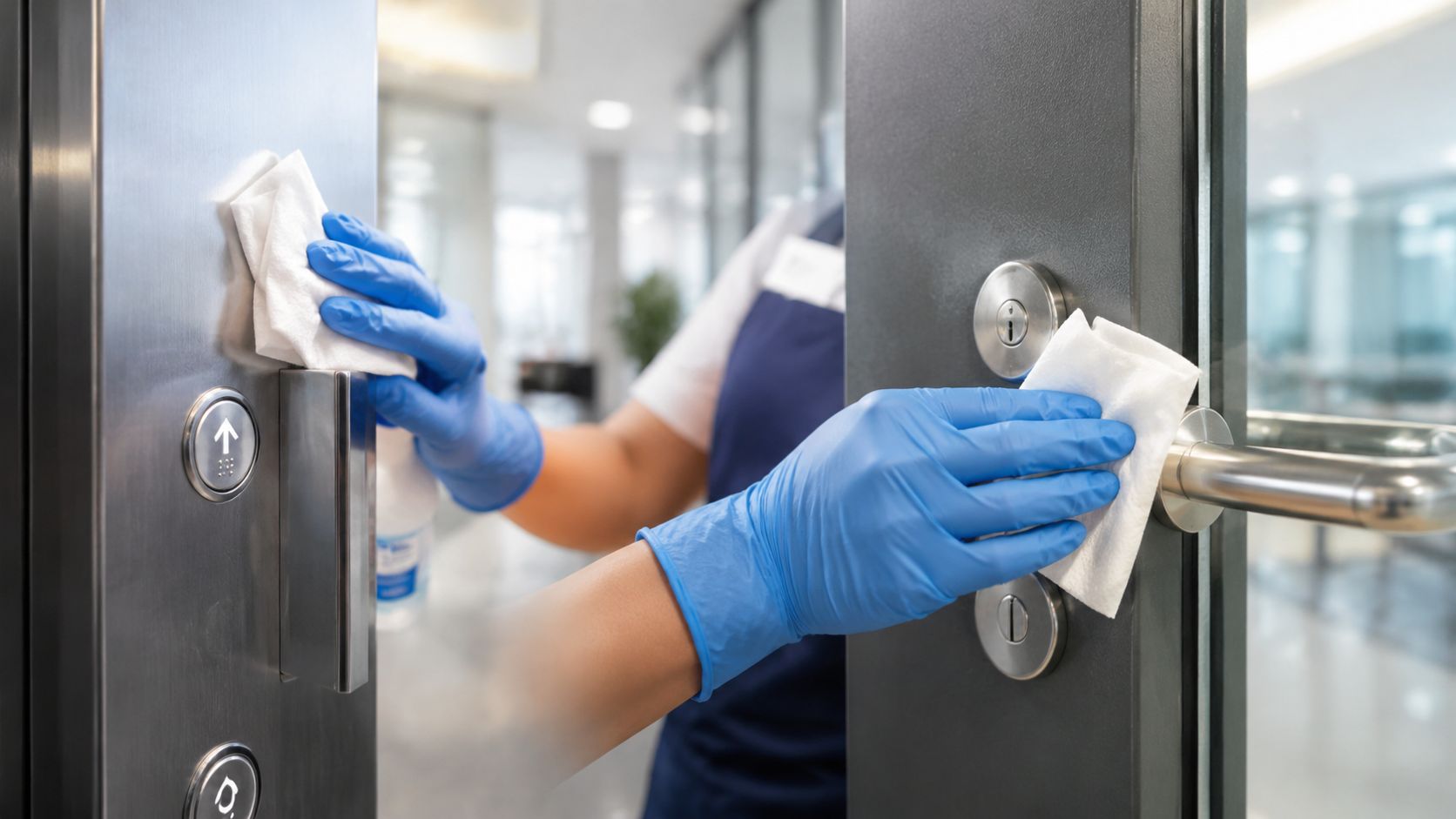
Targeted cleaning focuses on high-touch points such as door handles, elevator buttons, light switches, shared keyboards, faucet handles, fridge handles, coffee equipment, and shared devices. The schedule should follow the CCOHS minimum benchmark during the seasonal period, with supervisors recording completion rather than assuming it happened.
Outbreak-triggered cleaning starts when the workplace identifies linked respiratory cases or receives direction from public health or occupational health. It should include a review of affected areas, more frequent touchpoint treatment, cleaning after a symptomatic person leaves, and confirmation that the product's label contact time, material compatibility, and required personal protective equipment are being followed.
Product dwell time is not optional. A disinfectant must remain visibly wet for the label's stated contact period, and staff should never mix products or improvise concentrations. Soap and water can remove soil and some contamination, but disinfection is warranted when a surface has been contaminated by respiratory secretions, after a symptomatic visitor leaves, or when an outbreak response calls for it. Canada's flu-prevention guidance recommends routine cleaning and disinfection of high-touch surfaces, not cleaning only when objects look dirty.
Use a touchpoint audit
The audit can be a simple table with four fields:
- Location: Reception, elevator lobby, washroom, kitchen, meeting room, or workstation zone.
- Object: Handle, button, switch, faucet, appliance, keyboard, or shared device.
- Frequency: Routine, targeted, or outbreak-triggered.
- Verification: Staff initials, time completed, product used, and any exception noted.
Two or more suspected linked cases on one floor should prompt a manager to pause and assess whether the standard schedule remains sufficient. The response should follow the organisation's outbreak policy and applicable Ontario guidance, rather than relying on an informal deep-clean request.
The detailed commercial disinfection process is relevant when an office needs a defined scope for high-touch areas, but every provider should still document product approval, contact time, worker training, and the boundaries of the service.
Stocking Supplies, Hygiene Stations and Signage
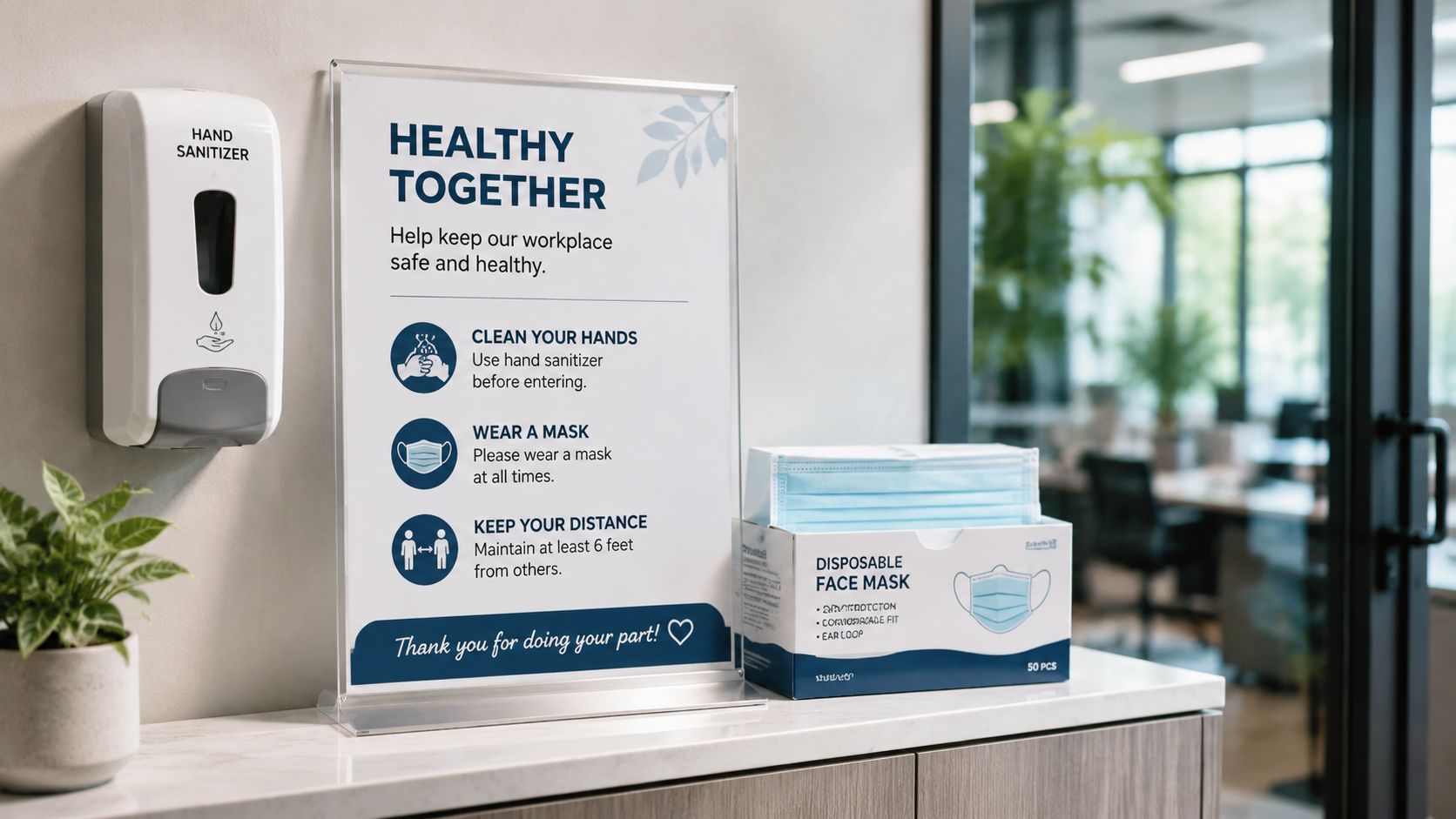
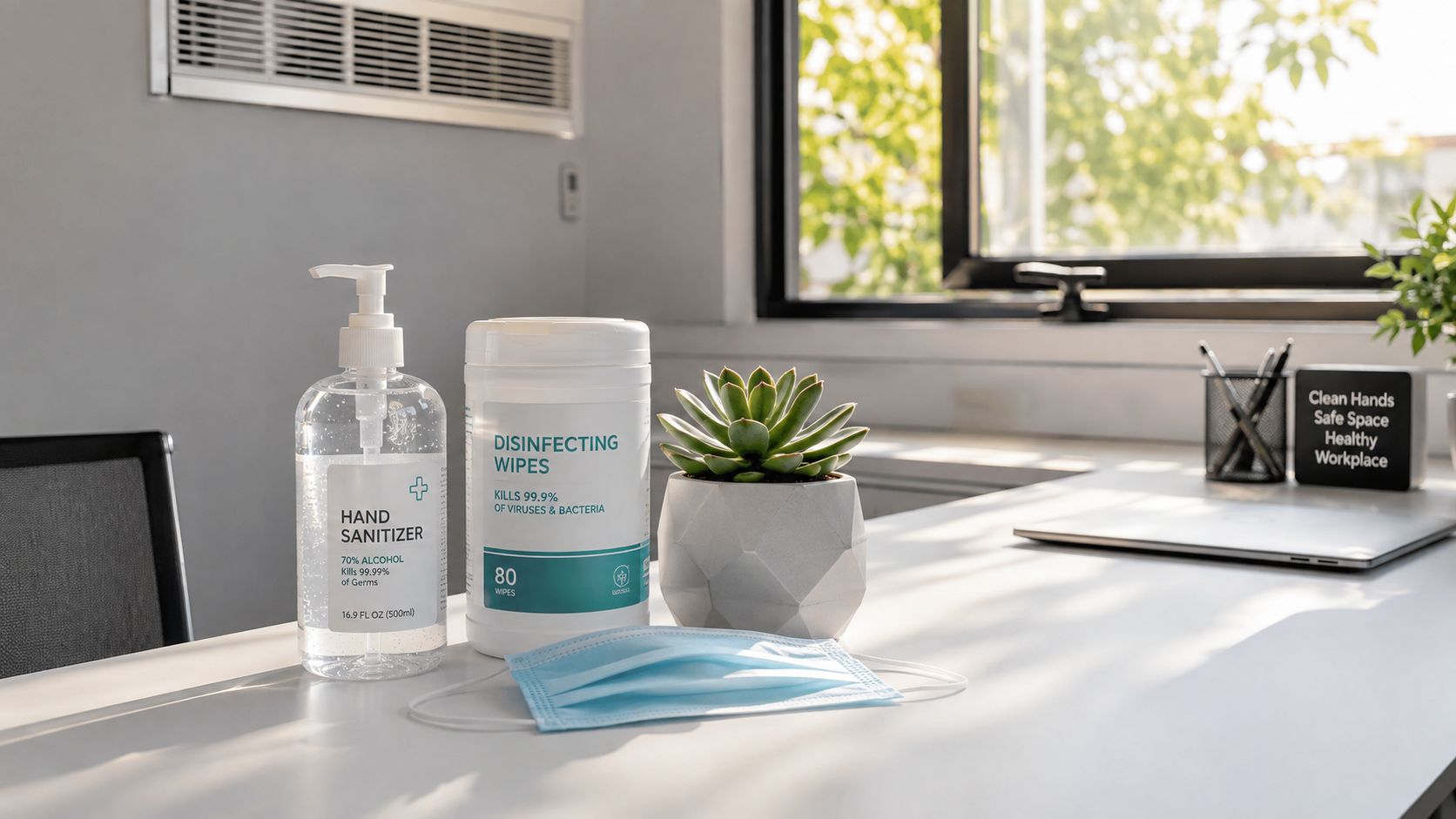
A supply cupboard isn't a seasonal plan unless someone knows what it contains, where it belongs, and when to reorder. The Canadian public-health baseline is straightforward: provide soap and water, alcohol-based hand sanitizer containing at least 60% alcohol, tissues, and waste facilities where people naturally need them. PHAC personal protective measures also identifies common high-touch objects such as handles, switches, phones, computers, tablets, tables, and countertops.
Build the stock list before ordering
The written list should include:
- Hand hygiene: Liquid soap, paper towels, and sanitizer with at least 60% alcohol.
- Respiratory etiquette: Tissues, lined waste bins, and disposable masks at reception.
- Cleaning operations: Health Canada-authorised disinfectants with a DIN, compatible wipes or cloths, gloves, and product-specific safety information.
- Continuity items: Replacement dispenser cartridges, spare bin liners, and backup supplies held outside public areas.
Canadian guidance recommends handwashing with soap and water for at least 20 seconds, or using sanitizer for 20 seconds or until dry. CCOHS hand-hygiene guidance adds useful moments for hand cleaning, including after coughing, sneezing, blowing the nose, using the washroom, eating, handling food, or touching high-touch surfaces.
Set reorder points based on actual consumption, delivery lead times, and occupancy. A manager shouldn't choose a universal station-per-area formula without knowing the floor plan. A better rule is to place stations at entrances, elevator banks, kitchens, washrooms, and every meeting-room cluster, then check whether someone can reach one without crossing the entire office.
Make signs answer a behaviour question
The most useful signs show proper handwashing, remind people to cover coughs and sneezes, and prompt users to wipe shared equipment after use. Put the message at the moment of decision, such as beside a meeting-room screen or above a kitchen sink, rather than placing every notice at reception.
Overbuying usually involves decorative or redundant items while basic soap, tissues, masks, or waste liners run short. A commercial hygiene supply reference for catering environments can provide additional ideas for organising consumables, but office managers should still match the list to the facility's actual traffic and cleaning scope.
The cleaning supplies service information can help when a business wants procurement and cleaning responsibilities clarified together. The important control is continuity, not the appearance of a fully stocked counter on one inspection day.
Sick-Leave, Remote Work and Return-to-Work Thresholds
A written sick-leave rule protects staff better than a vague request to “use common sense.” Without clear thresholds, employees often make inconsistent decisions based on workload, manager pressure, or whether symptoms feel serious enough to justify staying home.
Public Health Ontario advises that workers with a suspected acute respiratory infection should be referred to occupational health, stay home when sick, and generally return when fever has resolved, symptoms have been improving for 24 hours, and gastrointestinal symptoms have resolved for 48 hours. Lingering mild cough or congestion doesn't automatically mean a person remains infectious. Public Health Ontario's respiratory-infection guidance gives managers a clearer basis for policy language than an absolute demand for symptom-free living.
Put the threshold in writing
A practical policy can state:
Employees with respiratory or gastrointestinal symptoms should notify their manager, avoid shared workspaces, and follow occupational-health advice. Return is generally appropriate after fever has resolved, symptoms have improved for 24 hours, and gastrointestinal symptoms have resolved for 48 hours, subject to current public-health direction.
The organisation must still define how the policy interacts with paid sick leave, unpaid leave, short-term disability coverage, accommodation duties, and collective agreements. Those employment terms shouldn't be implied by a cleaning policy. HR should review them separately and communicate what documentation, if any, is required.
Use a role-based remote-work decision tree
For roles that can be performed remotely, the manager should ask whether the employee is well enough to work without pressure to conceal symptoms. If the answer is no, the correct option is sick leave or medical support, not a forced work-from-home day. If the employee is recovering, fever-free, improving, and able to work, remote work can reduce shared-air exposure while preserving continuity.
Roles involving reception, laboratory work, warehouse operations, childcare, clinical contact, equipment handling, or on-site customer service may not transfer cleanly to home. Managers should identify substitutes and escalation contacts before the season begins.
Employees living with vulnerable household members can request practical accommodations, but the office should apply consistent privacy-respecting criteria. Recent travel alone shouldn't trigger automatic exclusion; current symptoms and public-health advice should guide the decision. Ontario guidance also notes that influenza A and B incubation periods are one to four days, which supports early symptom reporting and prompt separation when someone becomes unwell.
Working With a Professional Cleaning or Disinfection Vendor
Commercial cleaning and disinfection are related but different services. Routine commercial cleaning removes soil, waste, odours, and everyday debris from an occupied facility. Disinfection applies an appropriate product to a cleaned surface for the required contact time to reduce specified microorganisms. A quote that uses both terms without defining tasks, frequencies, products, and verification isn't detailed enough for seasonal planning.
Managers should compare scopes rather than slogans. A useful proposal identifies daily routine cleaning, touchpoint treatment, washroom restocking, floor care, glass, waste handling, and any optional outbreak response. Fogging or electrostatic application may be offered as an add-on, but it shouldn't replace the direct cleaning of high-touch objects or become a substitute for source control and ventilation.
Questions that reveal operational maturity
Ask each provider:
- Which products will be used, and what are their Health Canada DINs?
- Does the scope list each touchpoint category and treatment frequency?
- Are written standard operating procedures available for routine and outbreak work?
- How are cleaners trained in chemical handling, PPE, contact time, and surface compatibility?
- Can the provider provide insurance certificates and worker-safety documentation?
- What response time applies when a confirmed case is reported on site?
- Who verifies completion, and how are missed tasks recorded?
- Which services are included, and which create additional charges?
A serious vendor won't promise that a single spray eliminates workplace transmission. The provider should explain what cleaning can control, what it cannot control, and how the service fits the building's ventilation and sick-leave procedures.
Score the quote by scope
| Scope item | What to verify | Red flag |
|---|
| Routine office cleaning | Areas, frequency, staffing, and task list | “Full clean” without room-level detail |
| Touchpoint disinfection | Objects covered, schedule, product, and contact time | A generic promise to sanitise everything |
| Washrooms and kitchens | Restocking, fixtures, appliances, and waste | Supplies treated as an unpriced afterthought |
| Floor and carpet care | Method, frequency, and furniture responsibilities | Seasonal floor work bundled without access requirements |
| Outbreak response | Trigger, arrival window, affected-area scope, and documentation | Unlimited claims based on fogging alone |
| Quality verification | Supervisor sign-off, inspection process, and issue correction | No record of completed work |
| Commercial terms | Term, cancellation, extra visits, and emergency rates | An attractive base quote with unclear exclusions |
Pricing should be discussed as a range, not a universal rate. Cost drivers include floor area, occupancy, washroom count, cleaning frequency, service timing, access conditions, consumable restocking, floor or carpet work, and outbreak-response requirements. Monthly, quarterly, and on-demand disinfection visits suit different risk profiles, but none should be selected without reviewing the building's routine controls.
Arelli Cleaning can be included in the same comparison sheet as any other GTA provider. Its published service range includes office cleaning, commercial cleaning, specialty floor and carpet work, and disinfection, but the decision should rest on the written scope, proof of compliance, responsiveness, and fit with the office's operating conditions. The commercial cleaning services page gives managers one reference point for that review.
Monitoring Effectiveness and a Final Seasonal Checklist
A seasonal plan becomes useful when managers can see whether people are following it. The most valuable measures are small enough to maintain and specific enough to trigger action. They should help answer four questions: Are absences changing, are cleaning tasks completed, is air moving adequately, and are employees using available prevention measures?
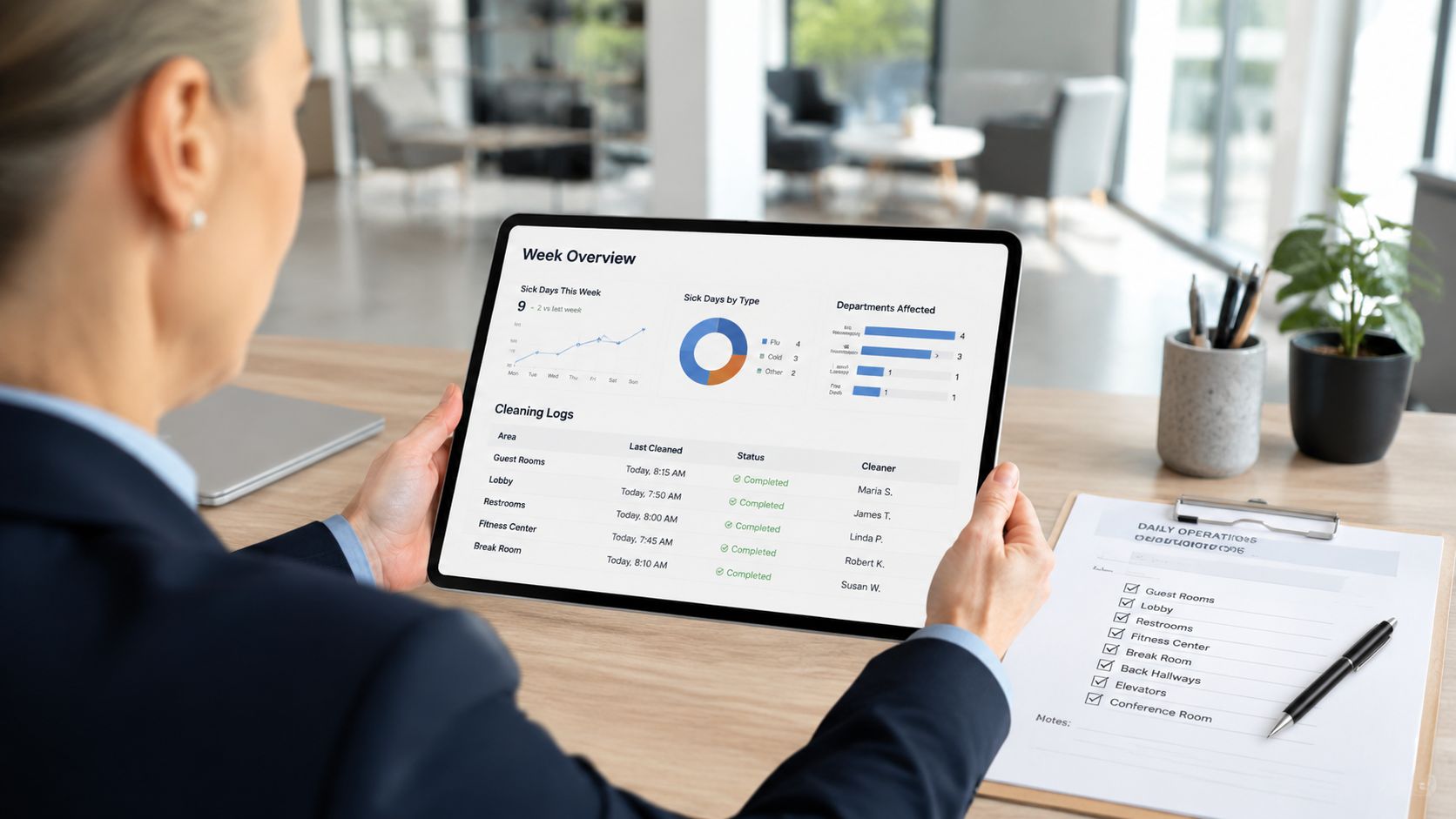
Track weekly sick-day counts by department, while protecting employee privacy and avoiding attempts to diagnose illness from attendance data. Review cleaning verification logs, including supervisor sign-offs or ATP swab results where the organisation already uses them. Record CO2 readings in occupied zones, filter-change dates, HVAC exceptions, and voluntary flu-shot uptake. Canadian surveillance reported that only 34% of adults were vaccinated in the 2025–2026 season. The federal flu-prevention guidance supports annual vaccination promotion as one part of a broader control package, not as a replacement for ventilation or source control.
Review the signals monthly
A monthly review should identify trends, exceptions, and owners. If absenteeism rises above the office's established baseline, or if repeated cleaning exceptions appear in the same area, the manager can move from routine to targeted disinfection. The baseline must come from the organisation's own records, not an invented industry threshold.
Escalation also makes sense when a symptomatic worker has used a shared space, when linked cases appear, when meeting-room CO2 readings remain above the office target, or when a building operator reports ventilation limitations. The response should be documented, time-limited, and reviewed after conditions change. A practical office-cleaning infographic for Ontario workplaces can supplement the internal checklist, but it shouldn't replace site-specific controls.
Seasonal execution checklist
- Late August: Assign the facilities lead, review prior absence and cleaning records, and confirm the building contact for HVAC issues.
- Early September: Book HVAC commissioning, inspect filtration, measure occupied-zone CO2, and identify rooms that may need portable air cleaning.
- Early September: Count sanitizer, soap, tissues, masks, liners, gloves, and disinfectant. Set reorder points based on actual use and supplier lead times.
- Mid-September: Audit touchpoints and map hygiene stations at entrances, elevator banks, kitchens, washrooms, and meeting-room areas.
- Late September: Finalise the sick-leave, remote-work, and return-to-work policy with HR. Train reception and managers on the first response to symptoms.
- October: Confirm routine and targeted cleaning scopes with the vendor. Verify products, DINs, contact times, insurance, training records, and escalation contacts.
- Early November: Send the seasonal communication, check supply levels, inspect signage, and confirm the first outbreak-response decision meeting.
- Mid-November: Complete the readiness check because Toronto positivity exceeded 5% during this period in the 2025–26 season. Confirm HVAC operation, cleaning logs, policy access, and vendor availability.
- During high activity: Review sick-day counts, cleaning exceptions, CO2 readings, and supply consumption monthly or more often if conditions require it.
- After an incident: Record the affected areas, actions taken, gaps found, and policy changes needed before the next seasonal cycle.
Preparing Your Office for Cold and Flu Season isn't about adding the most visible cleaning task. It's about making the right control happen early, assigning responsibility, and escalating proportionately when workplace conditions change.
Arelli Cleaning provides GTA offices with routine commercial cleaning, high-touch disinfection, supply support, and documented cleaning systems that can be aligned with seasonal readiness plans. Visit Arelli Cleaning to review service options, then use the checklist to request two or three quotes and ask each provider the same scope, product, training, verification, and response-time questions.






.webp)