A law office, design studio, clinic-adjacent office, warehouse office, or school administration area won't produce the same cleaning demands. Shared devices, public access, and food use all matter.
- High-use zones
Kitchens, lunchrooms, printer stations, and washrooms often determine the minimum workable frequency even when the rest of the office looks manageable.
Common service models and when they fit
Most offices choose from a few practical scheduling patterns.
- Daily cleaning: best for busy, client-facing, multi-washroom, or high-occupancy environments
- Three times per week: a common middle ground for active offices that need regular upkeep without daily visits
- Weekly cleaning: often suitable for lower-traffic offices with limited public access
- Bi-weekly service: usually works only when occupancy is light and staff keep the space orderly between visits
A business should resist copying another office's schedule just because it sounds standard. A small office with constant visitors may need more attention than a larger office with mostly remote staff.
Practical rule: Schedule cleaning around mess creation, not square footage alone.
How operations affect timing
Frequency also interacts with staffing and access. If the office runs early, late, or on rotating shifts, the timing of the clean matters almost as much as the number of visits. That's one reason facilities teams often borrow ideas from workforce planning when they evaluate service windows. This guide to effective staff scheduling is useful background for thinking through coverage, handoff points, and after-hours access.
A simple self-assessment
A buyer can usually identify the right starting point by asking:
- Do clients visit the office regularly?
- Do washrooms show visible wear before the end of the day?
- Does the kitchen need frequent resetting?
- Do bins overflow between visits?
- Do staff notice dust, streaks, or odours before the next clean?
If the answer is yes to several of these, the current or planned schedule is probably too light.
Start with a workable baseline
It's often better to start with a slightly more substantial frequency and reduce later than to begin too lean and spend the first month correcting complaints. Buyers should ask vendors how schedule changes are handled in practice. That answer reveals flexibility, responsiveness, and whether the contract supports real operational needs.
Decoding Pricing and Contracts for Office Cleaning
A first cleaning quote often looks simple. One monthly number, a short service summary, and a signature line. The problem is that two quotes with similar prices can describe very different levels of work.
That is why pricing has to be read like a floor plan, not like a flyer. The monthly fee matters, but the actual buying decision sits underneath it: what gets cleaned, how often, who supplies what, how problems are corrected, and how easy it is to adjust the agreement if your office routine changes.
For Scarborough businesses, a small office usually costs far less than a mid-sized office, but square footage only sets the outer boundary. A compact office with busy washrooms, a shared kitchen, and frequent client traffic can cost more to maintain than a larger, quieter space. Buyers who treat price as a reflection of labour, access, and task detail usually make better contract decisions.
Estimated monthly office cleaning costs in Scarborough
| Office Size (sq ft) | Typical Frequency | Estimated Monthly Cost |
|---|
| Up to 2,000 | Weekly to multiple visits per week, depending on scope | Around $250/month and up |
| 2,000 to 5,000 | Multiple visits per week or more comprehensive recurring service | Around $850/month and up |
Use those figures as a starting range, not a fixed rate card. The useful question is not "What is the average price?" It is "What exactly am I buying at this price?"
What usually changes the quote
A cleaning contract works like a maintenance schedule for a vehicle. The base service covers routine care. Extra tasks, harder operating conditions, and tighter timelines increase the cost because they increase labour time, supervision, or both.
Scope depth
A light service may cover floors, bins, washrooms, and visible dusting. A fuller scope may add kitchen resets, touchpoint disinfection, interior glass, detailed washroom restocking checks, and workstation attention. If periodic tasks such as carpet treatment or high dusting are included, they should appear separately from recurring work.
Building complexity
Two offices can have the same square footage and still price differently. Multiple washrooms, glass partitions, mixed flooring, stairwells, reception areas, lunchrooms, and partitioned layouts all add cleaning time. The buyer should expect the quote to reflect layout difficulty, not just floor area.
Timing and access conditions
Evening cleaning may fit office operations better, but it can also involve alarm procedures, key control, restricted zones, elevator coordination, and lock-up requirements. Those conditions affect labour planning and site supervision. If the cleaner must work around building rules or limited access windows, the contract should say so clearly.
Supplies and consumables
This point causes confusion more often than it should. Some contracts include only labour and standard cleaning products. Others also cover liners, soap, paper products, and washroom consumables. If that distinction is left vague, budget overruns and service disputes usually follow.
Ask for a quote that separates recurring cleaning, periodic work, and supply-related charges. That single step makes proposals far easier to compare.
How to read the contract like a buyer, not just a signer
Price gets attention first. Contract language decides whether that price stays workable.
A low monthly fee can lose its value quickly if the agreement is hard to change, hard to cancel, or too vague to enforce. New office managers often focus on the front page number and skim the operating terms. That is where many service problems begin.
Clauses worth checking closely
- Term length: Shorter initial terms reduce risk while you test service consistency.
- Auto-renewal language: Renewal dates and notice periods should be easy to find and written in plain language.
- Cancellation terms: The agreement should explain how either party can end service, with timelines stated clearly.
- Scope attachment: The contract should include a room-by-room or task-based schedule, not a loose promise of "general cleaning."
- Quality control and rework: There should be a written process for reporting misses, requesting correction, and escalating repeated issues.
- Insurance documentation: Proof of current coverage should be available before service starts, not after a problem appears.
- Change procedures: If your office grows, reduces staff attendance, or adds a new area, the contract should explain how scope changes are priced and approved.
That last point matters more than many buyers expect. Office cleaning contracts are not static documents. They need a clear method for handling changes without forcing a full renegotiation every time the workplace shifts.
Warning signs in pricing discussions
Some proposals raise concerns before service even begins.
- Vague inclusions: broad phrases without task detail
- One-line pricing: a single total with no breakdown of routine versus periodic work
- Missing supply assumptions: no written statement about who provides consumables
- Discounts tied to long commitments: especially before the vendor has shown consistent performance
- Verbal promises not reflected in the contract: if it is important, it needs to appear in writing
A useful way to test a proposal is to ask, "If service quality drops in month two, where in this contract do I point?" If the answer is unclear, the agreement is too loose.
The strongest choice is usually the quote that makes expectations measurable, changes manageable, and responsibilities plain on both sides. That is the difference between buying a cleaning service and setting up a cleaning system that your office can manage.
Navigating Health Safety and Compliance Mandates
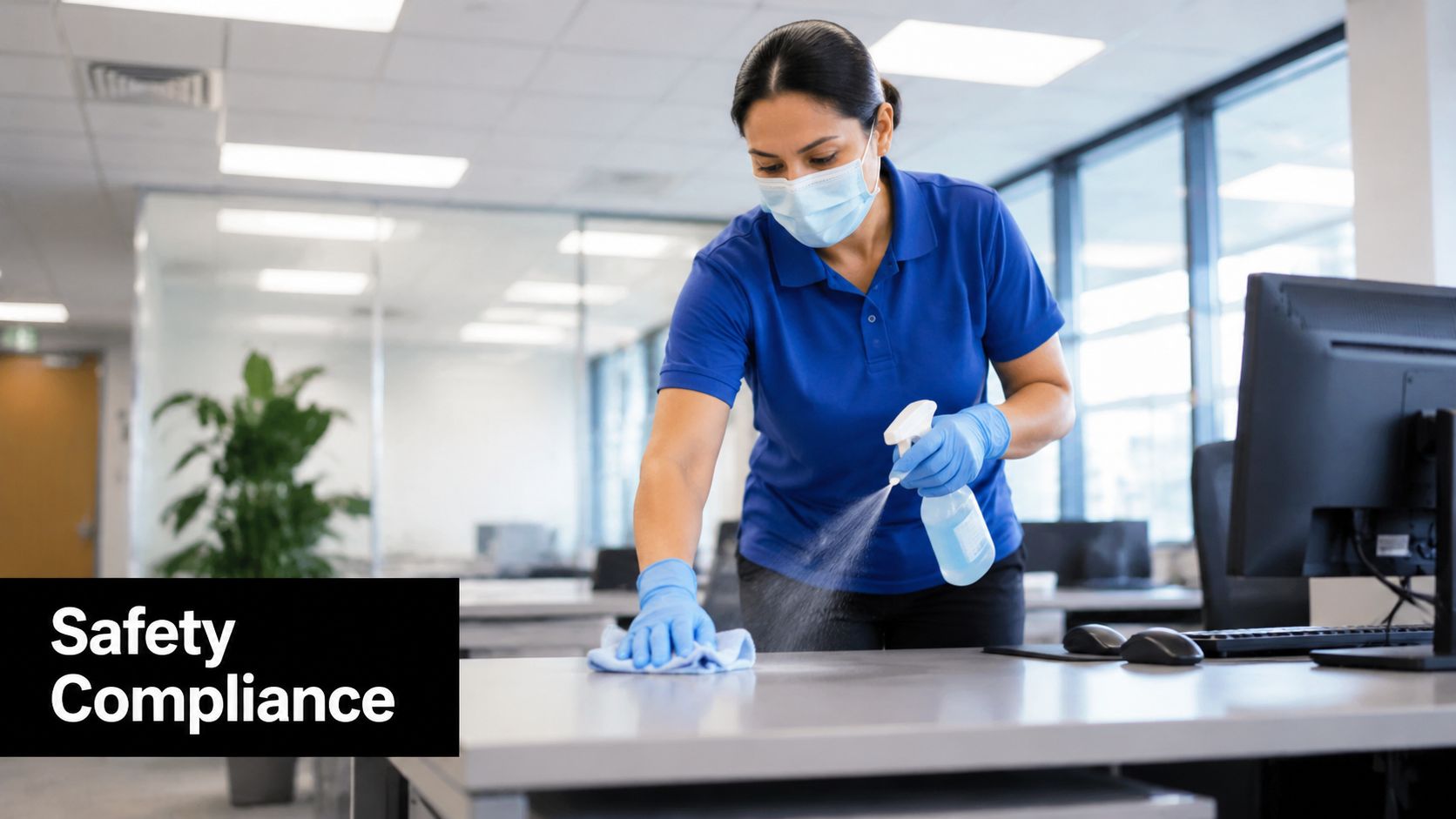
A cleaning contract can look clear on price and scope, then still create risk on day one. The usual scenario is simple. A cleaner arrives after hours, uses a product your staff cannot identify, leaves no record of where it was applied, and your office manager is left answering questions the next morning. That is not just a service issue. It is a compliance gap.
For Scarborough businesses, health and safety review should sit near the top of the selection process. It works like checking the wiring before you buy the building. If a provider cannot explain training, chemical handling, incident reporting, and recordkeeping in plain language, the problem starts before the first mop bucket is filled.
The three compliance pillars buyers should recognise
New office managers often hear a string of acronyms and assume they all mean roughly the same thing. They do not. Each one answers a different question, and knowing the difference helps you ask better vendor questions.
OHSA
Ontario's Occupational Health and Safety Act sets the broad rules for maintaining a safe workplace. For cleaning buyers, the practical takeaway is straightforward. The vendor's work should support safe conditions for staff, visitors, and anyone else in the office during or after service.
WHMIS
WHMIS deals with hazardous products, labels, safety data, and worker training. In everyday terms, this tells you whether cleaning staff know what they are using, what the risks are, and how to handle spills, storage, and exposure properly. If a provider cannot show current WHMIS practices, you are relying on guesswork where procedure should exist.
CIMS
The Cleaning Industry Management Standard is a management benchmark for how a cleaning operation is organised and controlled. Buyers do not need to become certification experts, but they should understand what the standard points toward. Documented quality checks, defined work methods, communication systems, and supervision are all signs that the company runs on repeatable processes rather than memory.
Why product approval matters
Disinfection creates confusion because buyers often group it together with routine cleaning. The two are related, but they are not identical. Routine cleaning removes soil and reduces buildup. Disinfection involves product approval, dwell time, surface suitability, and staff training.
That is why product questions belong in the vendor interview, not as an afterthought. Ask whether the provider uses Health Canada approved products for the intended commercial application and whether staff can explain where those products should and should not be used. If you want a clearer picture of how this should be structured in practice, review how commercial disinfection and sanitising programmes are defined operationally.
Compliance should appear in training records, product lists, site procedures, and service logs. Sales language alone is not enough.
What compliant operations look like day to day
Good compliance is usually visible in ordinary routines, not dramatic moments. You should be able to see evidence of control in how the provider documents work, stores products, handles complaints, and supervises crews.
A dependable operation usually includes:
- Documented task records: proof of what was cleaned, when, and by whom
- Chemical control procedures: labelled products, safe storage, and clear handling instructions
- Training records: current WHMIS and site-specific instruction for frontline staff
- Issue reporting channels: a defined process for reporting incidents, deficiencies, or product concerns
- Supervision habits: periodic inspections and written follow-up on problems
- Consistent site methods: the same core process across shifts, teams, and absences
Office managers who want a broader view beyond cleaning can also review these practical risk management insights. They are useful for understanding how small procedural gaps turn into avoidable operational exposure.
Why this belongs in vendor selection
Compliance should shape your buying decision because it affects more than legal exposure. It influences service consistency, complaint handling, staff confidence, and how quickly problems are corrected. A provider with clear safety systems is usually easier to manage because the rules, records, and escalation paths already exist.
Many Scarborough buyers miss an important contract point. A cleaning company is not only promising tasks. It is also bringing a method of work into your office. Your job during selection is to test whether that method is controlled, documented, and suitable for your workplace. That is the difference between hiring a crew and choosing a cleaning partner you can govern with confidence.
Your Vetting Checklist for Choosing the Right Cleaning Partner
It is 4:45 p.m. on a Thursday. You have two cleaning quotes in your inbox, one is cheaper, and both promise reliable service. By Monday, your leadership team wants a recommendation. At that point, the job is not to guess who sounds better. The job is to run a fair test and see which provider can document how they will work in your office.

A useful vetting process works like a procurement scorecard, not a sales conversation. Every shortlisted company should receive the same questions and submit the same type of proof. That gives you a clean comparison. It also helps you spot a common problem in Scarborough office cleaning selection. Many proposals describe tasks, but far fewer explain contract controls, staffing oversight, or what happens when service quality slips.
Required documents to request
Start with records that can be checked.
- Proof of liability insurance: Ask for a current certificate of insurance and confirm that the coverage is appropriate for commercial cleaning work in an occupied office. Many office clients look for meaningful general liability coverage because accidents, property damage, and third-party claims can become the client's problem if documentation is weak.
- WSIB clearance documentation: This helps confirm the contractor is managing workplace coverage obligations.
- Training confirmation: Ask for evidence that frontline staff receive current WHMIS training and any site-specific instruction your office requires.
- A written scope of work: The proposal should break tasks down by area, frequency, and exclusions.
- Supervision and escalation details: You should know who checks the work, how deficiencies are logged, and who has authority to fix recurring issues.
If a vendor hesitates to provide basic documentation, treat that as useful information. A cleaning contract is only as manageable as the paper trail behind it.
What to look for in the proposal
A strong proposal should let you picture the service before the first shift starts. If it leaves too much to assumption, you will spend the first few months clarifying things that should have been settled during selection.
Clear service mapping
Look for room-by-room detail. Reception, open office areas, meeting rooms, kitchens, washrooms, private offices, and touchpoints should be listed with the related tasks. Periodic work should be separated from routine work so you can tell the difference between daily cleaning, weekly detail work, and occasional project tasks.
Vague wording hides future disputes. “Clean kitchen” can mean wiping counters to one vendor and cleaning appliances, sinks, cabinet fronts, and floors to another.
Communication structure
The quote should explain how service requests are submitted, who responds, how quickly issues are reviewed, and how rework is handled. A vendor with a named contact, a simple reporting path, and a documented follow-up routine is usually easier to manage than one that says, “Just call us if anything comes up.”
Operational flexibility
Office use changes. Headcount rises, hybrid schedules shift traffic patterns, and leased space expands or contracts. A workable agreement should explain how scope changes are priced, how extra work is approved, and what happens if your service needs change mid-term.
That point gets missed often. Buyers compare the starting price and skip the adjustment rules. Later, every small change turns into a negotiation.
Buyer's rule: If a provider cannot explain scope, service ownership, and change handling in writing before the contract, those issues will be harder to control after signing.
Red flags that deserve caution
Some warning signs are quiet. They do not always look dramatic in the sales process, but they usually create friction later.
- Pressure to sign quickly: rushed decisions reduce review time and increase the chance of missed contract terms
- Thin documentation during pricing discussions: a polished sales pitch does not replace certificates, scopes, and written procedures
- No site visit before quoting: office layout, floor types, traffic levels, and washroom count affect labour and scheduling
- Generic proposals: recycled wording often signals shallow site assessment
- No clear complaint path: if no one owns service recovery, small misses tend to repeat
A short educational video can also help buyers think through vendor standards and workplace expectations before final selection.
A simple scorecard for final comparison
Once you have proposals, score each one against the same criteria. Keep the system simple enough that another manager could review your notes and reach a similar conclusion.
Scope accuracy
Does the quote match the actual office layout, usage pattern, and cleaning priorities?
Documentation quality
Were insurance records, WSIB status, training confirmation, and supervision details easy to verify?
Contract clarity
Are term length, scope changes, extra charges, and exit conditions written clearly?
Service accountability
Is there a defined contact person, inspection method, and complaint resolution process?
Operational fit
Does the provider appear organised enough for your building's pace, security expectations, and communication style?
That framework helps you choose with evidence instead of instinct. More importantly, it turns vendor selection into a controlled business decision. For a Scarborough office manager, that is the real goal. You are not only hiring a cleaning crew. You are selecting a contractor you can monitor, measure, and manage with confidence.
A Modern Approach to Common Cleaning Service Challenges
A common failure pattern looks like this. The walkthrough goes well, the quote looks reasonable, and the first few weeks feel fine. Then the true test begins. A sick-day absence is not covered properly, a washroom complaint sits for two days, or a once-a-month task disappears unnoticed because no one can point to where it was promised.
That is why modern cleaning management is less about adding more service items and more about building a service system that holds up under routine pressure. For a Scarborough office manager, the question is not, "What do they clean?" The better question is, "What in this provider's operating model prevents the usual breakdowns?"
A useful way to assess that model is to check three pressure points.
First, scope must be specific enough to manage. A vague scope works like a blurry floor plan. People may agree on the general idea, but they will make different assumptions once work begins. Strong providers spell out task ownership, special requests, consumable responsibilities, and periodic work in plain language.
Second, accountability must be visible. If quality checks happen, you should know who performs them, how often they happen, and what record is kept. If complaints are raised, there should be a defined path for response and follow-up, not a loose promise that someone will "take care of it."
Third, the service arrangement should adjust without creating friction. Offices change. Headcount grows, meeting rooms get used differently, and seasonal demands appear. A cleaning contract should give you a practical way to revise the scope, schedule extra work, or exit cleanly if the fit is wrong.
What a stronger service model looks like
In practice, that usually shows up in a few concrete ways:
- A sample clean or trial visit: useful when you want to judge the standard in your actual office, not in a sales conversation
- Clear contract wording: easier to manage when responsibilities or service levels need to change
- Digital reporting or issue tracking: helpful for logging missed tasks, confirming follow-up, and reducing "he said, she said" disputes
- Reliable support access: useful when an urgent spill, illness event, or after-hours request needs quick action
Arelli Cleaning is one example of a provider presenting this kind of service model. As noted earlier, its offer includes no-term contracts, no cancellation fees, free sample cleans, Health Canada-approved disinfection products, 24/7 support, and app-based quality communication. Those features do not guarantee the right fit for every office. They do show the kind of operating details worth checking for when you want fewer surprises after the contract starts.
Why this matters during selection
A polished proposal can hide a weak operating system. A shorter, clearer proposal can be easier to manage because it shows who does what, how issues are documented, and what happens if your office needs change.
That is the practical test. Choose the provider whose service design reduces ambiguity, shortens response time, and gives you evidence when standards slip. That approach helps you avoid the most common cleaning problems before they become monthly management problems.
Conclusion and Further Reading
Choosing office cleaning services in Scarborough is really a vendor management decision with visible daily consequences. A cleaner affects how the office feels in the morning, how clients read the business, and how smoothly shared spaces function through the week.
The most reliable buying process is structured. Define the scope first. Match the frequency to how the office operates. Review contract terms with the same care as the monthly fee. Then verify compliance and documentation before treating any quote as comparable.
A smart next step is simple. Use the checklist, shortlist suitable providers, and get 2 to 3 quotes based on the same written scope. That approach gives a business a fair comparison and a stronger chance of finding a partner that fits both the building and the budget.
Further reading
Internal resources
External resources
A business that wants a practical next step can use this framework to prepare a clear scope, ask sharper questions, and compare providers on substance rather than guesswork. For teams that want one more local option in that process, Arelli Cleaning can be included alongside other vetted quotes.







.webp)