The week before students return, a school can look ready while still carrying serious operational gaps. Floors may be polished, classrooms may be dust-free, and washrooms may have fresh supplies, yet the HVAC system might not have been inspected, filters may be unavailable, and the cleaning schedule may depend on staff who are not assigned. Cleaning and preparing educational facilities for the school year requires more than a last-minute deep clean. It requires a sequence that protects indoor air quality, controls high-touch risks, meets product rules, and matches the labour available.
A workable plan starts with risk, not appearance. Surface cleaning remains important, but ventilation, filtration, washroom coverage, construction dust, documentation, and staff verification deserve equal attention. The following framework is designed for schools, child-care centres, training facilities, and other educational environments across the Greater Toronto Area and broader Canadian context.
Table of Contents
The Back-to-School Readiness Challenge
The pressure usually arrives all at once. A facility manager is coordinating classroom resets, floor care, furniture moves, summer construction, supply deliveries, HVAC servicing, staff schedules, and parent communications while trying to leave enough time for inspection. A room can be visually clean but still have dust above ceiling tiles, blocked vents, poorly fitted filters, or a washroom schedule that doesn't reflect actual use.
That is why ad-hoc preparation fails. Teams often start with the most visible work, then discover that less visible tasks require access, specialist labour, or equipment downtime. If HVAC inspections are left until the final days, a filter problem can compete with classroom cleaning. If construction dust isn't isolated early, it can spread through corridors and return-air pathways after the cleaning crew has finished.
Ontario's reopening guidance for the 2021-2022 school year established a more structured baseline. It suggested cleaning and disinfection at least twice daily, with more frequent attention when spaces were heavily used or visibly soiled, and it called for the highest-grade HVAC filters possible, preferably MERV 13, with ventilation systems operating two hours or more before and after occupancy. The guidance also required disinfectants with a Drug Identification Number, or DIN. These requirements show why school readiness moved beyond periodic janitorial cleaning into coordinated infection-control and building-performance work. Ontario's school reopening guidance provides the historical reference point.
What creates the bottleneck
The difficult decisions are usually practical:
- Time: Which areas must be completed before occupancy, and which can follow a phased schedule?
- Labour: Which tasks belong to routine custodial staff, and which require qualified HVAC, mould-remediation, or post-construction crews?
- Access: Can ceiling spaces, mechanical rooms, washrooms, and storage areas be reached without disrupting other work?
- Verification: Who confirms that a task was completed, with which product, and at what time?
A school may also need a dependable communication process for absences, schedule changes, or urgent notices. An attendance alert platform for educators can support operational communication, but it can't replace a documented cleaning and maintenance plan. For day-to-day school sanitation and facility preparation, a defined school cleaning service scope is more useful than a vague promise of “deep cleaning.”
Practical rule: A reopening plan is ready only when every critical task has an owner, a time window, the right equipment, and a way to verify completion.
Conducting a Pre-School-Year Risk Assessment
Before assigning a single extra cleaning hour, walk the building and map the risk. Skipping that step can leave a busy washroom understaffed while labour is sent to low-use rooms. The assessment should show where occupancy, touch frequency, moisture, air movement, contamination history, and operational complexity create the greatest exposure.

Start with a room-by-room review
Walk the building with a current floor plan and record conditions instead of relying on memory. Mark classroom touchpoints, washroom fixtures, drinking fountains, shared devices, gym equipment, cafeteria contact areas, reception counters, staff rooms, and transportation interfaces. Note whether each space is used continuously, intermittently, or by multiple groups.
Record visible soil, odour, moisture, damaged finishes, inaccessible surfaces, supply shortages, and construction dust. Put ventilation observations on the same form. Identify blocked grilles, noisy equipment, damaged diffusers, missing access panels, and filters that do not fit their frames. These findings affect both cleaning priorities and the staffing needed before the first bell.
Apply a simple priority test
Place each area into one of three operational categories:
- Pre-occupancy priority: Complete before students and staff return. Include unresolved contamination, washroom readiness, visible construction residue, unsafe spills, and ventilation faults affecting occupied areas.
- Enhanced routine: Assign additional attention where touch frequency, shared use, or illness activity makes ordinary maintenance insufficient.
- Standard maintenance: Keep the normal schedule where use is predictable, surfaces are intact, and no specific hazard is present.
The categories keep an empty storage room from receiving the same response as a busy washroom. They also support a defensible budget discussion because extra labour is tied to observable conditions.
Include people and access in the assessment
Volunteers, contractors, tutors, or community groups may enter before the first day. Coordinate access with safeguarding requirements, including appropriate school volunteer checks. Cleaning teams also need clear rules for locked rooms, staff offices, laboratories, food areas, and mechanical spaces.
Use the findings to build a pre-opening action list. For each item, record the location, risk reason, required task, responsible role, completion window, and verification method. Facility pre-cleaning services can support the initial reset, while the school defines the areas, standards, and handover process. This record also exposes staffing gaps early, when schedules can still be adjusted.
How School Cleaning Standards Have Evolved
In July 2020, Ontario's back-to-school safety package included enhanced cleaning and disinfecting for schools and buses, along with 900 additional custodians. That figure reflected the labour capacity required to support reopening, not a preference for cleaner-looking buildings. It marked a shift toward treating custodial staffing, documented procedures, and indoor-air conditions as parts of school readiness. The Ontario education safety package records that change.
From routine service to defined controls
Traditional school cleaning centred on visible results and routine maintenance. Floors were swept, washrooms serviced, waste removed, and classrooms reset. Those duties still matter, but supervisors now have to define what gets done, how often it occurs, which products are permitted, who performs the work, and how completion is checked.
Later school-health guidance specified that high-touch surfaces, including desks, doorknobs, and light switches, should be cleaned and disinfected at least twice daily. Some districts also established nightly desk and chair disinfection, daily carpet vacuuming, and planned HVAC cleaning. The supervisor's job therefore includes verifying capacity and records, not just walking through a building and judging its appearance.
The cleaning method became more technical as well. Canadian school guidance sets out a two-step sequence: remove soil with a detergent or cleaner, then disinfect after the surface is visibly clean. The disinfectant must remain wet for the label's required contact time. Product performance depends on both preparation and dwell time. The Canadian guidance for cleaning and disinfecting schools also provides Ottawa Public Health benchmark concentrations for bleach-based solutions, including 500 parts per million for routine sanitizing, 1000 parts per million during outbreaks, and 5000 parts per million for blood or body-fluid contamination, with minimum contact times ranging from one to more than ten minutes.
Frequency alone does not establish a reliable standard. A twice-daily task performed with an unsuitable product, on a visibly dirty surface, or without adequate contact time does not provide the same result as a correctly completed process.
Modern educational facility cleaning combines method, timing, approved products, staff training, and completion records. Before the first bell, managers should also review COVID-conscious cleaning practices while protecting time for ventilation checks, filter work, and the staffing needed to complete scheduled tasks.
Building a Zoned Cleaning and Disinfection Plan
Without defined zones, a crew may clean a classroom and move on while a washroom inspection remains unsigned because no one knows who owns it. A zoned plan assigns each area a scope, service frequency, product rule, equipment kit, and handover standard. Supervisors can then identify completed work, delayed tasks, access problems, and gaps before the building fills.
Assign the right work to each zone
Classrooms require attention to desks, chair backs, shared supplies, touchscreens, door hardware, sinks, and floors. Washrooms add fixtures, partitions, dispensers, replenishment, odour control, slip prevention, and inspection. Common areas include railings, benches, reception surfaces, cafeteria tables, drinking fountains, and shared equipment. Administrative offices may need lighter routine service, while reception desks and staff collaboration areas often receive frequent contact.
| Zone | High-Touch Surfaces | Cleaning Frequency | Special Considerations |
|---|
| Classrooms | Desks, chair backs, door hardware, switches, shared devices | Set by occupancy and risk assessment, with high-touch disinfection at least twice daily where Ontario guidance applies | Protect electronics, respect teacher materials, and keep products off learning equipment |
| Washrooms | Fixtures, faucets, flush controls, dispensers, handles, partitions | At least daily for high-touch areas, with more frequent service where use or soiling demands it | Replenishment, odour control, slip prevention, and inspection must be included |
| Common areas | Railings, benches, counters, drinking fountains, cafeteria tables | Set by traffic and visible soil, with enhanced service during illness activity | Schedule around movement, meals, and shared activities |
| Offices and staff areas | Handles, switches, counters, shared tables, device touchpoints | Routine service with targeted attention to shared surfaces | Coordinate with occupied work and confidential materials |
Use the two-step method correctly
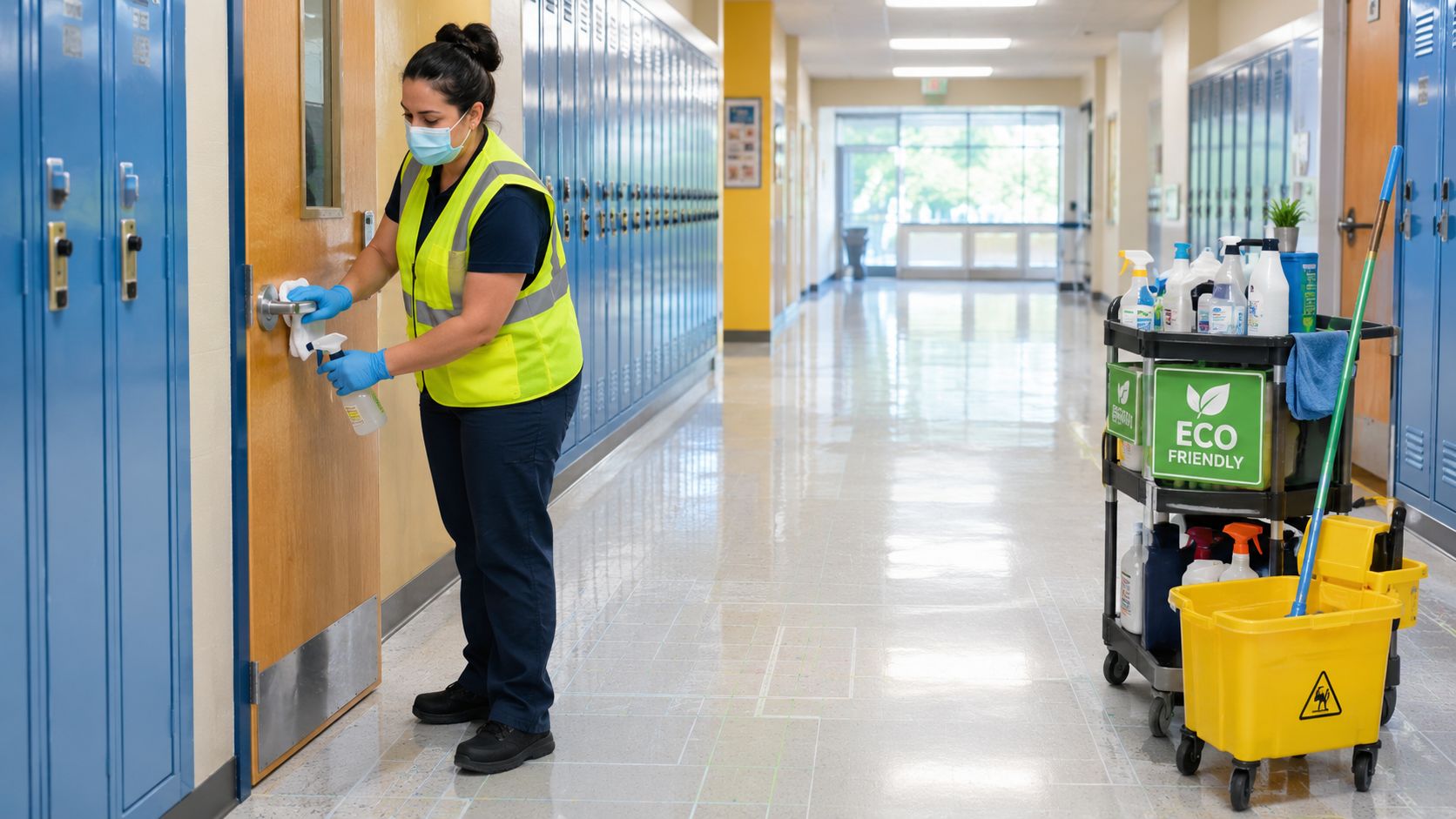
Remove soil with the appropriate cleaner first. Apply a DIN-approved disinfectant only after the surface is clean, following the label for dilution, application, safety precautions, and contact time. Ontario's reopening guidance made DIN approval part of school-year readiness, so purchasing teams should verify product status before the first shift. A substitution discovered during an inspection can delay several zones at once.
Staff need PPE suited to the product and task. Gloves do not replace hand hygiene, while eye or respiratory protection may be required for certain chemicals or conditions. Cloths, mop heads, buckets, and vacuum equipment also need a maintenance plan. Otherwise, workers can transfer soil from one zone to another.
Schedule around school operations
Complete disruptive work during closure periods where possible. Divide ongoing service into opening, daytime response, and closing tasks, with clear ownership for each shift. Colour-coded equipment or separated kits reduce cross-zone transfer, while a short daily handover records unfinished work, spills, supply shortages, access problems, and areas needing specialist attention.
Facility leaders reviewing how to manage COVID-19 risks can adapt those workplace illness-control principles to the school's occupancy and policies. Staffing plans should also reserve time for high-level surfaces, including ledges, vents, and ceiling fixtures. Scheduled high dusting services reach areas that routine floor-level cleaning leaves untouched.
Why Ventilation and Filtration Deserve Priority Attention
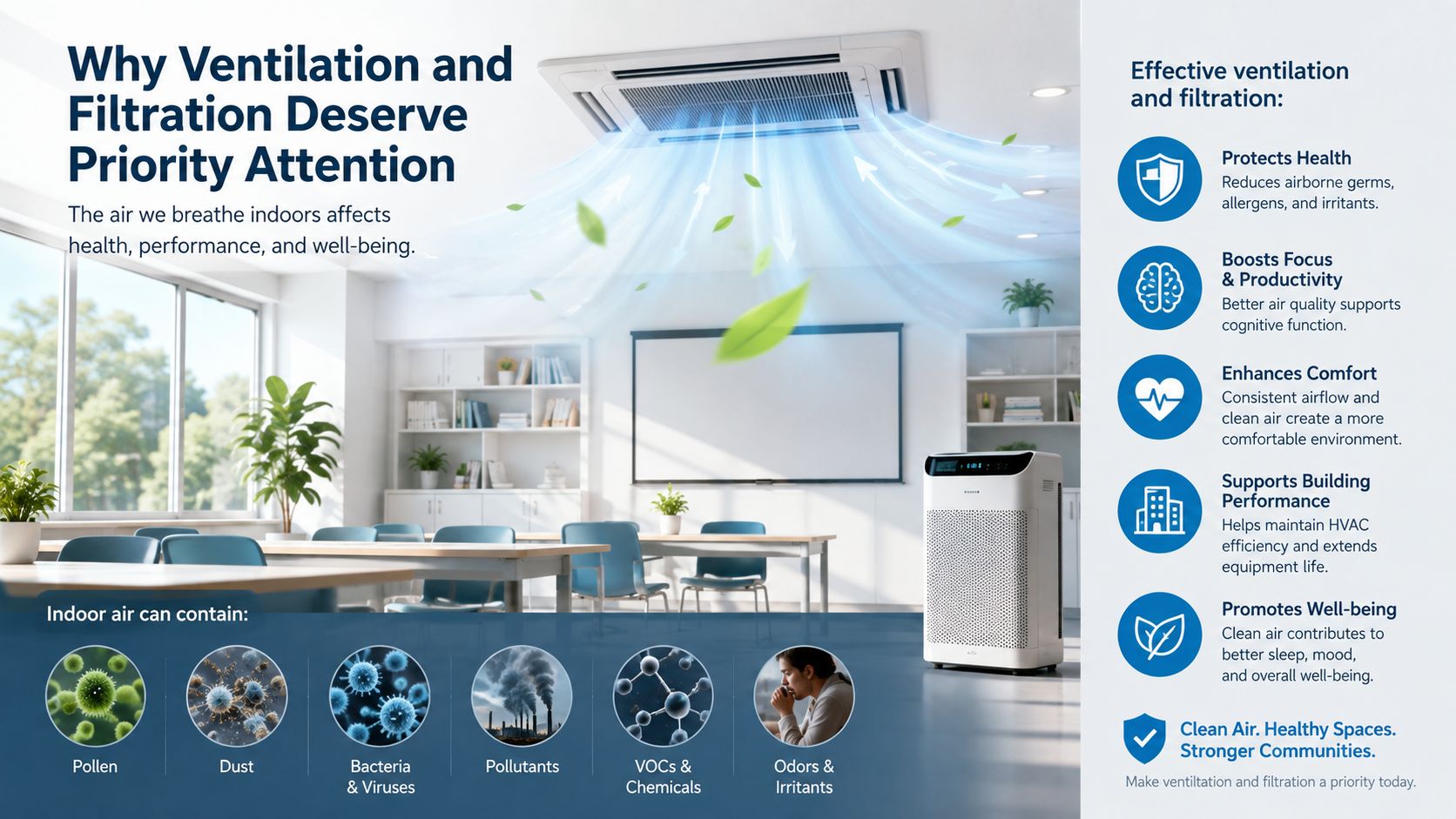
A classroom can have freshly disinfected desks and still smell stale when the HVAC system has not been flushed overnight. That condition affects the whole room, while surface cleaning addresses specific contact points. With limited labour and budget, facility managers need to schedule air-system checks before adding extra wiping hours that may leave a building-performance problem unresolved.
Ontario guidance recommends inspecting school HVAC systems before occupancy, calibrating them for maximum airflow and increased fresh-air intake within system limits, and installing the highest MERV filter the system can accommodate, with MERV 13 preferred where feasible. Exhaust systems should remain functional during occupancy. Buildings that rely on natural ventilation can improve indoor air quality by opening windows briefly at intervals, with limited temperature impact. Ontario's ventilation memorandum sets out these operational priorities.
Make the budget decision by consequence
Ventilation does not remove the need for cleaning. The practical decision is which unresolved condition would create the greater operational consequence if the team leaves it incomplete.
Move HVAC work to the front of the reopening schedule when filters are damaged, poorly fitted, overdue for replacement, or unavailable. The same priority applies when classrooms remain stuffy, exhaust systems fail, or construction has altered air pathways. Put additional surface-cleaning time first where there is visible soil, a known contamination event, frequent shared use, or a washroom or food-service concern.
Air-system work also needs a staffing plan. Assign someone to confirm filter availability, arrange access equipment, coordinate technical support, and record completed checks. That work should not compete with classroom turnover on the final day.
Ontario guidance highlights filter fit, replacement frequency, and continued operation during occupancy. The Toronto District School Board reports maintaining about 16,000 HEPA units and aiming for three to six equivalent air changes per hour in many spaces. These figures show the scale of air-cleaning deployment in a large system, not a universal target for every school. Ontario's later school ventilation guidance stresses system capacity, filter fit, and careful handling of mould and indoor-air-quality remediation.
Protect the system during remediation
Mould cleanup, water damage, and heavy construction dust require controlled remediation. Crews may need to seal vents, isolate rooms, or shut down HVAC equipment while work proceeds. Cleaning surfaces while contaminated air continues circulating can spread material and create rework.
Use this pre-opening sequence: inspect, correct, document, clean, then verify. Arrange filter stock, access equipment, replacement parts, and qualified technical support before classrooms are released for occupancy. Record who completed each check and what remains outstanding, so the first shift is not forced to discover system problems during arrival.
Solving the Staffing and Scheduling Puzzle
When a spill breaks the morning routine, the schedule collapses unless the roster reserves coverage for unplanned events. Compliance expectations describe required work, while the building manager must decide who handles it and when. Ontario's washroom regulation came into force on January 1, 2026, and provincial protocols continue to call for at least daily cleaning and disinfection of high-touch areas, with some items cleaned after each use or at regular intervals. Ontario's washroom regulation clarifies the expectation, but the staffing problem remains.
Build the roster around workload peaks
Separate fixed duties from responsive coverage. Fixed work includes opening checks, washroom service, classroom resets, waste removal, and closing inspections. Keep capacity available for spills, bodily-fluid incidents, unexpected soiling, and rooms that become unusable during the day.
If every worker is assigned continuously, one incident can disrupt the entire route. Preserve coverage for unplanned events, even if that requires reducing low-risk appearance work during peak occupancy. Set the priority order in advance: safety hazard, contamination control, washroom function, high-touch readiness, then cosmetic detail.
Construction creates access and timing conflicts. Dust can settle after cleaning, while trades may block rooms or corridors. Require a handover between contractors and custodial staff that identifies the released area, debris removed, vents protected, and surfaces ready for final cleaning.
Bring in qualified support at the right point
Routine custodial staff should not manage every technical issue. HVAC calibration, mould response, significant water damage, hazardous-material concerns, and post-construction cleanup may require qualified crews with appropriate containment, equipment, and documentation.
Use a clear escalation structure:
- Routine team: Daily cleaning, disinfection, waste, replenishment, and inspection.
- Supervisor: Schedule changes, repeated deficiencies, supply gaps, and access conflicts.
- Specialist: HVAC performance, mould remediation, major dust events, water damage, or work requiring technical controls.
Reopening reliability also depends on recruitment and retention. Schools and service providers can review cleaning career opportunities when developing a broader labour pipeline. Each shift still needs a defined route, realistic task volume, equipment access, and a handover method. Without those controls, additional staff may increase headcount without improving coverage.
Quality Assurance and Documentation Frameworks
A clean corridor means little on paper if the supervisor cannot show which product was used, when the work occurred, and who completed it. A useful quality system verifies the process as well as the final appearance. It can expose a missed washroom inspection, an unrecorded product substitution, or a filter replacement that never made it into the maintenance record. Records should help supervisors find failures early and demonstrate due diligence later.
Use a practical verification checklist
Each critical zone needs a sign-off covering:
- Location: Building, floor, room, and zone.
- Task: Cleaning, disinfection, replenishment, inspection, or maintenance.
- Timing: Date and service period.
- Product: Cleaner or disinfectant used, including DIN information where applicable.
- Method: Surface preparation, contact time, PPE, and equipment used.
- Result: Complete, incomplete, or requiring follow-up.
- Verifier: Staff member or supervisor who checked the work.
Supervisors should combine periodic visual inspections with targeted process checks. A process check can confirm that visibly soiled surfaces were cleaned before disinfection, label contact time was followed, equipment stayed separated by zone, and chemicals were stored safely. The record should also capture spills, blood or body-fluid incidents, complaints, missed services, corrective actions, and specialist handoffs.
Track meaningful operational indicators
Choose measures that show whether controls are working:
- Completed critical tasks compared with scheduled tasks.
- Repeated deficiencies by room or shift.
- Washroom replenishment failures.
- HVAC inspection and filter replacement status.
- Open corrective actions and their age.
- Training completion for cleaning staff.
- Response time for spills or contamination events.
Training should cover WHMIS requirements, product labels, dilution, contact time, PPE, hand hygiene, colour-coded equipment, safe lifting, and escalation procedures. Biohazard incidents require a separate response protocol because they may involve different disinfectant concentrations, PPE, isolation, waste handling, and supervisor notification.
Documentation principle: If a task affects health, safety, air quality, or compliance, the record should show what happened, who completed it, and what occurred when the result wasn't acceptable.
A school can start with a controlled paper checklist or shared digital form. The format matters less than consistent fields, supervisor review of exceptions, and accessible records. Keep the system useful during a busy reopening. Forms that nobody reads do not improve control.
Reliable preparation brings together the risk assessment, zoned cleaning plan, HVAC inspection, staffing schedule, approved products, specialist escalation, and documented verification. Use that checklist when requesting two or three quotes, and ask providers how they coordinate ventilation, maintain washroom coverage, handle construction dust, respond to mould, confirm product compliance, and conduct quality audits. Arelli Cleaning provides routine school and commercial cleaning, disinfection, floor care, high dusting, and post-construction cleaning. Facility leaders can review Arelli Cleaning as one option before selecting a service partner.







.webp)