Toronto medical offices should be fully cleaned at least once per day, high-touch surfaces disinfected at least daily, twice daily in busier clinics, and examination-room equipment disinfected after each patient. The correct schedule still depends on room function, patient volume, care type, and contamination risk.
A clinic manager may have a full waiting room, several appointments booked before lunch, and an infection-prevention review approaching, while the janitorial agreement says only “cleaned nightly.” That wording doesn't explain whether reception counters, chair arms, examination tables, shared equipment, and washroom touchpoints receive attention during the operating day.
The practical answer to how often should Toronto medical offices be cleaned? is therefore not one number. Daily cleaning is the operating floor. High-touch rounds, patient turnover, visible-soil response, and outbreak escalation determine what happens above that floor.
Why One Cleaning Frequency Does Not Fit a Toronto Medical Office
“Nightly cleaning” usually describes a service window, not a complete infection-prevention programme. A cleaner may empty waste, vacuum floors, wipe washrooms, and disinfect accessible surfaces after closing, while clinical staff remain responsible for equipment and room turnover during the day. If the agreement doesn't define those responsibilities, important tasks can sit between the two teams.
Public Health Ontario uses a risk-based approach. High-touch surfaces in healthcare areas require more attention than low-touch surfaces and should be cleaned and disinfected at least daily, with additional service when contamination risk rises. Door handles, light switches, reception counters, chair arms, examination surfaces, faucets, and frequently handled equipment all fall within the practical high-touch group. Public Health Ontario's environmental-cleaning guidance supports this distinction.
The four-part operating model
A workable Toronto clinic schedule separates four activities:
- End-of-day full cleaning: Environmental surfaces, floors, washrooms, waste, reception, staff areas, and ordinary office spaces receive a documented service.
- High-touch rounds: Door hardware, counters, chair arms, switches, washroom touchpoints, and shared controls receive additional attention during operating hours when traffic or contamination risk warrants it.
- Between-patient turnover: Examination tables, phlebotomy chair armrests, blood-pressure cuffs, glucometers, and similar non-critical equipment are cleaned and disinfected after each use.
- Escalation cleaning: Spills, blood or body-fluid contamination, respiratory-virus activity, outbreaks, unusually heavy traffic, or higher-risk procedures trigger immediate or more frequent service.
This structure avoids two expensive mistakes. Applying the same intensive schedule everywhere wastes resources in low-traffic administrative rooms. Applying a single nightly routine to every clinical area leaves busy examination and procedure spaces under-serviced.
Operating rule: “Daily” is a baseline for environmental cleaning, not permission to postpone patient-contact cleaning until the office closes.
The clinic manager should ask for a room-by-room matrix that identifies the task, responsible person, product, contact time, and completion record. A contract that says only “cleaned nightly” is too vague for a practice with patient turnover or shared clinical equipment.
How Ontario Classifies Risk in Clinical Spaces
Ontario guidance distinguishes between a health care clean and a hotel clean. A health care clean applies to spaces where patient care occurs. It includes ordinary removal of dirt, dust, and waste, alongside disinfection, increased cleaning frequency, auditing, and other infection-control measures. A hotel clean applies to non-care areas and follows a less intensive standard.
The difference matters because a medical office isn't one uniform environment. An examination room, procedure room, reception area, staff kitchen, corridor, and accounting office may occupy the same premises, but they don't present the same transmission risk.
Mapping the rooms
A clinic manager can classify spaces by asking four practical questions:
- Does patient care occur in the room?
- Do patients or staff repeatedly touch the same surfaces?
- Can blood, respiratory secretions, skin contact, or other body fluids reach the environment?
- Does the room support a procedure, shared equipment, or rapid patient turnover?
Public Health Ontario identifies high-risk areas as spaces requiring cleaning after each case, event, or procedure and at least twice daily. Moderate-risk areas require cleaning at least daily and more often when heavily soiled. Public washrooms require a separate service response based on use and contamination. Ontario's environmental-cleaning factsheet for healthcare settings provides the risk-based foundation for these distinctions.
Risk determines the method
The tier affects more than frequency. It also influences the order of work, the degree of supervision, the product selected, and the required wet contact time. Cleaning must precede disinfection because organic soil can reduce disinfectant effectiveness. Staff must follow the product label for dilution, contact time, surface compatibility, storage, and personal protective equipment.
A reception desk may need a documented daily clean and additional high-touch attention. An examination room may need full environmental cleaning at the end of each shift, with patient-contact surfaces reset after every use. A procedure space needs a more demanding event-based process. Room names help, but actual activity drives the decision.
A Room-by-Room Cleaning Schedule for Toronto Clinics
A Toronto clinic needs separate cleaning triggers, not one blanket frequency. Use the room schedule below as the operating baseline, then increase service for heavier traffic, vulnerable patients, visible soil, respiratory illness, or more intensive clinical care.
| Area | Surfaces | Minimum frequency | Notes |
|---|
| Reception and front desk | Counters, chair arms, pens, door hardware, light switches | At least daily, with extra rounds when heavily used or contaminated | Assign staff and cleaners clear responsibility for shared items |
| Waiting area | Chair arms, tables, counters, handles, frequently handled devices | At least daily, with extra rounds as traffic or respiratory risk rises | Remove visibly soiled items immediately |
| Examination rooms | Examination surfaces, counters, sinks, high-touch points | Full environmental clean at least daily | Reset patient-contact surfaces after each use |
| Shared equipment | Blood-pressure cuffs, glucometers, examination-table surfaces, armrests | After each patient or use | Follow manufacturer and disinfectant instructions |
| Procedure areas | Clinical surfaces and exposed equipment | After each case, event, or procedure and at least twice daily | Escalate response after body-fluid contamination |
| Public washrooms | Fixtures, handles, faucets, dispensers, floors | At least daily, with service adjusted to use and soil | Document inspections and replenishment |
| Administrative rooms | Desks, phones, switches, floors | Daily or according to use and risk | Use the lower-risk schedule only where patient care does not occur |
Daily service needs a defined scope
End-of-day service should cover environmental surfaces, waste, floors, washrooms, reception, corridors, staff spaces, and ordinary offices. High-touch points must appear as named tasks, not disappear inside a generic “dusting” line. The service record should show whether those points were cleaned and disinfected, rather than merely confirming that someone entered the room.
A clinic manager should also separate four work orders: end-of-day room cleaning, high-touch rounds during operating hours, between-patient turnover, and outbreak or contamination response. This matrix prevents a nightly clean from being mistaken for patient-ready clinical control.
The disinfectant should carry a Canadian Drug Identification Number. Managers can verify that number in Health Canada's Drug Product Database, then confirm surface compatibility, dilution, storage, protective equipment, and labelled wet contact time. The provincial primary-care cleaning checklist provides a practical way to document whether the schedule distinguishes routine work, turnover, and contamination response.
A clean-looking counter does not prove that disinfectant stayed wet for the required contact time.
Floors need daily attention where traffic and clinical activity justify it, with spot cleaning whenever soil or spills appear. Carpeted areas require regular vacuuming and a planned deeper-care schedule based on condition, soil load, and manufacturer requirements. Vents, return grilles, upholstery, baseboards, and spaces behind equipment belong in periodic facilities maintenance. Those tasks support the schedule, but they do not replace the daily clinical work.
Between-Patient Turnover and Equipment Disinfection
Between-patient turnover is a clinical workflow, not just a janitorial visit. The responsible staff member should remove single-use materials, handle waste correctly, inspect the room for visible contamination, clean the surface, apply the appropriate disinfectant, and keep the surface wet for the product's labelled contact time before restoring the room.
Public Health Ontario specifically identifies non-critical medical equipment such as examination tables, phlebotomy chair armrests, blood-pressure cuffs, and glucometers for cleaning and disinfection after each use. The provincial guidance on environmental cleaning in healthcare settings supports a use-based schedule rather than a calendar-only routine.
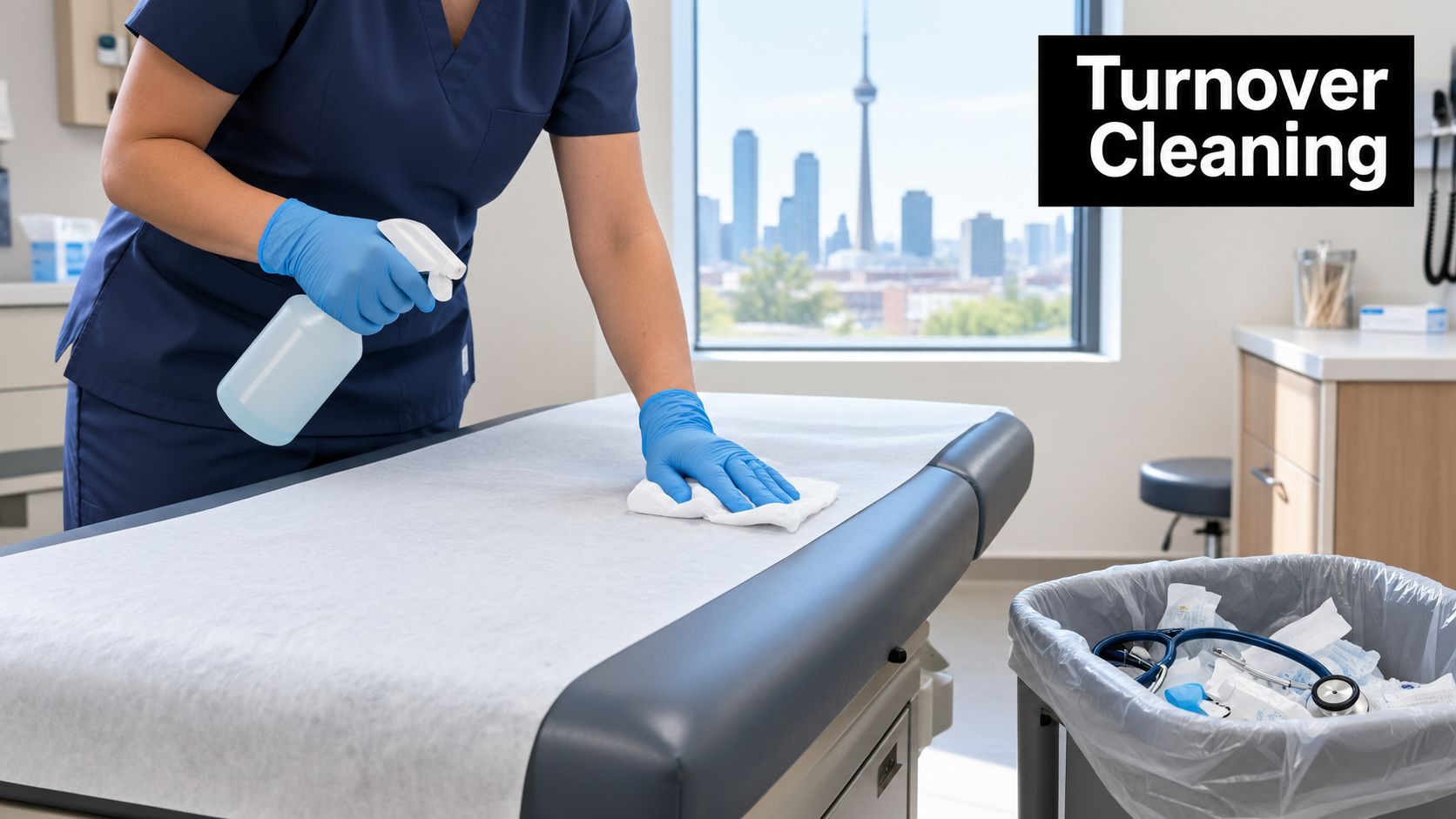
The turnover sequence
A written turnover procedure should address:
- Room contents: Remove disposable barriers and waste, and move soiled linen into the designated handling stream.
- Clinical contact points: Wipe examination surfaces, armrests, cuffs, controls, handles, and other equipment that touched the patient.
- Reusable devices: Clean stethoscopes, blood-pressure cuffs, otoscopes, pulse oximeters, and similar items according to their manufacturer instructions.
- PPE and sharps: Use the required protective equipment, avoid carrying contaminated materials through clean areas, and check sharps containers without manipulating their contents.
- Room release: Confirm that the disinfectant has completed its labelled contact time, the surface is suitable for use, and the room is reset before the next patient enters.
The exact duration depends on the product, surface, room condition, and task. A clinic shouldn't promise a fixed turnover time if that promise encourages staff to wipe and immediately reuse a surface before contact time is complete.
Specialty spaces need their own protocols. ENT scopes, dental chairs, gynecological examination tables, sensors, tubing, and other product-sensitive equipment may require barrier changes, specialised chemicals, or manufacturer-specific procedures. The contractor should never improvise on clinical devices.
For a broader explanation of contamination control across affected surfaces and materials, clinic managers can review this full decontamination process as supplementary operational reading. A medical-office cleaning programme can also separate contractor duties from clinical duties through a documented commercial disinfection and sanitizing service specification.
Adjusting Frequency by Practice Type and Patient Volume
The baseline changes when the practice changes. A consultation office with limited patient movement may operate close to the daily environmental-cleaning floor, provided staff disinfect patient-contact equipment after use. A walk-in clinic, dental office, diagnostic setting, or procedure-based practice needs more frequent intervention because rooms turn over faster and contamination opportunities are greater.
A practical decision matrix
| Practice profile | Main pressure point | Appropriate adjustment |
|---|
| Low-volume consultation office | Patient-contact equipment and ordinary high-touch surfaces | Daily full cleaning, after-use equipment disinfection, and immediate spill response |
| Busy walk-in clinic | Repeated contact with reception, seating, doors, washrooms, and clinical rooms | Add high-touch rounds during operating hours and increase washroom and room checks |
| Dental practice | Operatory turnover, barriers, aerosols, specialised equipment | Use a separate operatory turnover protocol and keep dental-unit, waterline, and instrument-processing duties with clinical staff |
| Procedure room | Blood, body fluids, invasive care, and event-based contamination | Clean after each procedure or event, then complete the required daily and session-based service |
| Diagnostic or shared-treatment space | Shared devices and repeated patient contact | Disinfect equipment after every use and audit the reset process |
The manager should assess volume, acuity, procedure type, room sharing, and visible contamination together. Office size alone is a poor scheduling tool. A small room used continuously can carry more operational risk than a larger administrative suite with little patient contact.
Canadian federal healthcare guidance recommends that heavily used horizontal and frequently touched surfaces be cleaned at least twice daily and whenever soiled. The federal infection-prevention guidance makes twice-daily high-touch service a stronger operating standard for continuously used areas, vulnerable patient populations, and shared treatment spaces.
The question isn't whether the whole clinic needs to be cleaned twice daily. The question is which surfaces and rooms earn that higher frequency.
Outbreaks, respiratory-virus activity, spills, heavy traffic, or a sudden change in patient population should trigger a temporary escalation. The written matrix should state who authorises that change, which rooms receive priority, and how the additional work is recorded.
Why Auditing and Verification Matter More Than Frequency
A clinic can increase cleaning frequency and still leave infection-control gaps. The wrong dilution, insufficient contact time, one cloth moving between zones, or a missed chair-arm underside can undermine an otherwise frequent service. Extra visits do not fix a method that staff cannot perform consistently.
Ontario's physician regulator expects clinical offices to complete an infection-transmission risk assessment at least annually and maintain an action plan. Public Health Ontario also points to Canadian-licensed products, manufacturer instructions, and risk-based auditing. The College of Physicians and Surgeons of Ontario's infection-prevention advice supports a formal quality-assurance process. A signed cleaning log is evidence of a task, not proof that the task worked.

What verification should test
A defensible programme checks:
- Product control: Keep the product label, Drug Identification Number, dilution, contact time, storage requirements, and surface compatibility available.
- Task completion: Record the area, task, date, time, and responsible staff member.
- High-risk performance: Inspect examination and procedure rooms more closely than administrative offices.
- Missed surfaces: Use visual checks, fluorescent markers, or another suitable method to find touchpoints routine inspection misses.
- Corrective action: Document the response to missed work, including who fixed it and when.
Healthcare environmental-cleaning guidance supports sampling at least 10–15% of outpatient examination or procedure areas weekly, expanding to 25% when resources permit. Public Health Ontario's environmental-cleaning and auditing resource provides the benchmark for a proportionate audit programme.
Schedule an independent review at least annually. An external auditor routinely catches recurring missed touchpoints, unclear ownership, and product incompatibilities that in-house staff have stopped seeing. The practical standard is clear: verify the cleaning matrix, not just the number of visits.
Hiring a Commercial Cleaner and Documenting Compliance
A commercial cleaner should be evaluated on healthcare controls, not just appearance. The clinic manager needs evidence that the provider understands clinical zones, contamination pathways, product instructions, staff protection, equipment compatibility, and recordkeeping.
Questions before signing
The selection checklist should include:
- Training: Can the provider show training in bloodborne-pathogen precautions, clinical cleaning methods, PPE use, and safe waste handling?
- Products: Does the provider identify the disinfectants used, their Drug Identification Numbers, surface compatibility, dilution, and labelled contact times?
- Zoning: Does the team use separate or controlled equipment for clinical and non-clinical areas to reduce cross-contamination?
- Staffing: Are replacement cleaners trained on the same room matrix and escalation rules?
- References: Can the provider supply references from comparable Toronto medical, dental, diagnostic, or professional practices?
- Supervision: Who reviews the logs, responds to missed tasks, and communicates an outbreak or contamination escalation?
- Scope: Does the proposal distinguish clinical turnover from end-of-day environmental cleaning?
The contract should name each room category and define the required task. “Nightly cleaning” isn't enough. A useful service agreement states the daily environmental duties, high-touch rounds, patient-contact responsibilities, spill response, periodic maintenance, documentation, and escalation process. Failure to complete a defined frequency should be a service issue recorded through the agreement, not an informal disagreement about what “clean” means.
For broader operational context, clinic managers can compare the contract structure with these facilities management best practices, while still applying Ontario-specific infection-prevention requirements to clinical spaces.

Records that survive scrutiny
A basic compliance file should contain:
- A current room-risk matrix and cleaning schedule.
- Daily logs with times, tasks, and staff initials.
- Product labels and safety documentation.
- Manufacturer instructions for sensitive equipment and surfaces.
- Supervisor inspection records and corrective actions.
- Audit results for high-risk areas.
- A short summary showing what was completed, what was missed, and how issues were corrected.
A general commercial cleaner may suit a low-risk consultation office if the provider can follow the documented matrix. A healthcare-specialised provider such as Arelli Cleaning may be considered where the practice needs medical-office cleaning, flexible service planning, and documented disinfection controls. The relevant test is verification capability, not the label attached to the company. Details of a medical-office scope can be reviewed through medical office cleaning services.
Key Takeaways and Further Reading for Toronto Clinics
The operating rule is clear: clean the environment daily, disinfect patient-contact surfaces after use, schedule high-touch rounds according to risk, respond immediately to contamination, and keep records that prove the work occurred. Cleaning frequency is a matrix, not one number. End-of-day cleaning, between-patient turnover, routine touchpoint rounds, and outbreak escalation each need their own trigger.
Use this checklist to brief staff and cleaning providers:
- Classify rooms: Separate patient-care, procedure, shared-equipment, public, and administrative spaces.
- Assign ownership: State which tasks belong to clinical staff and which belong to the commercial cleaner.
- Write intervals: Set task-specific frequencies for rooms, surfaces, equipment, patient turnover, spills, and outbreaks.
- Control products: Record the product, Drug Identification Number, dilution, contact time, and compatibility requirements.
- Verify performance: Inspect high-risk rooms, sample completed work, and record corrective action.
- Review triggers: Reassess the matrix when procedures, patient volume, equipment use, or infection conditions change.
For further reading, start with Public Health Ontario's clinical-office cleaning guidance and its environmental-cleaning and auditing resource. Also review the CSA Z317.2 standard for healthcare-facility cleaning and disinfection, along with Public Health Ontario's IPAC core competencies. The Arelli service areas page can help identify regional coverage. The clinic's infection-prevention lead should confirm the final room matrix.
Review the schedule whenever the practice adds a procedure, changes patient volume, shares equipment differently, or experiences an outbreak. The written frequency sets the baseline. Verification shows whether the baseline is being met.
Use the checklist above to define room-by-room requirements and compare 2–3 quotes. Ask each provider how it will handle patient turnover, product contact time, audits, missed tasks, and records. Then book a free sample clean with Arelli Cleaning to see how the documented matrix performs in your own rooms before signing.









.webp)