Toronto property managers, and their counterparts across the GTA, typically select janitorial vendors through a formal evaluation process focused on compliance, operational consistency, service accountability, and commercial discipline. Strong procurement outcomes are rarely driven by headline price alone. They depend on whether a vendor can support building operations consistently, reduce avoidable risk for the ownership group, and deliver against scope without creating unnecessary administrative burden for the site team.
Why the Lowest Bid Is Usually a False Economy
The lowest bid may appear commercially attractive at the outset, but it often becomes expensive once day-to-day building operations begin. A property manager in the Entertainment District may reduce budget on paper, then spend the following months addressing service complaints, escalating missed tasks, and explaining why tenant experience has deteriorated despite an active janitorial contract.
When a vendor significantly underprices the work, the margin is typically recovered elsewhere. In most cases, that shows up as limited supervision, inconsistent staffing, weak reporting, or an operating approach that treats the scope as flexible rather than contractual.
Practical rule: If a quote is materially lower than competing bids, ask which service elements, controls, or assumptions have been reduced.
The hidden cost is rarely limited to the invoice. It usually appears as internal administrative burden, reputational pressure with tenants, and increased operational risk when the building team discovers that the vendor cannot produce current documentation, adequate insurance, or a reliable supervisory record.
For Toronto, the GTA, and Ontario buyers, this is why vendor selection is most effective when treated as a disciplined procurement process rather than a price comparison exercise. This applies across core GTA submarkets such as Mississauga, Vaughan, Markham, Richmond Hill, and Brampton, where buyer expectations around compliance, reporting, and service continuity remain broadly consistent. Across the market, buyers consistently prioritize compliance first, operations second, and price after that, because a building is procuring service continuity and risk control, not simply cleaning labour and supplies. A capable cleaning partner should operate like a controlled service business, not an ad hoc provider moving from site to site.
When a property manager evaluates commercial cleaning services, the key question is not which provider offers the lowest number. It is which provider can maintain common areas, washrooms, and tenant spaces consistently while reducing management friction for the on-site team.
<iframe width="100%" style="aspect-ratio: 16 / 9;" src="https://www.youtube.com/embed/jwIUNL9hu7c" frameborder="0" allow="autoplay; encrypted-media" allowfullscreen></iframe>
Mandatory Compliance and Insurance Screening Steps
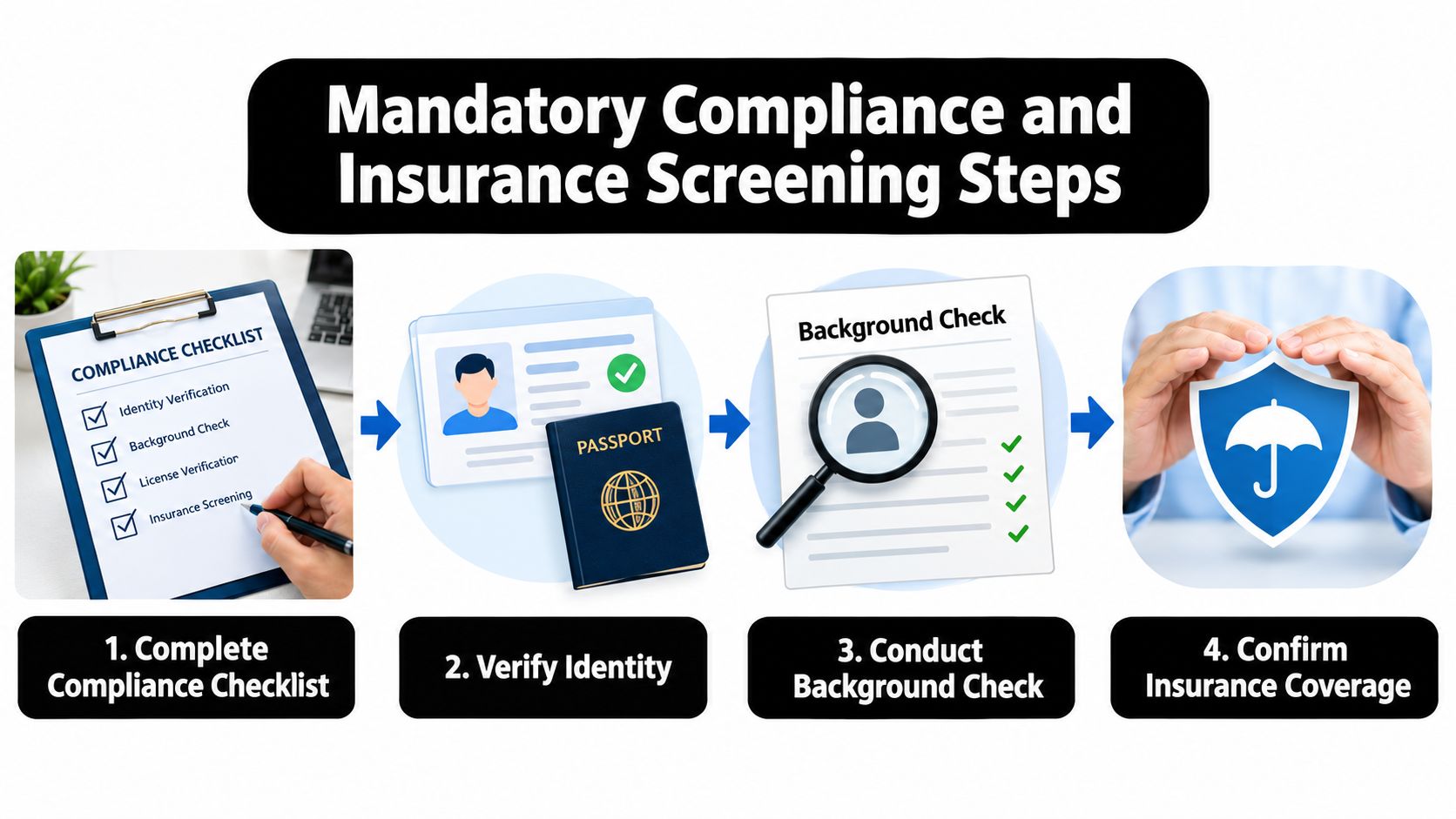
The first stage should not be a site walkthrough. It should be documentation review. Toronto property managers commonly begin with WSIB clearance, a current certificate of insurance, proof of licensing or incorporation, and a written scope that defines what the vendor will and will not deliver. Ontario procurement guidance is clear on this point, proposals that omit mandatory documentation are often disqualified.
A prudent insurance standard for a typical office property is at least $5 million in general liability coverage. In higher-risk environments, the required limits and coverage types may need to be stronger, particularly where spill response, contamination, or specialized surfaces are involved.
What to verify before a walkthrough
- WSIB status: Confirm clearance for every jurisdiction where the company operates, not only the Toronto office address.
- Insurance wording: Ensure the certificate is current and names the property manager or ownership entity where required.
- Legal existence: Verify incorporation or business registration so the vendor is an established operating entity, not simply a trade name.
- Scope controls: Request the draft work scope before discussing price, because vague scope language almost always produces vague service outcomes.
BOMA Plus' Accredited Vendor Program is a useful benchmark because it expects government registration, provincial workers' compensation in every jurisdiction, valid liability insurance, a standard contract template, and executed contracts signed by both parties. That framework aligns with how sophisticated buyers already assess vendors in Toronto, because a cleaning provider manages site access, reputational exposure, and recurring service obligations.
A related lesson appears in insurance requirements for construction, where contract risk is reduced by validating documentation before work begins. The context differs, but the discipline is the same. Strong buyers do not allow compliance gaps to be explained after mobilization.
Vendors who hesitate when asked for compliance documentation rarely become easier to manage after award.
The most efficient way to reduce risk is to request the documents first and the sales presentation second. If a vendor needs repeated follow-up to provide basic records, that is already a meaningful performance signal.
The FAQ for Toronto buyers often comes down to one practical issue, so this vendor selection FAQ is worth keeping available as documentation begins to accumulate.
Writing an RFP That Separates Qualified Vendors From Commodity Bidders
An RFP only works when the scope is precise enough to require substantive responses. If the request simply says "office cleaning," each bidder will fill in the gaps differently, and the lowest quote will usually reflect the most optimistic assumptions rather than the most reliable operating model.
Scope language that produces comparable bids
A strong RFP identifies the building by floor, space type, and service frequency. It should define restroom sanitation, waste removal, vacuuming, dusting, glass touchpoints, and any after-hours access rules. The more clearly the scope defines the work, the less room there is for pricing distortion and service disputes later.
Market guidance for Toronto and Ontario procurement also points to proposed operations, work plans, and deliverables, not just credentials. That matters because two vendors can both be insured and still deliver materially different service quality.
To make bids comparable, request pricing as a monthly rate, plus separate line items for add-on services such as carpet cleaning, strip and wax, or disinfection work. That format prevents a low base rate from concealing expensive extras.
A practical way to structure the RFP is to require bidders to answer the following in writing:
- What gets cleaned: List every space type and task.
- How often it gets cleaned: Daily, weekly, periodic, or event-driven.
- How work is verified: Checklists, supervisor sign-off, photos, or logs.
- Who manages the site: Name the operations contact and escalation path.
- What happens when service slips: Corrective action process and response timing.
guide to create better RFPs
A vendor may appear qualified on paper, but unless the proposal defines execution clearly, the property manager is still buying uncertainty.
Sample vendor scorecard for an RFP review
| Criteria | Weight | What to Look For |
|---|
| Compliance package | High | Complete documentation, current records, no gaps |
| Scope response | High | Clear, building-specific response, no vague assumptions |
| Operations plan | High | Supervisor coverage, staffing model, escalation path |
| Work plans and deliverables | Medium | Real schedule, checklists, reporting cadence |
| Price | Medium | Transparent monthly rate and clearly priced add-ons |
| References | Medium | Comparable buildings, stable service history |
A useful internal reference during drafting is office cleaning in Toronto, because location-specific service patterns matter more than generic national templates.
The best RFPs are often unremarkable to read. That is usually a positive sign. Vendors should be responding to a building's actual operating requirements, not improvising around a broad or undefined wish list.
Scoring Execution Quality Beyond the Lowest Bid
Once the documentation is cleared, the substantive evaluation begins. Toronto procurement practice gives significant weight to scope, experience, operations, and work plans, but many underperforming cleaning contracts fail in the gap between proposal language and weekday execution.
What execution quality looks like
The strongest vendors do not simply say they supervise accounts, they demonstrate the operating cadence. Weekly site walks, written findings, and visible corrective follow-up are strong indicators that the account is being actively managed rather than merely staffed.
Photo-verified completion is another practical control. If the vendor stores floor-by-floor or zone-by-zone photos after cleaning, disputes become easier to resolve and audits become easier to conduct. That does not replace an in-person review, but it removes the usual ambiguity over whether a task was completed.
Practical rule: A vendor that documents the work is usually less expensive to manage, even if the invoice is modestly higher.
Documented SLAs matter for the same reason. A contract that defines response times and corrective-action timelines tells the property manager whether the vendor treats service failures as a managed process or a convenience issue.
Execution Quality Scoring Rubric
| Indicator | Max Points | What High Scores Look Like |
|---|
| Compliance readiness | 20 | Documents are current, complete, and easy to verify |
| Scope clarity | 20 | Vendor restates tasks accurately and flags assumptions |
| Operations plan | 20 | Named supervisor, routine site visits, clear escalation |
| Work plan and reporting | 20 | Checklists, photos, logs, and audit trail are built in |
| SLA rigor | 10 | Response and corrective timelines are specific |
| Price | 10 | Competitive, but not the main selection driver |
commercial disinfection and sanitizing
That approach gives a property manager a practical basis for choosing the vendor most likely to perform over the life of the contract.
Setting Up Trials, KPIs and Contract Negotiation Tactics
A trial period reveals operational reality faster than a polished proposal. Two to four weeks is usually sufficient to assess how the crew performs under normal building conditions, whether that includes late access, unexpected spill response, or periods of elevated tenant traffic.
KPI tracking that is actually useful
The trial should be measured weekly, not remembered generally at the end. A simple tracker keeps the discussion focused on service delivery and issue resolution rather than personalities or sales impressions.
| KPI | Target | Actual | Notes |
|---|
| Schedule adherence | As agreed | | Track missed or late shifts |
| Task completion rate | Near complete | | Compare against the scope checklist |
| Complaint volume | Low and stable | | Separate minor and repeat issues |
| Response time | Prompt | | Measure from request to action |
| Corrective-action closure time | Fast | | Count days, not promises |
The contract requires the same level of discipline. Payment terms, notice periods, escalation clauses, and termination rights should be clear before signatures are exchanged. A vendor can perform well operationally and still create administrative problems if the agreement locks the property manager into vague scope changes or one-sided penalties.
What to avoid in negotiation
- Unlimited travel or miscellaneous fees: These can escalate quickly and are difficult to audit.
- Scope language that can expand indefinitely: The more elastic the wording, the more change orders later.
- Penalties that apply only to the client: Balanced agreements create stronger accountability.
- Verbal scope changes: If the change is not documented, it becomes a dispute later.
Quarterly business reviews are worth requiring because they help prevent gradual service decline. Written change orders serve the same purpose when the building adds space, changes operating hours, or shifts how areas are used.
For office accounts that need regular site visibility, office cleaning services should be assessed based on whether the vendor can support the building's actual operating rhythms, not simply the initial scope.
A trial is not a formality. It is one of the lowest-cost ways to determine whether the vendor can operate within the contract without creating additional work for the property team.
The End-to-End Vendor Selection Workflow
The most effective workflow is simple enough to repeat at each renewal cycle. First, remove vendors that fail compliance. Next, issue an RFP with a defined scope, score proposals on execution quality, run a trial, and finalize the contract around SLAs, reporting, and review dates.
Reusable selection sequence
- Compliance screen. WSIB, insurance, legal registration, and written scope controls.
- RFP issue. Floor-by-floor scope, task detail, frequencies, and pricing format.
- Execution scoring. Supervisor cadence, reporting, SLAs, and reference checks.
- Trial period. Two to four weeks of measured service.
- Contract close. Clear terms, written change controls, and review cadence.
That sequence matters because Toronto's procurement environment already favors formal selection methods. The vendor that demonstrates process reliability typically outperforms the vendor that merely appears less expensive.
The same logic appears in operational guidance for field teams, and proven field ops for 2026 is a useful external reference for how documentation, routing, and supervision support repeatable service delivery. Cleaning is not identical to field service, but the management principle is comparable.
Summary checklist
- Confirm compliance first.
- Write the scope tightly.
- Score execution, not just price.
- Use a trial before locking in.
- Keep quarterly reviews on the calendar.
Frequently Asked Questions
What documentation should a janitorial vendor provide before a site walkthrough?
Current WSIB clearance, a certificate of insurance, proof of legal registration or incorporation, and a draft scope of work.
How should Toronto property managers compare janitorial bids?
Compare bids against the same scope, frequencies, reporting expectations, and pricing format, not price alone.
Is the lowest-priced janitorial proposal usually the best choice?
Usually not. A very low price often signals reduced supervision, weak staffing, or extra costs later.
How long should a janitorial trial period last?
Two to four weeks is usually enough to assess execution, responsiveness, and day-to-day site management.
What should be included in a janitorial service level agreement?
Response times, corrective-action timelines, reporting cadence, escalation paths, and scope-change procedures.
How often should property managers review janitorial performance?
Quarterly reviews are a practical standard for most commercial properties.
Arelli Cleaning is one Toronto option that aligns with this type of selection process through no-term contracts, flexible stop-and-go service, and technology-supported quality control. Other vendors may be a better fit for different buildings, but the selection method should remain consistent.
For Toronto and GTA property managers seeking a more disciplined vendor selection process, Arelli Cleaning supports office and commercial cleaning programs through a model built on scope definition, compliance documentation, and service verification. Visit Arelli Cleaning to review service options, apply the evaluation framework in this article, and compare 2 to 3 qualified proposals on execution, controls, and fit.







.webp)