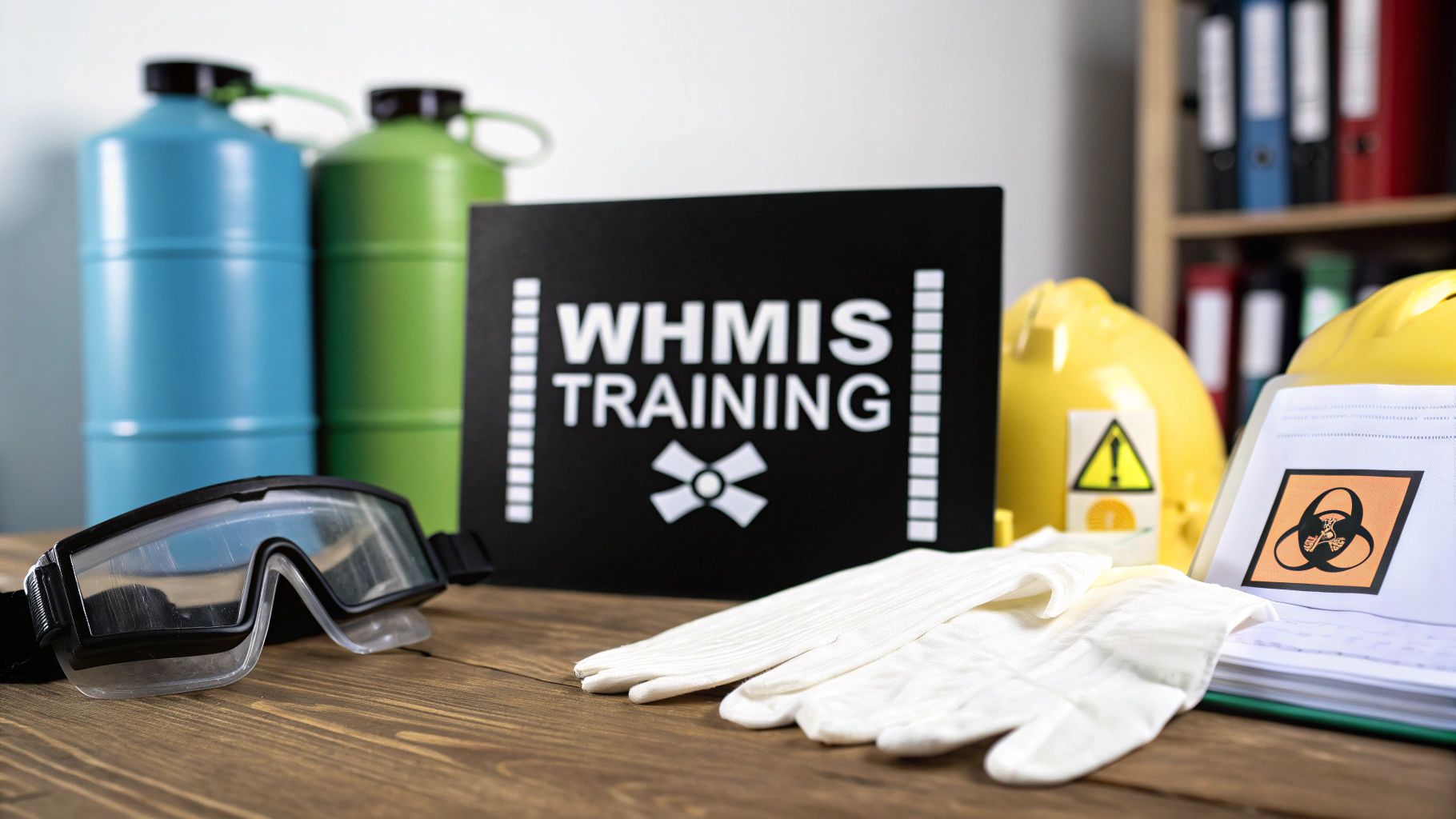
WHMIS training is a non-negotiable part of workplace safety in Canada. It's the system that teaches everyone how to handle, store, and work around materials that could be hazardous. Think of it as a comprehensive communication plan designed to head off injuries and illnesses before they happen, making sure every single person understands the risks tied to the products they use every day.
What Is WHMIS Training A Simple Guide
If you’ve ever wondered what WHMIS is all about, here’s the simplest way to look at it: WHMIS (which stands for Workplace Hazardous Materials Information System) is the universal safety language for Canadian workplaces. It’s more than just a list of rules; it's a vital communication system built to protect anyone who works with or near potentially dangerous products.
A great analogy is to think of WHMIS as a standardized set of traffic signs, but for chemicals.
Just like a stop sign gives a driver instant, clear instructions, a WHMIS symbol delivers immediate, easy-to-understand information about potential dangers. This system ensures that whether you're working in downtown Toronto or a remote facility in Northern Ontario, the information about a hazardous product is always presented in the same straightforward format. The ultimate goal? To prevent injuries by keeping workers informed.
The Three Pillars of WHMIS
The entire WHMIS system is built on three core pillars that work together seamlessly to create a safer environment. Getting a handle on these components is the first step to really understanding what WHMIS training covers.
The system breaks down into three interconnected parts: the labels on the products, the detailed info sheets that come with them, and the training that ties it all together.
| The Three Core Components of WHMIS | ||
|---|---|---|
| Component | Purpose | What to Look For |
| Product Labels | To provide a quick, at-a-glance warning about a product's main hazards. | Pictograms (symbols in red diamonds), signal words like "Danger" or "Warning," and brief hazard statements directly on the container. |
| Safety Data Sheets (SDSs) | To offer comprehensive, detailed information for safe handling, storage, and emergency procedures. | A standardized 16-section document covering everything from chemical properties and first aid to fire-fighting measures and disposal considerations. |
| Worker Education & Training | To ensure workers can understand the labels and SDSs and apply that knowledge to their specific jobs. | Hands-on instruction, online modules, and site-specific training that explains how to work safely with the hazardous products present in your workplace. |
Each element supports the others. The label gives you the immediate heads-up, the SDS gives you the full story, and the training makes sure you know what to do with that information.
This system has been a cornerstone of Canadian workplace safety since 1988. Its impact is undeniable; according to industry organizations like ISSA, better hazard communication is a key factor in reducing workplace incidents.
For any business, ensuring every single team member is properly trained is essential, especially when dealing with professional-grade cleaning supplies. This foundational knowledge doesn’t just tick a compliance box—it builds a genuine culture of safety. You can learn more straight from the source at the CCOHS website.
Why WHMIS Training Is a Legal Requirement
Let's get one thing straight: in Canada, WHMIS training isn't just a good idea—it's the law.
For any business where employees might come into contact with hazardous products, this system is a non-negotiable legal duty. It’s not an optional program you can choose to adopt; it’s a foundational requirement baked into a web of interconnected federal, provincial, and territorial laws.
This legal framework is designed to make sure everyone in the supply chain—from the manufacturer to the end user—shares responsibility for safety. The federal Hazardous Products Act sets the stage, creating clear and distinct duties for different groups. These aren't just suggestions; they are legally enforceable mandates that form the backbone of workplace safety right across the country.
Understanding Legal Roles and Responsibilities
The law breaks down the responsibility into three distinct groups, creating a closed-loop system of accountability. Think of it as a chain of custody for safety information. Each party has a critical role to play.
- Suppliers: This includes manufacturers, importers, and distributors. They are legally on the hook for classifying hazardous products, creating accurate Safety Data Sheets (SDSs), and making sure every single product they sell has a compliant WHMIS label.
- Employers: This is you. Your business is responsible for making sure all hazardous products in your workplace are properly labelled, getting the SDSs and making them easily accessible to your team, and—most importantly—providing comprehensive worker education and site-specific training.
- Workers: Employees have a legal duty to show up and participate in WHMIS training, actually understand the information, and then apply that knowledge to work safely with hazardous materials every single day.
This shared responsibility model ensures that critical safety information follows a product right from the moment it’s made to the moment it's used.
The Consequences of Non-Compliance
Don't think for a second these rules don't have teeth. Provincial and territorial bodies, like Ontario's Ministry of Labour, are in charge of enforcing these laws on the ground. They have the authority to walk into your workplace, conduct inspections, and hand out serious penalties if you're not compliant.
Failure to comply with WHMIS regulations can lead to some pretty severe consequences. We're talking about stop-work orders that can shut down your operations, substantial fines that hit your bottom line hard, and even potential legal liability if an incident happens on your watch.
For specialized environments like those found in industrial settings, the rules are even tighter. Proper training isn't just important; it's essential for managing the unique risks that come with heavy-duty chemicals. To stay on the right side of the law and protect their people, smart companies are even looking into innovative tools like augmented reality safety programs in the workplace to enhance their training.
At the end of the day, this legal framework makes WHMIS much more than just a safety protocol—it's a core business function. It ensures that every single workplace, from a high-tech manufacturing facility to a downtown law office, upholds a consistent, non-negotiable standard of hazard communication. That’s what turns the principles of WHMIS into real-world protection for millions of Canadian workers.
Who Actually Needs WHMIS Training in Your Workplace
When you hear “hazardous materials,” it’s easy to picture a factory floor or a science lab. The reality, though, is that the need for WHMIS training pops up in places you might not expect. Any worker who could possibly be exposed to a hazardous product in a commercial facility needs to be trained. That goes for manufacturing plants, sure, but it also applies to medical offices, law firms, and even standard corporate headquarters.
This broad scope often catches business owners by surprise. There’s a common myth that a typical office is somehow exempt, but that overlooks the everyday products sitting on shelves and in supply closets. Think about it: toner cartridges for the printer, special cleaning sprays for electronics, or even some heavy-duty air fresheners. If a product has a WHMIS label, anyone who handles it needs to know what that label means.
From the Front Desk to the Warehouse
The real question isn't about job titles; it’s about potential exposure. To get this right, you have to look at every single role in your facility and ask, "Could this person come into contact with a hazardous product?"
When you do that, the list of people needing training often gets a lot longer than you’d think.
- Office and Administrative Staff: The folks who change toner cartridges, use solvent-based correction fluids, or handle special cleaning wipes all fall into this category.
- Maintenance and Custodial Teams: These are your front-line workers when it comes to chemicals. They handle everything from powerful disinfectants to floor strippers, making their training non-negotiable.
- Medical and Dental Office Staff: Professionals in clinics are constantly working with sterilants, disinfectants, and various other chemicals that are squarely covered by WHMIS.
- Workers in Specialized Firms: Even employees at engineering firms, lawyer's offices, or insurance companies might use unique chemicals for equipment maintenance or document processing.
- Contractors and Temporary Staff: This is a big one. If outside workers bring or use hazardous products on your site, they must have up-to-date WHMIS training.
Why Professional Cleaning Staff Must Be Certified
The role of a professional commercial cleaning team is especially critical here. At Arelli Cleaning, our crews handle a wide array of powerful, effective cleaning chemicals every single day. For them, WHMIS knowledge isn't just a box to tick—it's a core requirement for their safety and for the safety of everyone else in your building.
A professional cleaning team that is fully WHMIS-certified is your first line of defence against chemical-related incidents. They are trained to know not just how to use a product effectively, but how to store it safely, handle spills, and understand the proper personal protective equipment (PPE) required for each task.
This expertise is a fundamental part of the award-winning service that has earned Arelli the Consumer Choice Award for three consecutive years (2023, 2024, and 2025). Our deep commitment to safety ensures that every professional office cleaning and commercial cleaning service we provide makes your workplace safer. This dedication shines through in specialized tasks like commercial disinfection and sanitizing, where a thorough understanding of chemical properties is absolutely essential. By making sure every team member is certified, we don't just clean—we deliver "Clean Office & Peace of Mind."
Decoding the Key Elements of WHMIS Training
A solid WHMIS program is so much more than just watching a video and signing a form. To be truly effective and compliant, the training needs to dig into the specific tools that give workers the power to make safe decisions every single day. Let's break down what every comprehensive WHMIS training session should really cover.
At its heart, WHMIS training is about teaching a new language—the language of chemical safety. It revolves around three core communication tools: hazard pictograms, product labels, and the detailed Safety Data Sheet (SDS). Getting these right is the first step toward building a genuinely safe workplace.
Understanding Labels and Pictograms
The first line of defence is always the label right there on the product. It’s designed to give you immediate, at-a-glance information about the biggest dangers. Proper training must explain how to read both supplier labels (the ones that come from the manufacturer) and workplace labels (the ones you create when you pour a product into a secondary container).
A huge part of these labels is the WHMIS pictograms. These are standardized symbols inside a red, diamond-shaped border that instantly tell you the type of hazard you're dealing with—flammable, corrosive, or toxic, for example. Good training ensures workers don't just memorize the ten symbols but actually understand the real-world dangers each one represents.
Here's a quick look at the symbols and what they mean. Recognizing these instantly is a non-negotiable skill for anyone working with hazardous products.
WHMIS Hazard Pictograms and Their Meanings
| Pictogram | Hazard Name | What It Means |
|---|---|---|
| Flame | The product can ignite and burn easily. | |
| Flame Over Circle | This is an oxidizing hazard; it can cause or intensify a fire. | |
| Gas Cylinder | The product contains gas under pressure that may explode if heated. | |
| Corrosion | It can cause severe skin burns, eye damage, or corrode metals. | |
| Exploding Bomb | The product has an explosion or reactivity hazard. | |
| Skull and Crossbones | Can cause death or severe toxicity with short exposure. | |
| Health Hazard | May cause or be suspected of causing serious long-term health effects. | |
| Exclamation Mark | Can cause less serious health effects, like skin or eye irritation. | |
| Environment | May cause damage to the aquatic environment. | |
| Biohazardous | For organisms or toxins that can cause disease in people or animals. |
Understanding these symbols is the foundation of WHMIS. It’s the visual shorthand that keeps people safe on the job.
Mastering the Safety Data Sheet (SDS)
Think of the Safety Data Sheet (SDS) as the detailed biography of a chemical. It’s a standardized, 16-section document that gives you the full story—way more than could ever fit on a label. Compliant training must teach employees how to find and make sense of this document to get critical information when they need it most.
A few key sections workers absolutely must know how to navigate include:
- Section 2: Hazard Identification: This is your quick summary of the product's risks.
- Section 4: First-Aid Measures: Crucial instructions for what to do if someone is accidentally exposed.
- Section 7: Handling and Storage: The practical guide for preventing accidents before they even have a chance to happen.
- Section 8: Exposure Controls/Personal Protection: Details on the Personal Protective Equipment (PPE) required, like specific gloves or goggles.
This knowledge isn't just theoretical. It’s essential when dealing with the powerful solutions used for detailed commercial disinfection, where a deep understanding of chemical properties is vital for everyone's safety.
Practical, On-the-Job Training
General knowledge alone isn’t enough. The final, and arguably most critical, piece of the puzzle is workplace-specific training. This is where theory hits the floor and becomes practice.
This hands-on component is what connects the dots between what’s written on an SDS and an employee's daily tasks. It covers the exact procedures for using specific products in your facility, emergency protocols for spills or exposures, and the proper way to use and care for PPE.
If you’re looking to build or improve your own safety program, these principles are key for creating a high-impact health safety course that doesn't just meet compliance but actually protects your people.
By weaving these key elements together, your WHMIS program stops being a legal checkbox and starts being a powerful, practical tool for preventing incidents and building a secure work environment.
How Professional Cleaners Ensure WHMIS Compliance
Choosing a commercial cleaning company isn't just about getting clean floors; it's about trust. The way a cleaning service manages its products and trains its people says everything about its professionalism and commitment to your facility’s safety. This is where a deep, practical understanding of WHMIS becomes the real differentiator.
At Arelli Cleaning, our entire promise of a Clean Office & Peace of Mind is built on a foundation of safety. WHMIS compliance isn't just a box we tick; it's baked into our DNA. Every single member of our cleaning staff is fully trained and WHMIS certified, so they know exactly how to handle professional cleaning products with genuine expertise and care.
Award-Winning Service Grounded in Safety
Our dedication to safety is a huge part of what makes our service award-winning. We’re incredibly proud to have earned the Consumer Choice Award for the third year running—a recognition that comes directly from the trust our clients place in us.
This trust is earned through rigorous standards. It doesn't matter if we're cleaning a lawyer's office in Vaughan, a medical clinic in Richmond Hill, or an engineering firm in Mississauga—our teams arrive with the right knowledge to maintain a safe environment for everyone.
We believe professional cleaning goes way beyond surface appearances. It’s about creating a genuinely healthy and secure space for your employees, clients, and visitors. Our WHMIS-certified cleaners understand the specific needs of different facilities, from manufacturing and warehousing to sensitive environments like dental office cleaning.
The Arelli Difference Near You
Trying to find a reliable "commercial cleaning service near me" can feel like a shot in the dark. We have local teams ready to go near every location we serve, including Toronto, North York, and beyond. You can see a full list of our communities on our service areas page.
Our commitment to the highest safety standards is matched only by our dedication to premium customer service. We’ve built our business around unique benefits designed to give you complete confidence in our work.
We stand apart from other cleaning companies with features like:
- A Price Match Guarantee to ensure you always get the best value.
- No cancellation or change fees, giving you total flexibility.
- A free 45-minute sample clean of a dedicated area of your facility with every quote, so you can see our quality for yourself.
- Premium customer service available on-site, by phone, or through our dedicated smartphone app.
When you choose Arelli, you're not just hiring a cleaning crew. You're partnering with a team of certified professionals who are truly dedicated to delivering a clean, safe workspace and genuine peace of mind.
Frequently Asked Questions About WHMIS
Even with a good grasp of WHMIS, a few questions always seem to pop up. Let's tackle some of the most common ones that business owners, managers, and employees run into. Think of this as your go-to guide for navigating compliance with confidence.
How Often Do I Need to Renew WHMIS Training?
This is easily one of the most frequent questions we hear, and the answer isn't a simple date on a calendar. While the federal government doesn't stamp a universal, Canada-wide expiry date on WHMIS certification, the industry best practice is clear: annual WHMIS refresher training.
Why? Because employers are legally required to review their safety programs at least once a year. But more importantly, you need to retrain someone whenever:
- A new hazardous product shows up in the workplace.
- Someone's job changes, altering their potential exposure to chemicals.
- It becomes obvious—either through an incident or just day-to-day observation—that a worker's knowledge has slipped.
For roles where people are constantly working with hazardous materials, like in professional commercial cleaning, annual recertification isn't just a box to tick. It’s a vital part of keeping your safety culture strong and your business compliant.
Is Online WHMIS Training Good Enough?
Yes, online WHMIS training can be a great starting point—it’s valid, efficient, and covers the general principles well. A good online course will teach you all about the pictograms, labels, and how to make sense of a Safety Data Sheet (SDS), usually wrapping up with a test to make sure you've absorbed the material.
But—and this is a big but—an employer's responsibility doesn't stop when the online course is finished.
Online training alone is not enough to be fully compliant. It must be supplemented with workplace-specific, practical training. This hands-on component is where you connect the general knowledge to the reality of your facility.
This site-specific training is where the real learning happens. It needs to cover the exact hazardous products used on your premises, your specific emergency procedures for spills or exposure, and the safe handling and storage rules for your unique operations.
What Changed Between WHMIS 1988 and WHMIS 2015?
The single biggest shift between the old WHMIS 1988 and the updated WHMIS 2015 was aligning with the Globally Harmonized System of Classification and Labelling of Chemicals (GHS). It was a massive—and much-needed—step toward standardizing how we talk about chemical hazards on an international level.
This transition brought a few key updates you'll notice right away:
- Standardized Pictograms: Those old, circular black-and-white symbols are gone. They were replaced with the ten pictograms we see today, each enclosed in a red, diamond-shaped border.
- New Hazard Classes: GHS brought in new rules for classifying chemical hazards, which makes our system more consistent with global partners.
- Safety Data Sheets (SDS): The old 9-section Material Safety Data Sheets (MSDS) were retired. In their place, we now have the much more detailed and rigidly formatted 16-section Safety Data Sheets (SDS).
This harmonization makes everything clearer and safer, especially for businesses that deal with international trade. It ensures safety information means the same thing, no matter where you are.
Does WHMIS Apply to Office Cleaning Products?
Absolutely. It's a common misconception. While that bottle of all-purpose cleaner you buy at the grocery store for your home might be exempt, that exemption disappears the moment similar products are used in a commercial setting.
The commercial-grade chemicals used by professional office cleaning services fall squarely under WHMIS regulations.
The team handling powerful disinfectants, degreasers, and sanitizers needs full WHMIS training. They have to understand the risks, know what Personal Protective Equipment (PPE) is required, and follow the right protocols for usage, storage, and emergencies. It’s fundamental to protecting the cleaning crew, your employees, and your property, ensuring you get a truly safe and Clean Workspace & Peace of Mind.
For a partner that builds its award-winning service on a solid foundation of safety and compliance, trust Arelli Cleaning. Our WHMIS-certified teams provide expert Commercial Cleaning services across the GTA, delivering a pristine facility and genuine peace of mind. Visit us at https://www.arellicleaning.com to get your free quote and a complimentary 45-minute sample clean.