Professional cleaning solutions for manufacturing facilities should be treated as a documented control measure, not an amenity. Ontario's baseline requires clean, unobstructed industrial work areas, immediate cleanup of hazardous spills, and documented washroom cleaning records showing the two most recent cleanings as of January 1, 2026.
A production supervisor may already be dealing with greasy floors beside equipment, dust on overhead services, forklift debris in shipping aisles, and a washroom log that nobody can produce during a shift. The cleaning contractor may also be using a degreaser or disinfectant without a current safety data sheet available to the people responsible for the site.
That combination creates operational exposure. A credible program has to control slip hazards, protect production areas from residue and dust, manage chemical handling under WHMIS, and leave an audit-ready record. It also has to work around production schedules rather than interrupt them.
Ontario has a substantial contract-cleaning ecosystem. A province-level market report says Ontario represents about 38% of Canada's contract cleaning services revenue, with Ontario's share estimated at about $3 billion by 2025 within a Canadian market of about $9 billion. The same report says the Ontario facilities-cleaning market returned to its pre-pandemic size during 2023–2025 and is projected to grow at roughly 3%–5% CAGR in the mid-term, creating broad vendor availability but also more choice to evaluate. Read the Ontario industrial and warehouse cleaning market overview.
Table of Contents
Costs, Schedules and the ROI of a Real Cleaning Program
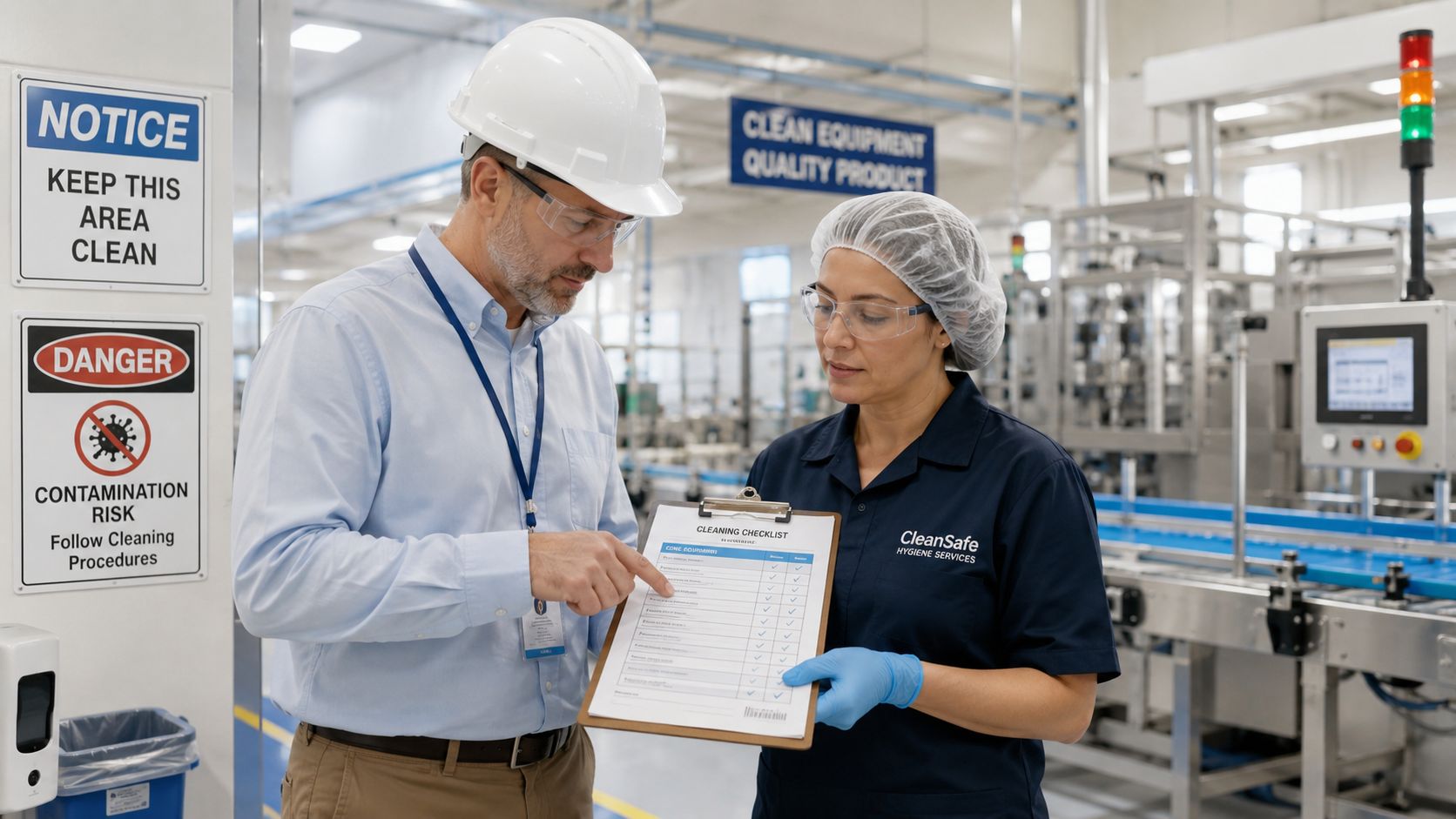
Why Manufacturing Facilities Need a Different Cleaning Approach
A factory isn't an office with larger rooms. Production lines introduce oils, coolants, metal chips, packaging debris, airborne dust, and equipment-access constraints. Warehouses add pallet fragments, battery-charging residues, dock traffic, and forklift contamination. Worker facilities create a separate sanitation obligation that now includes a specific recordkeeping duty in Ontario.
Ontario Regulation 851 requires industrial establishments such as factories and warehouses to keep floors, platforms, aisles, and passageways clean and free of obstructions. It also requires immediate cleanup of spilled materials that create hazards and prevents waste or refuse from accumulating in a hazardous way. Those requirements make housekeeping part of hazard control, not a cosmetic service. Review Ontario Regulation 851 for industrial establishments.
Practical rule: If a cleaning task affects access, traction, contamination control, chemical exposure, or inspection evidence, it belongs in the operating system, not in an informal checklist.
The common office-cleaning mistake
An office-style contract usually focuses on visible surfaces, bins, washrooms, and occasional floor work. That scope can leave grease around machinery, dust above production areas, residue near loading zones, and shared equipment touchpoints without a defined response time.
The better approach starts with an area risk map:
- Production zones: Identify soils, equipment restrictions, product-changeover needs, and spill-response expectations.
- Storage and shipping areas: Mark forklift routes, dock edges, charging areas, emergency access, and floor-coating requirements.
- Worker facilities: Define inspection intervals, touchpoint work, restocking, and washroom records.
- Special environments: Document cleanroom, food-contact, controlled-product, or other process-specific requirements before a contractor quotes.
The facility manager should then demand an area-specific scope, chemical inventory, SDS access, training evidence, inspection records, and a process for missed work. A generic “clean all areas” description isn't enough for an operation where each zone carries a different risk.
Why documentation changes the service decision
Ontario's newer washroom requirement makes documentation especially visible. The province says employers and constructors must keep washrooms clean and sanitary from July 1, 2025, and, effective January 1, 2026, must keep records of the date and time of the two most recent cleanings, with those records posted visibly or made available electronically to workers. See Ontario's washroom-facility requirements.
This guide's central recommendation is straightforward: buy cleaning by risk, define frequencies by area, and require records that a supervisor can inspect during the shift. That standard separates professional commercial cleaning from a low-cost surface-touching contract.
Service Types and What Each One Actually Delivers
Manufacturing cleaning services work best as a layered programme. Daily janitorial work maintains worker-facing areas and routine waste streams. Deep cleaning addresses accumulated soil and difficult access points. Disinfection, floor care, and post-construction cleaning solve different problems and shouldn't be treated as interchangeable line items.
| Service Type | Primary Purpose | Typical Frequency | What Commissioning Signals |
|---|
| Daily janitorial | Maintain washrooms, breakrooms, offices, waste points, and worker interfaces | Daily or shift-based | The facility needs consistent baseline control |
| Deep cleaning | Remove grease, weld residue, heavy soil, and overhead accumulation | Scheduled by buildup and production access | Routine service isn't controlling accumulated contamination |
| Post-construction cleaning | Remove contractor dust, debris, labels, and residues before restart | At project turnover | A renovated or expanded area needs a controlled handover |
| Disinfection | Reduce contamination on high-touch or pathogen-prone surfaces | Triggered by risk, operations, or site protocol | The facility needs a documented sanitation process |
| Floor care | Maintain traction, coating condition, and cleanability | Scheduled around traffic and coating needs | Floor performance affects safety, uptime, and maintenance cost |
Daily janitorial service
This tier covers the work most visible to staff, but it still needs industrial context. Washrooms require cleaning records, breakrooms need food and waste control, and office interfaces need coordination with production shifts. A day porter or shift attendant may also be appropriate where spills, waste, or touchpoints require a rapid response rather than a single end-of-shift visit.
Deep cleaning and high-access work
Deep cleaning should have defined triggers, not vague promises. Grease near equipment, weld splatter, overhead dust, vents, beams, and difficult floor edges need an approved method, access plan, and sign-off. Scheduling should account for lockout requirements, production downtime, ventilation, and the condition of coatings or machinery.
Post-construction cleaning is a separate commissioning task. The contractor should remove construction residues without introducing dust into an operating area, then document the final inspection before production restarts.
Disinfection and floor care
Disinfection only works when the product, surface, application method, and contact time are controlled. Toronto manufacturing guidance directed workplaces to clean high-touch surfaces frequently, including forklift controls, pump trucks, employee time clocks, handrails, and doors, and specified the use of disinfectants with a Drug Identification Number. Review Toronto's manufacturing workplace cleaning guidance.
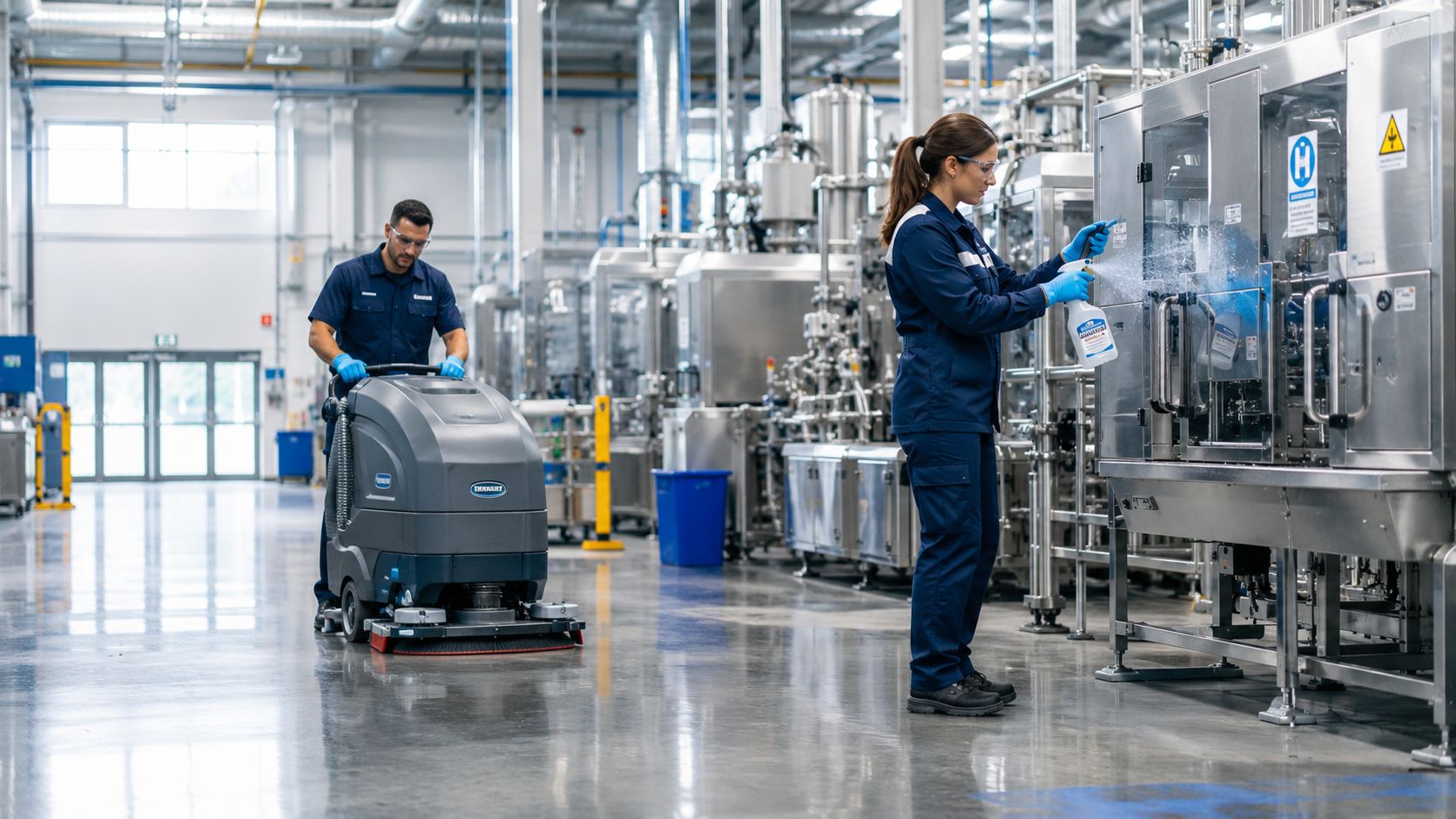
Floor care should reflect traffic patterns. Walk-behind scrubbing may suit confined production zones, while ride-on equipment can make sense for broad warehouse aisles where access and downtime permit. Strip-and-recoat, scrub-and-recoat, or epoxy restoration should be scheduled according to the floor system and operational wear, not bundled automatically into daily janitorial service. A facility manager can review broader commercial cleaning services when building a tiered scope.
The most common contracting error is bundling every task into one frequency. That often pays for routine wiping while leaving periodic floor, overhead, and equipment-area work undefined.
Compliance and Safety Requirements in Ontario Factories
Ontario compliance works when each requirement becomes a scheduled task with an accountable person and a retrievable record. Regulation 851 sets the industrial-establishment housekeeping baseline: floors, platforms, aisles, and passageways must remain clean; hazardous spills require immediate cleanup; and hazardous waste cannot accumulate into a risk. Put those duties into inspection points, response times, and supervisor sign-offs instead of leaving them as general legal language.
Turning housekeeping rules into work orders
Build the schedule around the hazards employees encounter during each shift:
- Spill response: Contain and clean any spill that creates a slip or access hazard immediately. Record the location, material, response, and time the area was released.
- Aisle control: Inspect production and storage routes before the relevant shift begins. Look for obstructions, pallet debris, waste, and residue.
- Waste handling: Remove waste before it becomes a hazard. Use separate procedures for process-specific or contaminated material.
- Emergency access: Keep exits, fire equipment, electrical panels, and safety stations clear. Verify access during area inspections.
- Washroom records: Record the date and time of the two most recent cleanings, then make those records accessible to workers on shift.
The washroom entry needs an owner, not just a blank line on a form. A paper log or digital record can work if supervisors can retrieve it during the shift and confirm that missed cleaning is corrected.
Federal workplace rules add a sanitation benchmark. Personal service rooms and food-preparation areas must remain clean and sanitary. Janitorial work that could create dusty or unsanitary conditions must prevent dust or other harmful substances from contaminating the air. Review the federal sanitation requirements for Canadian workplaces.
WHMIS and product evidence
Chemical control belongs to both the cleaning contractor and the facility. Every hazardous product needs a compliant supplier label and current safety data sheet. Workers need training that matches the products and procedures used onsite. Supervisors should be able to find each SDS, confirm PPE and first-aid requirements, and check that storage and dilution follow the hazard information. Review Canada's WHMIS requirements for hazardous products.
For disinfectants, Health Canada regulates products used on environmental surfaces or inanimate objects under the Food and Drugs Act, and products must receive a drug identification number before sale in Canada. Review the requirements for commercial disinfection and sanitizing before approving a program.
Product-contact cleaning demands stronger evidence: validated processes, completed cleaning records, status labels, and controls that prevent stagnant water from remaining in equipment after cleaning. Read Health Canada's cleaning-validation guidance.
A contractor that cannot provide these records before work starts is not ready for a regulated manufacturing environment.
Cleaning Chemistry and Equipment Choices That Hold Up
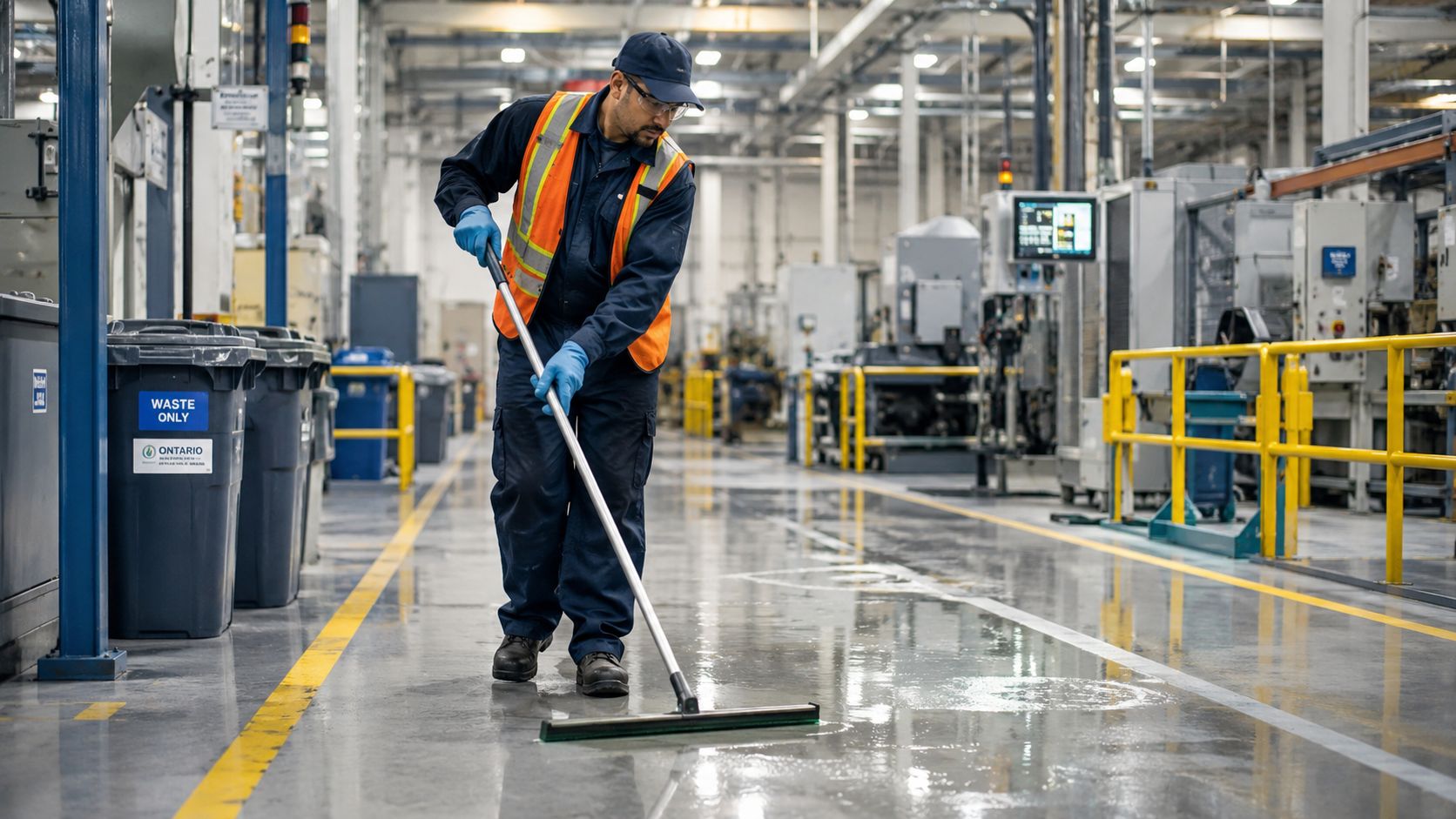
Cleaning chemistry should be selected by soil and surface, not by whichever product a contractor already has in a van. Oil-heavy deposits may require a suitable aqueous or solvent-based degreaser, but the choice must account for substrate compatibility, ventilation, worker exposure, rinsing, and waste handling. A product that cuts grease aggressively may damage an epoxy coating, soften a seal, or create an exposure problem if the process isn't controlled.
Concrete and epoxy floors usually need different decisions. A neutral cleaner may suit routine maintenance, while an alkaline cleaner may be more effective against heavier organic or oily soils. Neither should be approved without checking the floor manufacturer's compatibility requirements and the product's SDS.
| Solution Type | Best Use Case | WHMIS / Compliance Load | Key Selection Note |
|---|
| Aqueous degreaser | Routine oil and soil removal where rinsing is practical | SDS, label, dilution, PPE, storage, training | Match alkalinity and dwell time to the substrate |
| Solvent-based degreaser | Persistent deposits where water-based chemistry is unsuitable | Higher attention to vapour, ignition, ventilation, and exposure controls | Use only with a documented risk assessment |
| Neutral floor cleaner | Routine care for compatible coated or hard floors | SDS and dilution control | Favoured where frequent cleaning could affect coatings |
| Alkaline floor cleaner | Heavy organic and oily soil | SDS, PPE, dilution, rinse and runoff controls | Test compatibility before broad use |
| DIN-registered disinfectant | Environmental-surface disinfection where required | DIN verification, SDS, label directions, dwell-time records | Follow the label exactly and document application |
| Walk-behind or ride-on scrubber | Large hard-floor areas | Operator training, battery or charging controls, inspection | Select by area size, aisle access, and downtime |
| HEPA vacuum | Dust control on equipment, overheads, and sensitive zones | Filter maintenance, dust classification, operator controls | Never use compressed air as a substitute for capture |
| Steam or foam system | Selected equipment or process-cleaning applications | Heat, pressure, runoff, chemical, and access controls | Specify only where the substrate and process permit it |
Equipment should reduce risk, not merely labour
A scrubber should leave the floor clean and as dry as the process allows, with route planning that doesn't place wet work across active forklift traffic. HEPA filtration matters where dust capture is critical, but the filtration specification must match the dust and environment. Steam and foam systems can be useful in selected applications, yet they introduce heat, pressure, moisture, and recovery requirements that need written procedures.
Concentrated dilution systems may reduce waste and inconsistent mixing, but they don't remove WHMIS obligations. Every product still needs a current SDS, a label, storage controls, worker instruction, and a clear response plan for exposure or spills. Health Canada's guidance also reinforces that cleaning chemistry, contact time, rinsing, drying, and records form one controlled process, particularly where product-contact equipment is involved. Review the Health Canada guidance on cleaning-process controls.
For a broader supply and specialty-service scope, a facility manager can review cleaning supplies and specialty cleaning services. The selection rule remains simple: chemistry follows soil and surface, equipment follows area and downtime, and documentation follows every product.
Area-Specific Protocols for Production, Storage and Cleanrooms
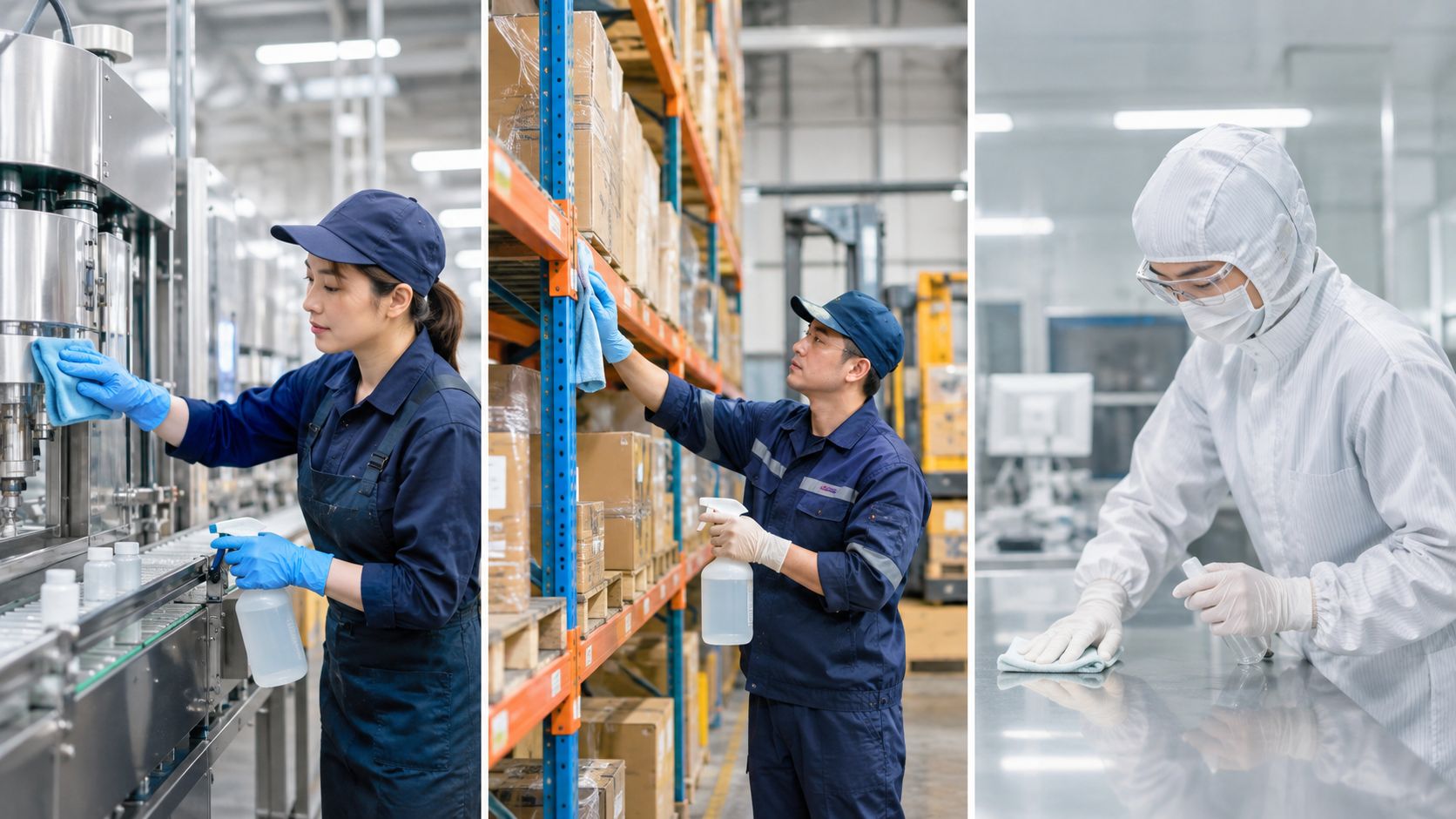
One master cleaning plan can serve a complex facility if it uses a common template with different tasks, frequencies, hazards, and acceptance criteria by zone. Rebuilding the entire programme for every area creates paperwork without control. The better method keeps the record structure consistent while changing the work instruction.
Production areas
Production-line cleaning should distinguish between routine housekeeping, changeover work, and spill response. Operators or cleaners may need to remove chips, manage coolant residue, wipe equipment surrounds, and clean tool-shadow areas without transferring soil to the next product run. The record should identify the line, work window, method, chemical, responsible person, and release status.
The schedule should also specify what cleaners may touch. A contractor shouldn't improvise around exposed components, controls, guards, or product-contact surfaces. Health Canada's validation expectations make this especially important where equipment contacts products or where multiple products create carryover risk.
Warehouses and shipping docks
Warehouse plans should prioritise aisle access, pallet debris, dock edges, battery-charging points, fueling areas, and spill-kit availability. Floor work belongs outside active forklift windows whenever possible, with a clear handback check confirming that routes are dry, unobstructed, and ready for traffic.
For facilities considering controlled production or storage spaces, an overview of an in plant modular cleanroom can help clarify how enclosure design, access, and cleaning requirements interact. The cleaning plan still needs to be written for the actual room, surfaces, process, and acceptance criteria.
Cleanrooms and worker facilities
Cleanrooms need a controlled sequence, approved materials, lint management, gowning compliance, and equipment appropriate to the room classification. The plan should specify top-down work, HEPA capture where required, sticky-mat control, waste removal, and release checks. Particle or environmental acceptance criteria belong in the site's quality system rather than in a generic janitorial scope.
Worker facilities need a separate inspection stream. Washrooms and related personal-service spaces require clean and sanitary conditions, touchpoint attention, replenishment, and records that remain available on shift. The warehouse cleaning service framework can support a broader commercial scope, but it shouldn't replace site-specific production or washroom instructions.
A scalable record should show zone, task, frequency, product, method, worker, supervisor review, exception, and corrective action. That format lets a plant change a frequency without losing control of the programme.
Choosing a Cleaning Vendor Without the Sales Pitch
Price should be reviewed only after competence has been established. A vendor that cannot manage chemicals, training, access controls, and records may create more work for the plant than it removes.
Start with non-negotiables
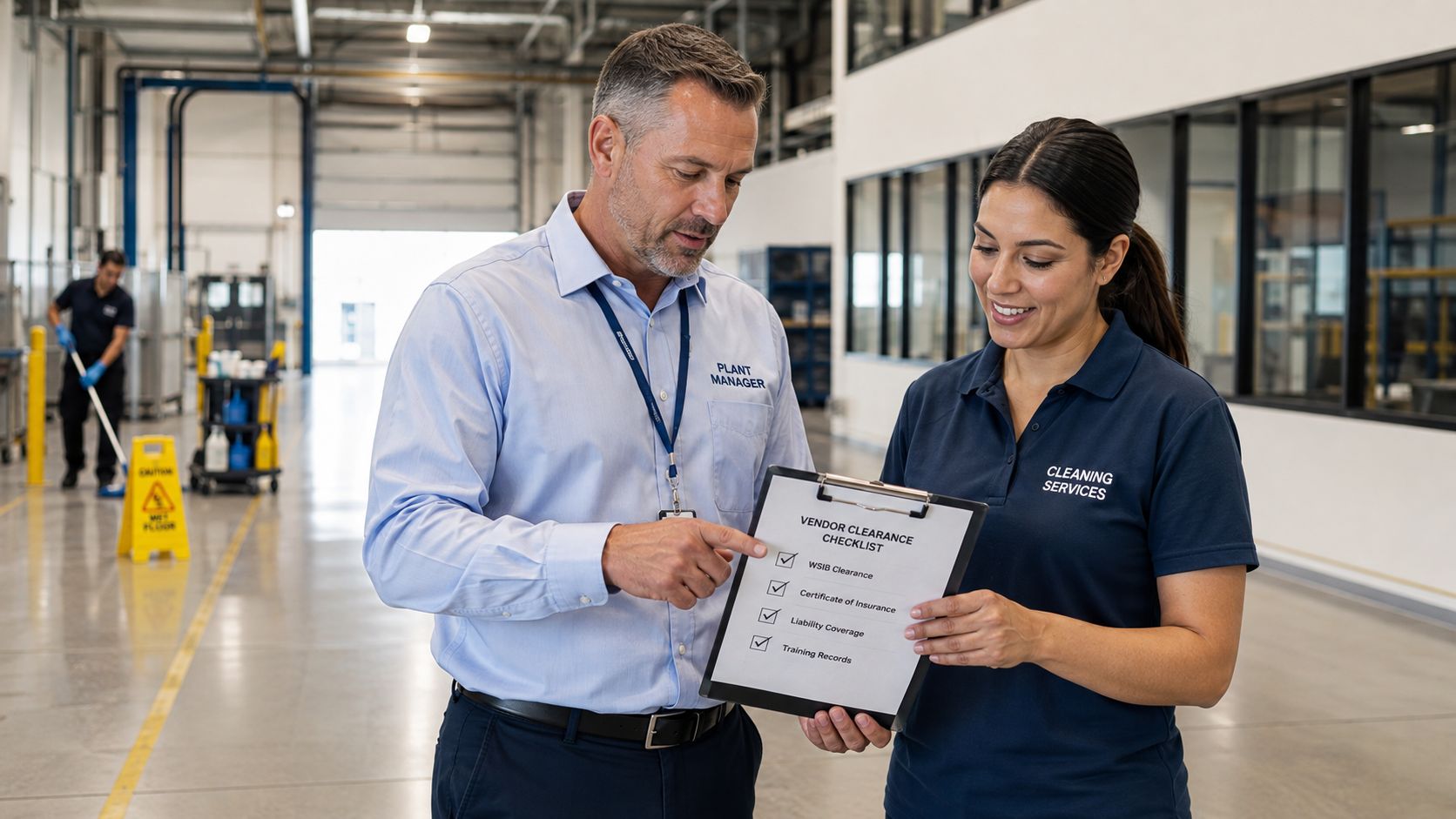
The prequalification file should include:
- WSIB clearance: Confirm that the contractor's workers are covered appropriately for the engagement.
- Commercial general liability: Check that coverage is suitable for the facility's operations and hazards.
- WHMIS training: Request training evidence for the personnel assigned to the site.
- SDS access: Require a current inventory and accessible SDS for every chemical used on the premises.
- Equipment list: Confirm industrial scrubbers, dust-control equipment, access tools, and maintenance responsibility.
- Supervision plan: Identify who supervises overnight or multi-shift work and who responds to incidents.
- Workmanship SLA: Define missed tasks, quality failures, response times, inspection rights, and corrective action.
A serious bidder will walk the site before quoting. That walkthrough should cover production restrictions, floor types, waste streams, chemical storage, emergency routes, cleanroom controls, washroom access, and the records the plant needs.
Questions that expose weak scopes
Ask who calibrates chemical dilution, how contact time is verified, what happens after a missed visit, and how the contractor handles a spill during production. Ask for an area-specific SOP rather than accepting a generic checklist. The vendor should also explain how substitute staff receive site orientation and how the supervisor confirms completed work.
| Evaluation Area | Evidence to Request | Warning Sign |
|---|
| Compliance | Insurance, WSIB evidence, SDS inventory, training records | Verbal assurances without documents |
| Staffing | Supervisor coverage, backup plan, site orientation | One named contact with no coverage plan |
| Equipment | Inventory, maintenance records, suitability by zone | Consumer tools proposed for industrial floors |
| Quality | Inspection form, SLA, corrective-action process | No measurable acceptance standard |
| Chemistry | Product list, DIN evidence where applicable, dilution process | Unlabelled bottles or unavailable SDS |
| Commercial terms | Clear frequencies, exclusions, extras, response terms | One low lump sum with no scope detail |
For neutral answers to common service questions, a facility manager can also consult the commercial cleaning FAQ. The final decision should compare two or three bidders against the same evidence-based scorecard, not against brochure language.
Costs, Schedules and the ROI of a Real Cleaning Program
A plant can have clean-looking aisles and still carry avoidable cost. Grease near equipment, dust above production lines, missed washroom records, and inconsistent shift handoffs create different risks from those in an open warehouse. Build the budget around work conditions, access, documentation, and response requirements, not floor area alone.
Ontario's contract-cleaning market is large, but market size does not set an individual facility's price. The quote depends on the site assessment and the controls the work requires.
| Cost Driver | Typical Impact on Monthly Cost | ROI Lever |
|---|
| Square footage and layout | More labour, travel within the site, and equipment time | Consistent coverage and fewer neglected zones |
| Hazard classification and soil load | More PPE, training, controls, and specialised methods | Fewer uncontrolled spills and safer access |
| Shift coverage | More handoffs, supervision, and response availability | Better continuity across production windows |
| Cleanroom or food-grade requirements | Controlled materials, records, validation, and release checks | Lower contamination and changeover risk |
| Specialised equipment | Equipment purchase, maintenance, operator training, and mobilisation | Faster floor work and better dust capture |
| Documentation | Inspections, SDS management, washroom logs, and corrective actions | Audit readiness and visible accountability |
| Periodic deep work | High-dusting, overhead access, floor restoration, and shutdown work | Longer asset life and fewer emergency cleans |
Request pricing by service unit, such as per visit, per shift, per square foot, or scheduled project. Require the provider to identify the cost effect of restricted access, floor condition, chemical handling, equipment needs, supervision, and recordkeeping. A precise figure without a walkthrough is false precision. Compare the scope behind each figure, not just the total.
Schedule design should match production. Assign routine tasks to defined shift windows, reserve response capacity for spills and process interruptions, and set periodic work during planned shutdowns. The supervisor should verify completed tasks, review exceptions, and confirm that washroom cleaning records capture the two most recent cleanings required for operations in 2026.
Measure ROI through operating evidence. Track missed-task closure, spill response time, floor-condition findings, washroom-record completion, repeat defects, applicable contamination or residue findings, and corrective actions by zone. These measures show whether contracted controls are being performed and whether defects decline. They do not prove that cleaning alone caused every safety or quality result.
A real program pays back through control first. Fewer repeat defects, better floor condition, complete records, and less preventable disruption make the financial result visible. Review the scope and records regularly, then adjust frequencies when the evidence shows that a zone is over- or under-serviced.
Sample Cleaning Plan, Checklist and Next Steps
A practical rollout can begin with a 90-day implementation cycle:
First phase
- Weeks 1–2: Complete the facility walkthrough, map hazard zones, confirm production windows, collect the chemical inventory, and verify SDS access.
- Weeks 3–4: Finalise area-specific SOPs, approve equipment, confirm worker training, and run a supervised trial clean.
- Weeks 5–8: Establish baseline inspections, record washroom cleaning times, review spill responses, and correct scope gaps.
- Weeks 9–12: Conduct the first internal compliance audit, review KPI trends, and approve changes to frequencies or methods.
Zone checklist
| Zone | Daily or Shift Checks | Periodic Checks | Record Produced |
|---|
| Production | Spills, chips, equipment surrounds, access routes | Deep equipment-area and overhead work | Line or zone sign-off |
| Warehouse | Aisles, docks, pallet debris, charging areas | Floor care and high-access dust control | Route inspection and exception log |
| Washrooms | Cleaning, replenishment, touchpoints | Supervisor review and corrective action | Date and time of two most recent cleanings |
| Cleanroom | Approved sequence, gowning controls, waste, surfaces | Environmental or quality-system review | Room release and cleaning record |
Five decisions should be made before the next inspection:
- Confirm the facility's hazard and process requirements.
- Lock the chemical, SDS, training, and cleaning-record trail.
- Pressure-test vendor references and supervision coverage.
- Set two measurable KPIs, such as record completion and repeat-defect closure.
- Schedule the first internal audit before a Ministry of Labour inspection.
Arelli Cleaning offers commercial cleaning, industrial and manufacturing janitorial support, floor care, high dusting, disinfection, and post-construction cleaning that can be scoped around production areas, warehouses, and worker facilities. Plant managers can review the service approach and request an informed discussion through Arelli Cleaning.






.webp)