A Toronto office breakroom can look orderly while still creating avoidable hygiene concerns. Coffee brews, lunches are reheated, dishes move between hands, and employees gather around the same refrigerator, faucet, microwave, and tables. A 2022 Ipsos survey found that 47% of Canadian workers were concerned about hygiene in shared office spaces, with breakrooms and washrooms identified as major concern areas. (Canadian workplace hygiene findings)
That concern changes the meaning of office kitchen and breakroom cleaning. The task isn't merely to remove crumbs or make counters look presentable. It supports health protection, regulatory readiness, employee confidence, and the professional image of the workplace. A neglected sink, full waste bin, or warm refrigerator can disrupt the workday long before anyone files a formal complaint.
Table of Contents
Introduction to Office Kitchen and Breakroom Cleaning
A busy shared kitchen has a predictable rhythm. One employee opens the refrigerator, another presses the microwave controls, someone fills a mug at the sink, and a colleague clears a lunch container onto the counter. Each action seems minor, but the same touchpoints receive repeated contact throughout the day.
The visible mess is only part of the problem. Food residue can remain around appliance handles, moisture can collect near sinks, and waste containers can create odours or attract pests when they aren't emptied appropriately. Employees may also avoid a breakroom that feels dirty, which changes how they use shared amenities and how they judge the organisation's attention to basic care.
The strongest cleaning programs treat the breakroom as an operational environment rather than a decorative room. They assign responsibilities, match cleaning frequency to usage, separate cleaning from sanitizing, and record completed work. That approach gives managers something more useful than a room that appears clean at inspection time. It creates a repeatable standard that staff and service providers can follow.
Practical rule: A shared food space should be cleaned according to how people use it, not according to how clean it looks from the doorway.
The Ontario context makes this especially relevant. Recent workplace sanitation expectations place greater emphasis on the condition of shared worker facilities, appropriate frequency, and documented cleaning. For Toronto businesses, a well-run breakroom program therefore protects both the employee experience and the evidence of responsible facility management.
Defining Office Kitchen and Breakroom Cleaning
Office kitchen and breakroom cleaning is the planned removal of food residue, soil, waste, odours, and contamination from shared eating and food-storage areas. It includes counters, tables, sinks, faucets, appliance exteriors and interiors, refrigerator surfaces, dish areas, floors, waste containers, and related touchpoints.
Three terms are often confused:
- Cleaning removes visible soil, grease, food particles, and other residue, usually with water and detergent.
- Sanitizing reduces microorganisms on a cleaned food-contact surface to an acceptable level through an approved method.
- Disinfection targets microorganisms on appropriate non-food-contact surfaces, such as a microwave handle or refrigerator door handle, using a product and procedure designed for that purpose.
A surface can be clean without being sanitized, and a sanitizer won't work reliably through grease or food residue. The sequence matters. Staff or cleaners should remove soil first, then apply the appropriate sanitizing or disinfecting process.
Commercial cleaning and janitorial work
In an office setting, commercial cleaning generally describes planned professional maintenance of business premises, including common areas and shared kitchens. Janitorial service often refers to the ongoing operational work that keeps a facility usable, such as waste removal, washroom care, restocking, spot cleaning, and routine touchpoint maintenance. The terms overlap, so the written scope matters more than the label.
Ontario's documented-cleaning expectations provide an important compliance signal. As of January 1, 2026, Ontario employers must keep records showing the date and time of the two most recent cleanings of shared worker spaces and consider usage frequency when defining schedules. The requirement appears in guidance concerning worker washrooms, but its practical lesson extends to breakroom management. (Ontario workplace sanitation regulation)
A useful record identifies the area cleaned, the date and time, the person or team responsible, and any issue requiring follow-up. It should support accountability without becoming complicated enough that people stop completing it.
Health and Infection Control Risks
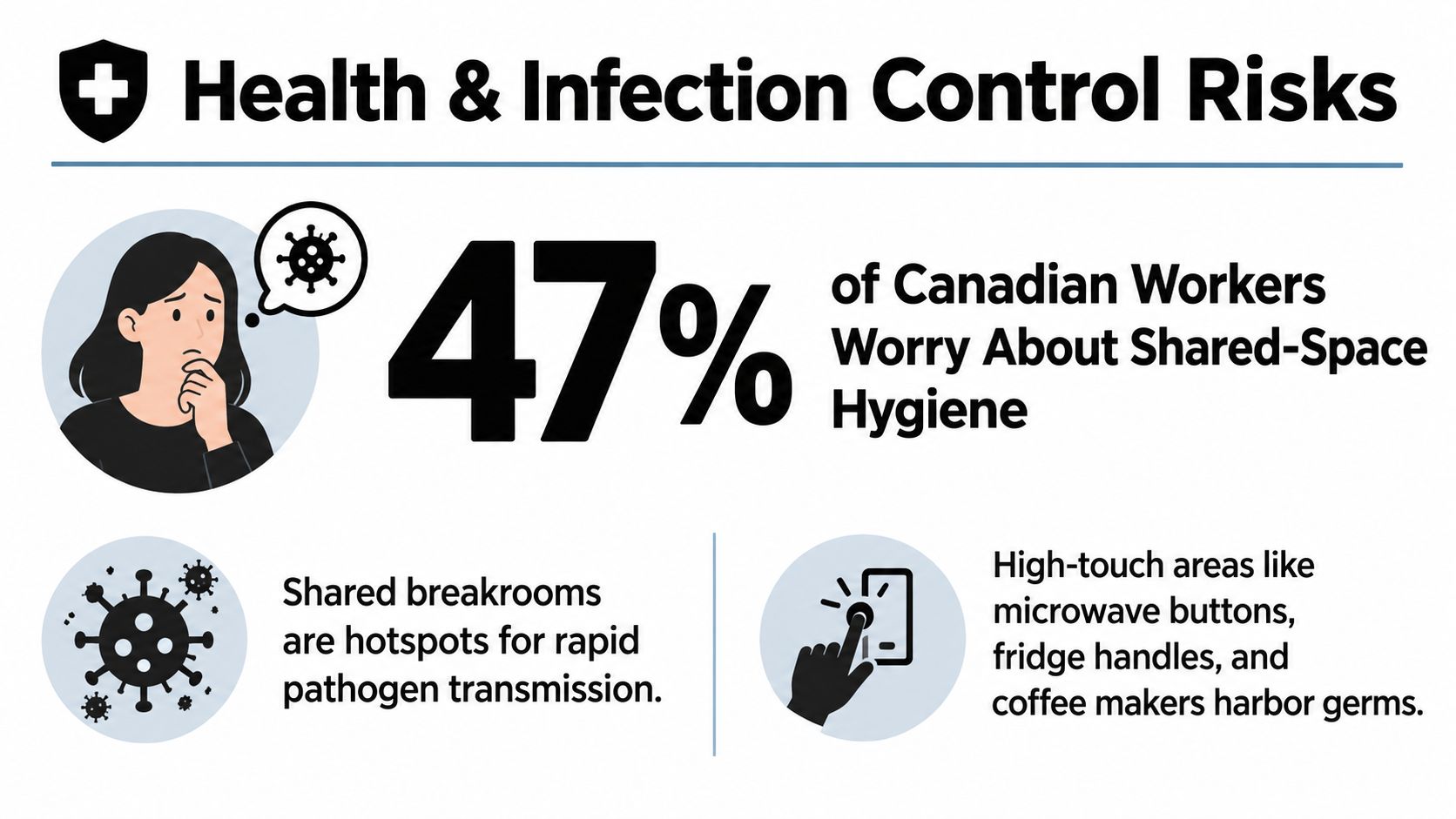
The concern around shared kitchens is understandable because the same surfaces connect many users. Microwave buttons, refrigerator handles, faucet levers, coffee-machine controls, cabinet pulls, and tables are repeatedly touched before employees eat. If cleaning concentrates only on floors and visible counters, these high-touch points can receive insufficient attention.
A 2022 Ipsos survey found that 47% of Canadian workers were concerned about hygiene in shared office spaces. The same referenced workplace-hygiene research indicates that a virus on one doorknob or tabletop could reach 40% to 60% of people and surfaces within two to four hours. (Canadian worker hygiene concerns and surface spread)
Why the touchpoint map matters
A facilities team doesn't need to treat every surface identically. A rarely used storage shelf and a communal microwave handle have different exposure patterns. The cleaning plan should identify where hands, food, moisture, and waste intersect, then give those locations appropriate attention.
That normally includes:
- Touchpoints, such as handles, buttons, taps, switches, and shared dispensers.
- Food-contact surfaces, including counters and preparation areas.
- Moisture zones, particularly sinks, drain surrounds, and dish racks.
- Waste points, including bin lids, rims, liners, and the surrounding floor.
Food debris can also attract insects. A practical resource on effective kitchen ant solutions can help explain why prompt spill control, covered waste, and dry surfaces matter alongside routine cleaning.
The cleaning service scope should state which surfaces receive detergent cleaning, which receive sanitizing, and which receive disinfection. For businesses seeking a dedicated program, commercial disinfection and sanitizing services can be evaluated against those written requirements.
Morale Productivity Brand and Compliance Benefits
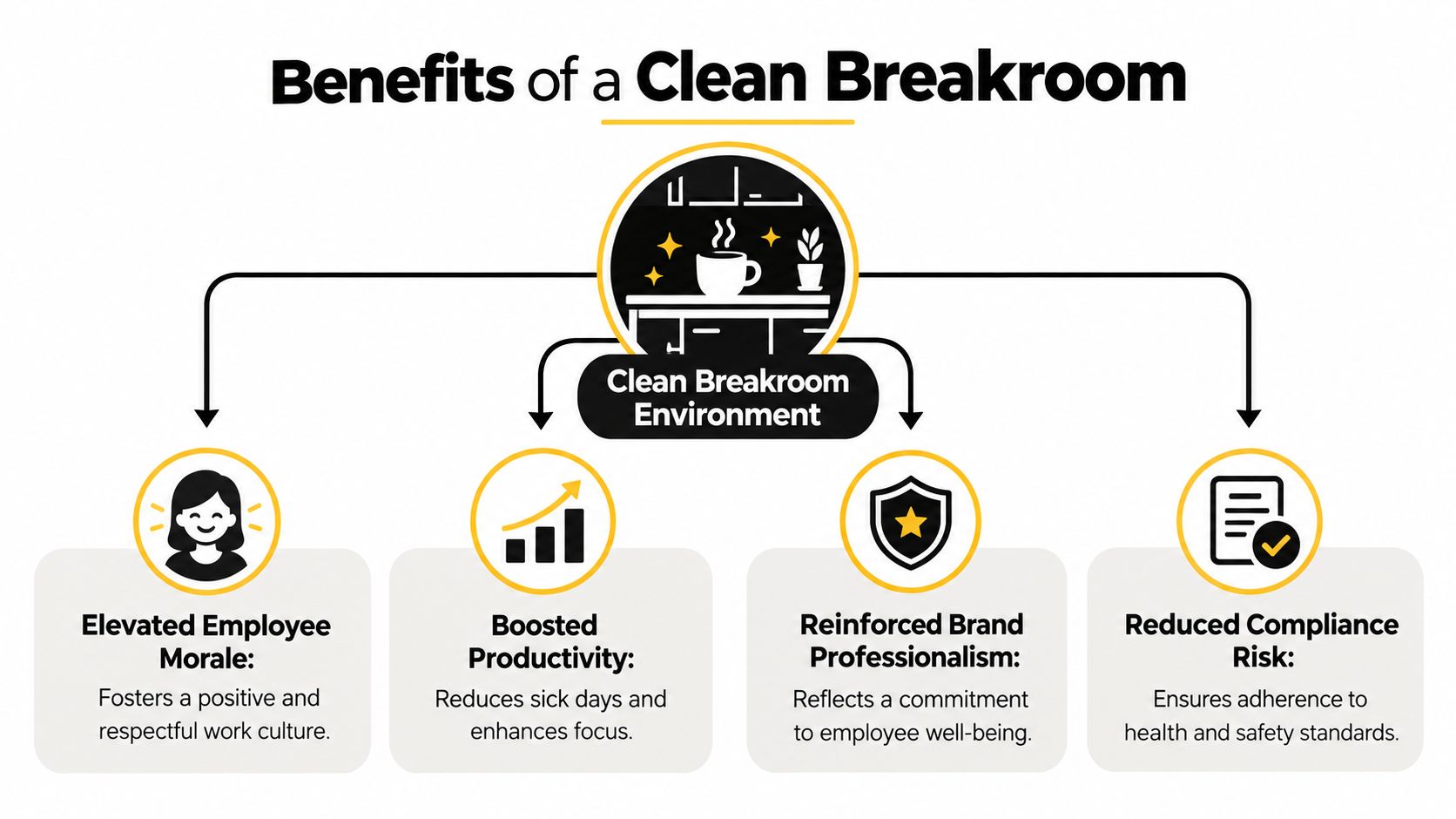
Employees notice whether a shared kitchen feels cared for. A clean table, stocked handwashing station, odour-free waste area, and orderly refrigerator communicate that the organisation respects the people using the space. That impression can influence comfort and trust even when employees never discuss it directly.
The benefit isn't limited to morale. A well-maintained breakroom reduces the friction caused by sticky counters, missing supplies, overflowing bins, and unusable appliances. Employees can take breaks in a space that functions as intended, while visitors and prospective hires see a workplace that manages shared resources responsibly.
The compliance connection
Canadian workplace rules require food-preparation and personal-service areas to be maintained in a clean and sanitary condition. Federal guidance also addresses food-waste containers, requiring removal often enough to prevent unsanitary conditions and cleaning and disinfection in an area separate from food preparation. (Canadian workplace sanitation requirements)
Toronto food-safety guidance reinforces the need for suitable handwashing facilities. A hand-wash basin should have hot and cold running water, soap in a dispenser, and paper towels or an approved roller towel. It should be reserved for handwashing, not food preparation or dishwashing. (Toronto handwashing requirements)
These details matter because a breakroom can appear spotless while the process remains weak. A sink used to wash dishes may lack soap or towels. Waste may sit beside food preparation. A cleaning log may omit the time and person responsible. Compliance depends on how the room operates, not just how it photographs.
A responsible program also protects brand image. Clients may never inspect a supply closet, but they can notice a dirty coffee station, stained table, or unpleasant odour during a meeting. Small signals shape perceptions of organisation, care, and reliability.
Practical Cleaning Schedules and Checklists
A breakroom schedule should reflect traffic, food preparation, waste volume, and moisture, rather than a fixed routine copied from another office. High-touch surfaces need more frequent attention than low-risk areas, and they should be cleaned and disinfected when visibly dirty or between users where appropriate, as recommended by the Canadian Centre for Occupational Health and Safety.
Daily controls
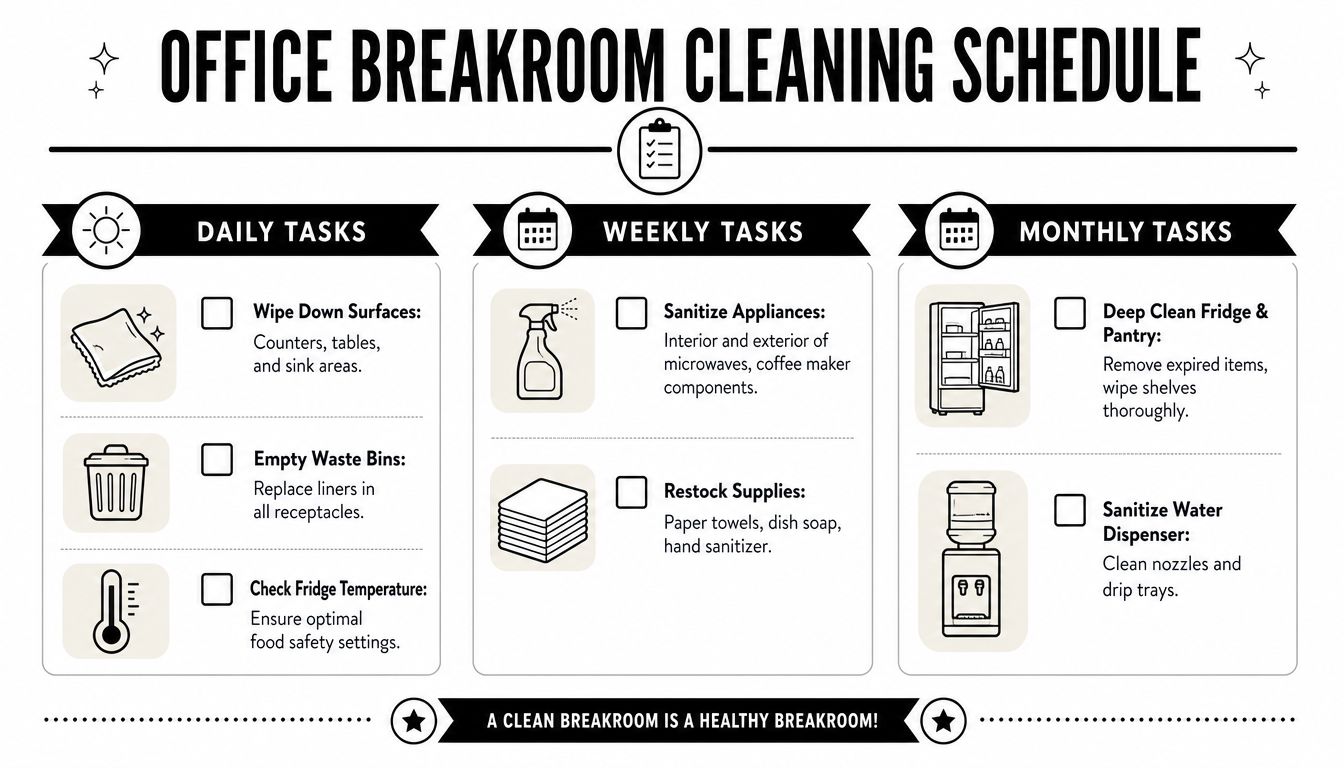
Daily work should restore the room to a safe, usable baseline:
- Wipe touchpoints: Clean microwave buttons, refrigerator handles, faucet handles, appliance controls, tables, and counters.
- Remove waste: Empty covered food-waste containers often enough to prevent unsanitary conditions, replace liners, and clean surrounding spills.
- Clean food-contact areas: Remove residue with detergent before applying the appropriate sanitizer.
- Check the refrigerator: Ontario guidance says refrigerated food should be kept at 4°C or lower, with temperatures monitored several times a day. (Toronto food-handler training guidance)
- Restock handwashing supplies: Confirm that soap, running water, and paper towels remain available.
Weekly attention
Weekly work can address buildup that daily wiping misses. Clean microwave interiors, coffee-maker components, sink basins, drain surrounds, cabinet fronts, dish racks, and the floor edges beneath appliances. Inspect for leaks, damaged seals, odours, and residue around refrigerator shelves.
The refrigerator should also be checked for spoiled or abandoned food according to the workplace's stated policy. The policy should protect privacy and avoid arbitrary disposal by explaining labelling, ownership, and removal expectations.
Monthly review
Monthly checks should focus on the system rather than one cleaning visit:
- Review logs: Look for missed tasks, incomplete entries, or repeated complaints.
- Inspect supplies: Confirm that detergents, sanitizers, gloves, liners, towels, and signage are available.
- Update the risk map: Add new appliances, seating, vending points, or workflow changes.
- Check equipment condition: Escalate damaged counters, cracked bins, failing refrigerator seals, or unsafe dish-storage areas.
- Refresh instructions: Keep food-storage, handwashing, and waste rules visible and easy to follow.
Accountability check: A completed checklist should show what happened, when it happened, and what still needs corrective action.
Routine Cleaning and Disinfection Practices
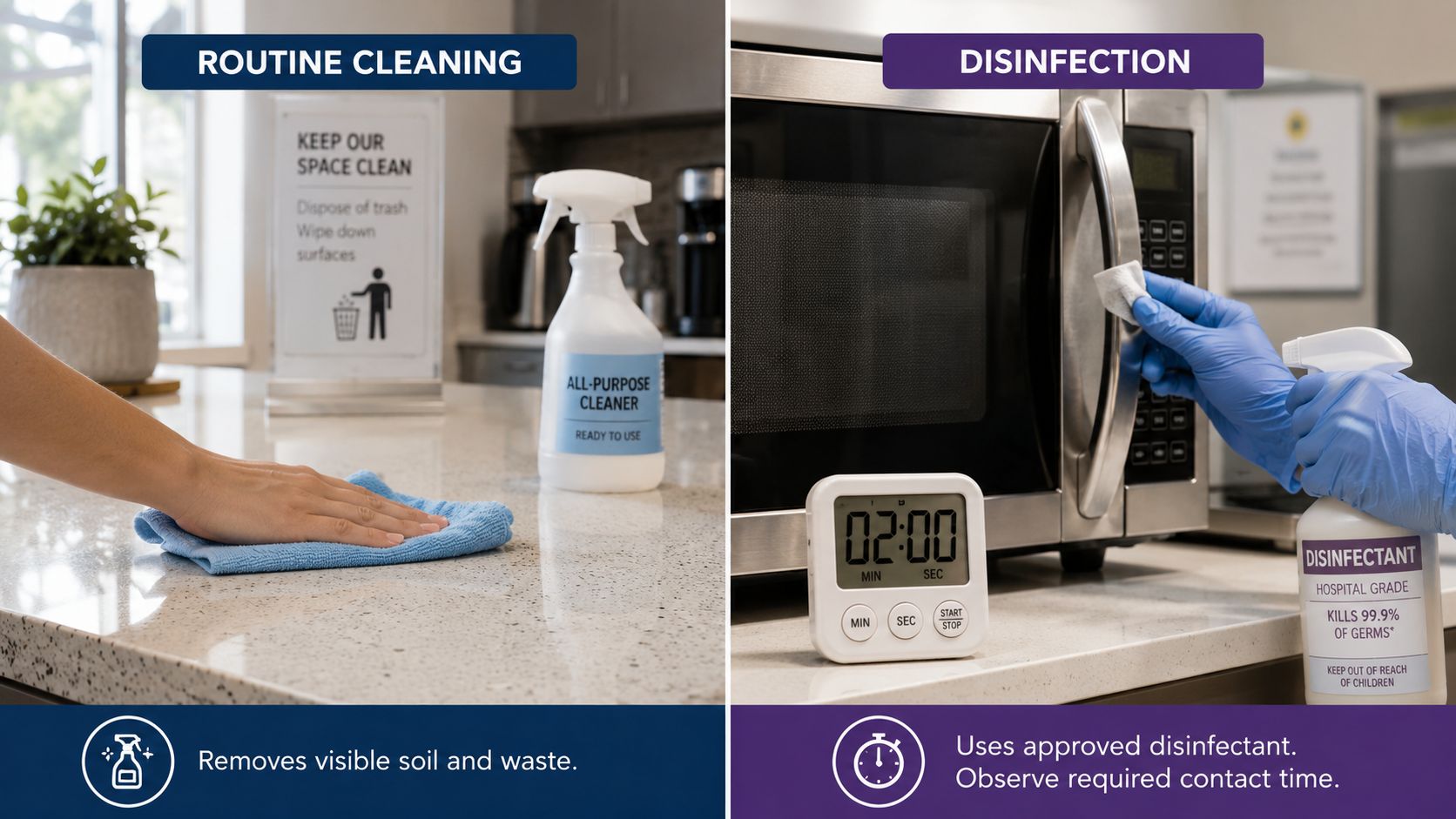
Routine cleaning and disinfection solve different problems. Detergent cleaning removes soil that people can see or feel. Disinfection addresses selected non-food-contact surfaces after cleaning, while sanitizing applies to food-contact equipment under the appropriate validated conditions.
A practical comparison
| Task | Primary purpose | Typical examples | Main control |
|---|
| Routine cleaning | Remove soil, grease, food, and residue | Counters, tables, floors, appliance interiors | Detergent, water, mechanical action |
| Food-contact sanitizing | Reduce microorganisms on cleaned food-contact surfaces | Food-preparation counters and equipment | Approved heat or chemical method |
| High-touch disinfection | Treat suitable non-food-contact touchpoints | Handles, buttons, switches, and taps | Correct product, coverage, and contact time |
| Waste-area sanitation | Prevent odour, pests, and unsanitary buildup | Bins, lids, rims, and nearby floors | Frequent removal, cleaning, and disinfection |
Toronto guidance identifies a hot-water method of 77°C for at least 45 seconds for sanitizing food-contact equipment. It also identifies chemical options, including chlorine at 100 to 200 mg/L, quaternary ammonium up to 200 mg/L, or iodine up to 25 mg/L, followed by air drying when possible. (Toronto cleaning and sanitation guidance)
Avoiding common process failures
Grease and biofilm can interfere with sanitizer performance, so spraying a product onto a dirty counter isn't a substitute for pre-cleaning. The worker should follow the product label, use the correct concentration, allow the required contact time, and avoid wiping the surface dry too soon when air drying is appropriate.
Tools also need control. Cloths used around waste shouldn't move directly to food-contact areas. Clean dishes, glasses, and cutlery should be washed between users or replaced with disposable items, consistent with shared-area cleaning guidance. That source URL has been used earlier for its high-touch recommendation, so the operational principle should be applied without duplicating the link.
Clean, dry storage reduces recontamination. Dish racks should allow drainage, counters shouldn't remain wet after cleaning, and spray bottles should be labelled and stored away from food.
Addressing Common Objections
“The room looks clean”
Appearance is useful, but it isn't proof of sanitation. A counter can be free of crumbs while a faucet handle, refrigerator grip, or microwave button remains heavily touched. Food-waste containers can also create odour and contamination concerns even when the tabletop looks polished.
The stronger response is process-based. A manager can ask which surfaces were cleaned, which were sanitized, which product was used, and when the work was completed. If no one can answer, the office has a visibility problem as well as a cleaning problem.
“Employees can wipe things after use”
Shared responsibility helps, but it doesn't replace a defined service schedule. Employees may not know whether a product is suitable for food-contact surfaces, may wipe without pre-cleaning, or may leave a wet cloth beside food. A written program assigns the deeper and repeatable work to a named person or service provider while keeping personal clean-up expectations simple.
“Daily wipes should be enough”
Daily attention may be suitable for some low-use surfaces, but it shouldn't automatically define the entire schedule. Ontario guidance emphasises actual facility condition and cleaning frequency relative to use, while the Ontario workplace regulation supports a documented approach to recent cleanings and usage patterns.
A busy breakroom may need touchpoint checks during operating hours, while a lightly used kitchenette may need a different pattern. The decision should consider traffic, food handling, waste, moisture, visible soil, complaints, and previous missed tasks.
“Cleaning is only a cost”
Cleaning requires budget, but neglect creates operational costs that are harder to control. Complaints consume management time, employees lose confidence in shared facilities, waste and odours affect the workplace experience, and missing records can complicate compliance responses. A documented schedule turns cleaning from an informal expense into a managed facility control.
Further Reading and Choosing a Commercial Cleaning Service
The most useful resources combine regulation with practical workflow. Ontario's workplace sanitation regulation clarifies why documented cleaning and usage-based frequency matter. Toronto's food-safety materials explain food-contact sanitation, handwashing facilities, and refrigerator control. Federal workplace requirements address clean food-preparation areas and waste handling. CCOHS guidance adds a practical emphasis on high-touch surfaces, shared objects, and written cleaning programs.
Internal resources can help a facilities manager connect the breakroom plan to broader operations:
- Arelli Cleaning service areas for location coverage in the Greater Toronto Area.
- Office cleaning services for a service scope that can include shared kitchen and breakroom areas.
- An internal guide to commercial disinfection and sanitizing can support product and process discussions where the facility has higher touchpoint exposure.
- A broader office-cleaning resource can help align breakroom tasks with washroom, floor, waste, and common-area routines.
What to ask a provider
A useful provider conversation should focus on evidence rather than broad promises:
- Scope: Which counters, appliances, handles, sinks, waste areas, floors, and storage zones are included?
- Frequency: How will the schedule change when usage, occupancy, food preparation, or waste volume changes?
- Methods: How are cleaning, sanitizing, and disinfection separated?
- Documentation: Does the provider record dates, times, completed tasks, exceptions, and corrective actions?
- Training: Are workers trained in chemical handling, food-contact safety, cross-contamination prevention, and workplace requirements?
- Quality review: How are missed tasks, complaints, inspections, and service changes documented?
- Pricing: What drives the range, including area size, frequency, shift timing, appliance detail, waste volume, supply responsibilities, and periodic deep cleaning?
What to avoid
Avoid generic proposals that say “kitchen cleaning” without listing surfaces or methods. Avoid unverified claims about eliminating every risk, and avoid a low quote that excludes waste handling, appliance interiors, documentation, or corrective visits. Comparing two or three written quotes against the same checklist produces a fairer decision than comparing headline prices alone.
Arelli Cleaning is one option for Toronto-area businesses seeking office and commercial cleaning, with breakroom care, documented quality processes, flexible service arrangements, and support for disinfection using Health Canada-approved products described in its service information.
Arelli Cleaning offers office and commercial cleaning that can include kitchen and breakroom surfaces, waste areas, high-touch points, and scheduled disinfection support. Businesses can use the checklist above, request a written scope, and visit Arelli Cleaning to discuss a facility-specific cleaning plan.






.webp)