Most Toronto offices need 3 to 5 professional cleanings per week as the practical baseline. High-traffic and client-facing spaces should move to daily service, while small, low-traffic offices can sometimes manage on 1 to 2 visits per week.
That answer is simple, but the schedule behind it is not. In Toronto, the right cadence depends on occupancy, washroom use, hybrid attendance, building standards, and how much client traffic the space sees. A Monday-to-Friday downtown floor is not the same job as a small back-office suite, and a washroom with steady traffic needs a different rhythm than a private office or boardroom.
Table of Contents
Why Washrooms and Lunchrooms Need Their Own Cadence
The Short Answer for Toronto Offices
For most Toronto offices, 3 to 5 professional cleanings per week is the sensible baseline, not an aggressive upsell. That range matches the reality of a working office where people are coming and going, touching shared surfaces, eating lunch on site, and expecting the space to look presentable all week.
A daily schedule makes sense when the office is client-facing, heavily occupied, or tied to a public-traffic environment. A lighter schedule can work for smaller offices with stable teams and limited visitor flow, especially when occupancy is uneven or hybrid. Toronto guidance also notes that many offices still follow an after-hours pattern, typically between 6 PM and 6 AM, and that hybrid offices often reduce nightly service to about 3 full-scope visits per week with lighter touch-ups on off-peak days, because frequency tracks with use rather than with habit alone.
Practical rule: if staff, visitors, and shared spaces stay active, the schedule should move up. If the office sits half-empty most days, the schedule can come down, but washrooms and lunchrooms usually stay on a tighter cadence than desks.
Toronto's downtown towers, winter salt, slush, and tenant expectations in Class A buildings push many offices toward more frequent service than a national average would suggest. The right setup is usually layered, with routine daily tasks, weekly deeper cleaning, and periodic detail work rather than one big visit that tries to do everything.
What Changes Your Cleaning Frequency
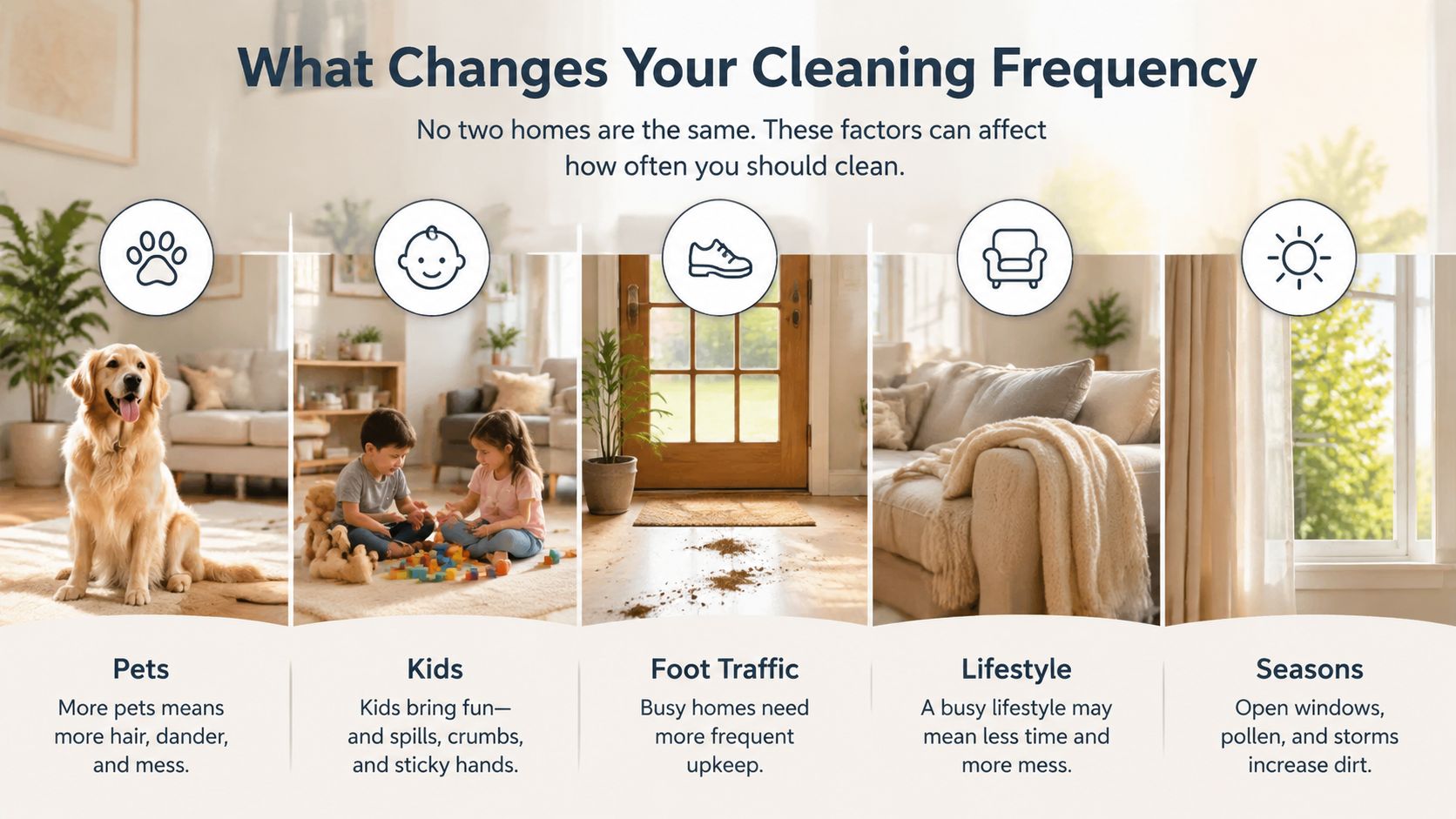
A Toronto office does not need a fixed cleaning rhythm by default. Occupancy, room use, and industry set the pace.
Occupancy drives the schedule first
How many people use the office matters more than floor size. Toronto and Ontario guidance both treat frequency as a function of use, and that fits real offices. A busy floor with full attendance, regular visitors, and shared rooms puts more strain on washrooms, lunchrooms, and entry points than a hybrid office that sits partly empty for much of the week.
Industry changes the hygiene load
A legal suite does not carry the same cleaning burden as a dental clinic, childcare site, gym, or food-handling workspace. The hygiene load rises with contact, spill risk, and the need for targeted commercial disinfection and sanitizing. Government of Canada building guidance also links cleaner indoor air and healthier workspaces to cleaning materials and ventilation management, so cleaning has to work with HVAC performance, occupancy peaks, and seasonal dirt brought in from outside (Government of Canada building-cleaning guidance).
High-touch zones force extra visits
Door handles, elevator buttons, shared kitchens, boardroom tables, and washrooms wear out first. They also show residue and tracked-in dust faster than the rest of the office. If an office treats those areas as part of a general clean, they usually fall behind.
Layout changes the workload
Open-concept floors are easier to inspect, but they often stay messy longer because more people touch the same surfaces. Cellular offices, multi-tenant suites, and long corridors create a different workflow. A smaller office with client traffic and shared washrooms can need more frequent service than a larger back-office floor that stays quiet.
Building class shapes expectations
Downtown towers, especially in financial and Bay Street settings, tend to expect a tighter standard. Presentation carries more weight in those buildings, so cleaning frequency usually rises even when headcount does not. Toronto planning should start with occupancy, room use, and tenant expectations, not a preset package.
For offices that want a small comfort boost alongside routine cleaning, pantry habits still matter. A simple reference like instant coffee for office morale is a reminder that lunchrooms and break areas need regular attention because people use them constantly.
Recommended Schedules by Office Type
Toronto offices are easier to manage when the schedule follows the room type and use pattern. A small suite, a large corporate floor, and a medical office should not be priced or cleaned the same way, because the service pressure is different.
Office types and practical cadence
| Office Type | Recommended Visits/Week | Priority Zones | Notes |
|---|
| Small office under 2,000 sq ft | 2 to 3 | Washrooms, kitchenette, entry points | Works well when the team is stable and visitors are limited |
| Mid-size office, 2,000 to 10,000 sq ft | 3 to 5 | Shared desks, lunchroom, meeting rooms, washrooms | This is the most common Toronto middle ground |
| Large corporate floor, over 10,000 sq ft | 5 or more, often daily | Lobbies, washrooms, elevators, high-touch surfaces | Downtown Class A spaces usually need evening service plus extra daytime support |
| Medical or dental office | Daily, often twice daily for busy practices | Treatment rooms, waiting areas, exam chairs, washrooms | Disinfection needs are more demanding than a standard office |
| Warehouse, industrial, showroom | 1 to 3 | Floors, washrooms, office nook, entry paths | The office area may need less service than the production or display zone |
| Childcare or education site | Daily | Washrooms, eating surfaces, toys, touch points | Cleaning must be tied to use, spills, and shared contact surfaces |
A useful way to think about it is by the weekly service rhythm, not by a single visit. A small office may only need a few full-scope visits, but the washroom and kitchen still need attention every time people use them. A larger office can justify daily service because there are more surfaces to reset, more people creating mess, and more expectations attached to presentation.
Operational truth: the busiest room in the building usually sets the pace for the whole contract, especially when it's a washroom or lunchroom.
That's why a one-size-fits-all package usually misses the mark. Toronto offices that look “small” on paper can still need a heavier cadence when they host clients, run long midweek meetings, or share amenities across multiple teams.
Daily, Weekly, and Monthly Task Stack
A professional office clean works best as a layered system. One visit does not cover every job that matters, so the schedule has to separate daily reset work from deeper maintenance.
The daily layer
Daily service should focus on what people see and touch first. Waste and recycling removal, washroom restocking, disinfecting handles and switches, spot-cleaning entrance glass, vacuuming traffic lanes, and a full bathroom sanitize all belong here. Some Canadian building-cleaning guidance recommends twice-daily cleaning for high-traffic areas and contact surfaces, which fits the reality of busy offices and shared spaces (building-cleaning guidance).
The weekly layer
Weekly work catches the jobs daily service tends to miss. Full vacuuming of carpeted zones, edge detailing, damp-mopping hard floors, dusting above shoulder height, wiping window sills and baseboards, cleaning appliance exteriors and interiors, and sanitizing shared conference equipment all fit here. For many Toronto offices, this is the difference between a space that merely looks tidy and one that stays properly maintained.
The monthly and quarterly layer
Monthly service should handle detail work that keeps buildup from taking hold, such as high dusting, interior glass cleaning, upholstery spot treatment, machine scrubbing, and restroom detail work. Quarterly work is where carpet extraction, fabric shampooing, blind dusting, and HVAC intake cleaning belong. Canadian office indoor-air guidance links cleaning materials, ventilation, and healthier office conditions, so these periodic tasks should stay in the scope, not get treated as optional extras (Health Canada-linked office indoor-air guidance).
| Frequency | Core Tasks | Why It Matters |
|---|
| Daily | Bins, touchpoints, washrooms, lunchrooms, traffic lanes | Keeps the office presentable and cuts visible buildup |
| Weekly | Floors, high surfaces, appliances, shared equipment | Prevents the clean-looking, dirty-feeling problem |
| Monthly | High dusting, interior glass, restroom detailing | Stops grime from settling into fixtures and finishes |
| Quarterly | Carpet extraction, upholstery, HVAC intake cleaning | Supports longer surface life and healthier indoor conditions |
The cleanest offices usually have the clearest task stack. When the scope is vague, important jobs get skipped until someone complains.
Why Washrooms and Lunchrooms Need Their Own Cadence
Washrooms should never share the same cleaning standard as a private office. Ontario guidance says washroom frequency should match the facility type and level of use, and that is the right rule here. Shared washrooms absorb more traffic per square foot than almost any other office space, so a smaller office with steady client visits can need more service than a larger office with light foot traffic.
Lunchrooms need their own cadence too. Shared sinks, microwaves, fridges, counters, and seating create repeated touchpoints and food residue that build fast during the week. In most GTA offices, those areas need a tighter routine than desks or boardrooms, and they usually perform better with cleaning on most weeknights than with a once- or twice-a-week pass.
A good contract starts with those two zones, then layers corridors, open desks, and private rooms around them. If a provider prices the whole office as one flat wash, the washroom and lunchroom scope usually gets diluted.
Ontario guidance on washroom frequency points office managers to the same conclusion. If the proposal calls for a deeper reset in high-use areas, detailed disinfection for shared spaces belongs in the conversation, not as an add-on after the fact.
The quickest way to under-clean an office is to give the washroom and pantry the same cadence as the boardroom.
Toronto office managers should ask one blunt question. Does the proposal treat washrooms and lunchrooms as priority zones, or does it apply the same cadence everywhere? If it is the latter, the schedule is too generic for a busy building.
Cost Drivers Behind Toronto Cleaning Quotes
Toronto cleaning quotes move for straightforward reasons, and office managers should judge them against the same yardstick. The largest driver is square footage, but the true cost comes from how much of that space is usable work area versus washroom, kitchen, or meeting-room space, since those rooms take more time per square foot.
What pushes a quote up
Visit frequency is usually the second lever. A move from three nights to five nights per week can raise the monthly bill materially because labour is the main cost, especially when the scope includes washrooms, kitchens, and floors. Specialty add-ons also change the number fast, including carpet extraction, window washing, floor stripping and waxing, and consumable supply restocking.
What to compare on every bid
Product quality matters too. Health Canada-approved disinfectants, microfibre systems, HEPA vacuums, and work windows that fit lease restrictions all affect how a provider prices the job. For comparison, a no-contract service model can be useful in some settings because it gives flexibility, which is often the right way to think about recurring service in office environments rather than locking into a rigid package.

A useful outside reference on contract flexibility in another maintenance category is Pestless Inc. Miami pest control guide, which shows why many service buyers prefer terms they can adjust when conditions change.
Use the same five buckets every time a quote lands: space, frequency, scope, specialty tasks, and product quality. If a bid doesn't break down cleanly against those categories, it's harder to compare and easier to overpay for vague coverage.
Questions to Ask Before You Sign a Contract
A cleaning contract should answer operational questions before it creates billing pressure. The easiest way to review a proposal is to move through scope, staffing, compliance, and contract mechanics in that order.
Scope verification
- Exact tasks per visit: Ask what happens on each visit, not just what “office cleaning” includes in general.
- Included areas: Confirm whether washrooms, lunchrooms, reception, stairs, and meeting rooms are included or treated as extras.
- Consumables: Clarify who supplies soap, paper towels, tissue, liners, and refill stock.
- Restocking rules: Ask how often supplies are checked and who flags shortages.
Staffing and supervision
- Employee structure: Confirm whether cleaners are employees or subcontractors.
- Background checks: Ask whether screening is performed before placement.
- Site inspections: Find out who checks quality and how often those inspections happen.
- Coverage continuity: Ask what happens if the assigned team is absent.
Insurance and compliance
- WSIB coverage: Confirm that workplace injury coverage is active.
- Liability coverage: Ask for commercial general liability details.
- Disinfection methods: Verify whether the provider follows proper high-touch disinfection practices for the site type.
- Training: Ask how staff are trained on chemicals, touchpoints, and room-specific procedures.
Contract mechanics
- Change flexibility: Ask how frequency changes are handled if occupancy rises or drops.
- Trial period: If offered, confirm what a trial clean covers.
- Cancellation terms: Get the cancellation language in writing before any start date.
- Support access: Clarify whether there's live support for service issues or emergencies.
The University of Toronto's building frequency schedule is a useful reminder that different room types need different cadences, with private offices cleaned bi-weekly, public office reception areas cleaned daily, and washrooms, changerooms, and showers cleaned daily (U of T caretaking frequencies). That kind of room-based thinking should show up in any serious contract.
A Toronto provider such as Arelli Cleaning can fit into that decision, but only as one option among several qualified companies. The right choice is the one that matches the site's occupancy, room mix, and service expectations without hiding the scope in the fine print.
Before signing anything, run the checklist, compare two or three quotes on the same scope, and ask how the schedule changes when occupancy changes. If the office needs a cleaner cadence, clearer washroom coverage, or more flexible after-hours service, visit Arelli Cleaning and compare its service model against the standards above.







.webp)