The office opens soon, the washroom needs attention, and nobody knows whether last night's crew emptied the recycling or merely moved it to the loading area. Meanwhile, a lingering odour after disinfection has prompted another message from staff. The office manager needs clear answers, not another broad promise of a thorough clean.
Cleaners Who Care® in Richmond Hill: How Service Works is best understood through the decisions behind each visit. A useful service arrangement identifies who cleans each area, how completion is checked, what happens when something goes wrong, and which responsibilities remain with the business or building operator.
Table of Contents
Service Walkthrough From First Call to First Clean
A practical Cleaners Who Care® service arrangement in Richmond Hill should follow seven stages, from booking through periodic review, with a written record at every stage. The sequence below is a framework for evaluating an engagement, not a substitute for a provider's confirmed terms.
Commercial cleaning means scheduled cleaning of non-residential premises under a written scope. Janitorial service means the routine interior upkeep within that scope. These working definitions help office managers compare commercial cleaning services without assuming that different providers use identical terminology.
Seven stages of the service and what each produces
| Stage | What Happens | Client Provides | Client Receives |
|---|
| Booking | Request logged with site type, size and operating hours | Address, floor count or plan, occupancy hours | Confirmed scope request |
| Site walk or remote review | Crew lead reviews traffic, washrooms, kitchens and high-touch areas | Access instructions and key or fob process | Draft scope by zone |
| Written quote | Scope priced by frequency, zones and specialty items | Priorities and budget ceiling | Quote with inclusions and exclusions |
| Sample clean | Agreed zones cleaned to test the scope | Feedback on selected zones | Adjusted scope and frequency |
| Onboarding | Crew assigned, reporting channel set and contacts confirmed | Primary contact, after-hours rules, key holders | Start date and service contacts |
| Routine service | Scheduled cleaning, inspections and exception logging | Feedback and urgent exception notices | Completion records for each visit |
| Periodic review | Scope checked against actual use and seasonal needs | Usage changes, such as hiring or relocation | Revised frequencies in writing |
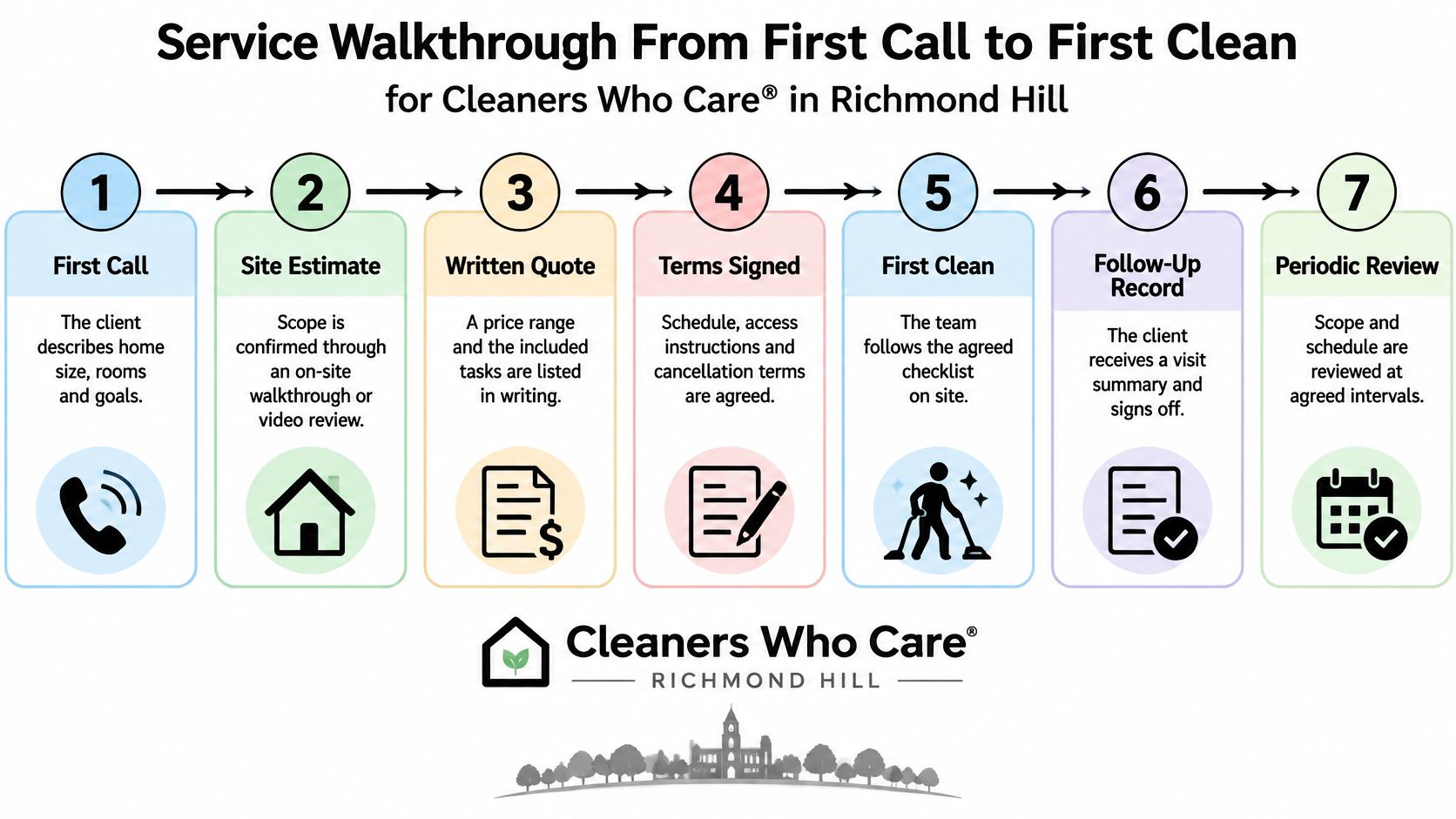
The client owns access arrangements, priorities and feedback. The crew lead owns the site assessment and draft scope, while the designated office contact coordinates sign-off and receives exception reports.
Timing depends on floor area, entry restrictions and the proposed start date. Request milestones in writing, then compare each shortlisted provider's process against this sequence. A different sequence isn't automatically a problem, but an unexplained gap deserves a question.
How to Book and Scope a Richmond Hill Site
An incomplete scope makes a quote difficult to trust. If a storage room, shared washroom or late-working department is missing from the assessment, the provider and client may be pricing different jobs.
Richmond Hill's historical business mix supports a flexible approach. Businesses with fewer than 20 employees represented 85% of businesses in the city's 2016 survey, while the share employing 20–99 people increased from 10.6% in 2006 to 12.8% in 2016, according to the city's employment survey summary. These are historical figures, but they provide useful context for designing adjustable scopes rather than assuming every workplace needs a large-facility package.
Build the scope by zone
List every space type. Include private offices, open-plan workstations, washrooms, kitchens, reception, storage and shared equipment rooms. Otherwise, an apparently complete quote may leave an entire room unassigned.
Record occupancy and operating hours, distinguishing busy periods from quiet ones. A reception area used throughout the day needs a different service discussion from a meeting room that's rarely occupied.
Mark high-touch surfaces, including door handles, lift buttons, printers and shared phones. Identify who may clean sensitive equipment and which manufacturer instructions apply.
Document keys, fobs, alarm procedures and after-hours entry. Keep security credentials in an approved secure channel, not in a widely circulated quote attachment.
Assign frequency by zone, not just by floor. The kitchen may need attention whenever staff use it, while a low-use archive room may need a less frequent schedule.
Define exclusions explicitly. Renovation debris, regulated waste and specialist equipment shouldn't disappear into a vague miscellaneous-cleaning allowance.
Request the completed scope before comparing prices. Each provider should be responding to the same room list, tasks and operating constraints.
Practical rule: A cleaning package is only useful when the office manager can identify what happens in each zone and when.
Documents for the first call
The initial discussion doesn't need a polished facilities manual. A marked floor plan and a short operational summary are more useful than an unsupported request for full cleaning.
- Space record: A floor plan or room list showing restricted and shared areas.
- Operating profile: Occupancy patterns, opening hours and known busy periods.
- Access summary: Entry restrictions and the person authorised to arrange credentials.
- Existing concerns: Photographs of problem areas where workplace policy permits them.
- Zone-and-frequency checklist: Proposed tasks, exclusions and service frequency beside each area.
Sample Cleans and Onboarding Before the Contract
A sample clean tests the proposed scope against the actual building, not against a brochure. Its value lies in finding mismatches before routine service begins.
Select representative zones rather than only the easiest visible area. A useful trial might include a complete washroom, a workstation area, a high-touch sweep and a specialty item where relevant. Confirm the trial's boundaries beforehand so neither party mistakes a limited demonstration for a building-wide restoration.
Check the result and the process
- Photograph agreed areas: Take before-and-after images only where privacy and security rules allow.
- Maintain a shared issue list: Identify the precise surface and expected task rather than recording that a room wasn't clean enough.
- Compare time assumptions: Note whether access delays or furniture movement changed the planned visit.
- Check security conduct: Confirm that doors, alarms and restricted rooms were handled as agreed.
- Record scope changes: Separate missed work from tasks that weren't included initially.
A trial can reveal a legitimate trade-off. An occupied desk may be inaccessible without moving confidential papers, for example. The solution is to decide whether staff will clear the surface or whether the cleaner will work only on accessible areas.
Make instructions usable
Onboarding should establish the primary contact, reporting channel and after-hours route for urgent issues. It should also confirm the language and format used for written instructions.
Richmond Hill's demographics and census profile documents a multilingual community. Clear signage, labelled instruction cards and unambiguous key-holder notes are therefore sensible operational choices. Where translated instructions are needed, the parties should agree who checks their accuracy.
Ask whether the sample clean is free or chargeable, which zones it covers, and what happens to the quote afterwards. A trial needn't be free to be useful, but its cost and purpose should be clear.
Don't sign until the sample clean produces either a written scope adjustment or written confirmation that the original scope matches the site.
Daily and Specialty Services and How Crews Run Them
A defensible visit follows a clear sequence: identify risk zones, set frequencies by use, remove soils, disinfect where required, respect product contact time, and verify completion. Disinfection should use a Health Canada-approved product carrying a drug identification number, with use governed by the label.
Health Canada's office-building indoor-air guidance recommends damp or wet cleaning methods, HEPA-filtered vacuuming where possible, and low-emission products. For routine office cleaning, that supports damp wiping with lint-free cloths and wet mopping rather than methods that unnecessarily redistribute dust.
Daily and specialty services with typical frequency and preparation
The intervals below are planning examples for a site assessment, not established requirements or promises that every provider offers every service. Floor condition, material compatibility, traffic and occupancy should determine the final schedule.
| Service | Typical Frequency | Method | Client Preparation |
|---|
| Daily office cleaning | Nightly or as scheduled | Dusting, damp wiping, vacuuming, washroom service, waste removal | Clear loose papers; secure valuables |
| Disinfection of high-touch surfaces | Daily or per risk assessment | Clean first; use an approved disinfectant and respect contact time | Flag sensitive occupants and ventilation arrangements |
| Strip and wax | Planning example of 1–2 times per year | Remove old finish, rinse and apply compatible finish after drying | Arrange furniture movement and drying time |
| Carpet cleaning | Planning example of every 6–12 months, adjusted for traffic | Pre-vacuum, extraction cleaning and drying | Clear floors; plan around drying |
| Window cleaning | Planning example of 2–4 times per year | Interior and exterior glass where access allows | Clear sills; confirm exterior access |
| High dusting | Planning example of 1–4 times per year | Accessible vents, fixtures, partition tops and ceiling corners | Clear workstations; notify occupants |
| Power washing | As needed, often seasonal | Suitable exterior surfaces, entrances and loading areas | Move vehicles; confirm drainage and water restrictions |
| Floor care | Weekly to monthly planning range, depending on floor type | Compatible scrubbing, burnishing or sealing | Confirm finish and traffic restrictions |
| Post-construction clean-up | At project completion, with scope confirmed | Dust removal, agreed debris clearing and final detailing | Identify who removes construction debris |
Preparation determines whether work can proceed
Routine work should specify accessible surfaces and consumables as well as tasks. For washrooms, for example, the scope should identify who supplies soap, paper products and replacement liners. Waste removal should name the destination, not merely say empty bins.
Specialty work needs a separate preparation conversation. Strip-and-wax work requires protected drying time; carpet extraction requires clear floors and a return-to-use plan. Power washing requires agreement on vehicle movement, drainage and any applicable restrictions.
Post-construction cleaning needs a particularly clear handover. Final dust removal isn't the same assignment as hauling construction debris, and either task may prevent the other from proceeding if responsibilities aren't settled.
Review applicable specialty cleaning services, then mark each item as routine, condition-triggered or a separate project. This keeps occasional restoration work from being confused with the ongoing janitorial budget.
Quality Checks, App Reporting and Safety Compliance
Quality verification should follow a repeatable cycle: supervisor inspection, exception logging, corrective action within an agreed window, and a record connecting the issue to its visit. A completion notice alone doesn't establish whether an inaccessible room or missed task was addressed.
Inspection arrangements should reflect the site. Ask whether the supervisor checks every visit or inspects at agreed intervals, which areas receive attention, and how unresolved items remain visible.

What reporting should show
An app can organise communication, but the office manager should evaluate its records rather than its appearance. A simpler reporting system may be adequate if it provides the same accountability.
- Completion notices: Tasks tied to the correct location and visit.
- Exception reports: Missed work, locked rooms, unavailable supplies and other obstacles.
- Permitted photographs: Images that comply with workplace privacy and security rules.
- Visible history: Previous visits, open issues and recorded resolutions.
- Urgent escalation: A defined route for matters that can't wait for routine review.
Ask specifically whether the system records exceptions. A list containing only completed tasks can leave the office manager unaware that an area wasn't serviced.
Safety documents and return-to-use decisions
Request WHMIS-aligned hazard communication, access to safety data sheets for products in use, and relevant training records. The Cleaning Industry Management Standard can also serve as a discussion point for management systems, but any claimed certification should be checked rather than assumed.
Indoor-air coordination deserves its own sign-off. Health Canada's detailed office-building guidance recommends major cleaning and maintenance during low-occupancy periods, with time for ventilation before occupants return, alongside documented housekeeping and inspections.
Surface cleaning and HVAC performance are separate responsibilities. The provider should coordinate intensive work with the building operator rather than imply that wiping surfaces resolves airborne exposure.
Before the first visit, keep this checklist:
- Verification: Inspector, inspection schedule and correction window agreed.
- Documentation: Product list, safety data sheets and training information available.
- Occupancy coordination: Heavy-work schedule, ventilation contact and re-entry communication established.
- Complaint response: Named recipient for reports of odours, irritation, headaches or respiratory symptoms.
Compare Quotes and Settle Terms Before Signing
Conditional price ranges are more useful than unexplained single figures while the scope is still being settled. Once the work is defined, the quote should explain the recurring charge, separately priced projects and circumstances that could change the price. There isn't a defensible Richmond Hill dollar benchmark available here, so a numerical market range would imply evidence that isn't available.
Cost discussions should cover floor area and layout, visit frequency, daytime versus after-hours work, specialty services, access complexity, product requirements, occupancy and contract length. Ask which assumptions matter most. A compact office with difficult entry procedures may require a different arrangement from a larger, straightforward site.

Provider evaluation criteria, good practice and warning signs
| Criterion | What Good Looks Like | Warning Sign |
|---|
| Contract terms | Clear cancellation policy and suitable no-term, stop-and-go or fixed-term options | Undisclosed cancellation fees or unexplained lock-in |
| Scope in writing | Itemised zones, frequencies and separately priced specialty items | A single full-cleaning line without tasks |
| Quality verification | Inspection records, exception logs and visible visit history | Invoices or verbal assurances treated as proof |
| Waste responsibilities | Defined collection scope and specialist arrangements for regulated waste | Nobody assigned chemicals, sharps, toner or debris |
| Chemicals and safety | Product list, disinfectant DINs and accessible safety data sheets | No product disclosure or unavailable safety information |
| Pricing basis | Scope, frequency and labour assumptions explained | An unexplained lump sum |
| Guarantee | Written conditions, remedy and response time | No defined claim or resolution process |
| Communication | Named contact, reporting channel and after-hours route | No escalation path beyond a general inbox |
A fixed-term agreement isn't unsuitable by nature. It may fit a stable site, while flexible terms may better suit a changing tenancy. The issue is whether the business understands the commitment and exit conditions.
Settle waste responsibilities explicitly
Routine janitorial collection is not regulated waste disposal. Moving a bag from a desk-side bin to a designated commercial collection point doesn't establish responsibility for its eventual treatment or disposal.
York Region's waste report and business guidance provide the local basis for checking private commercial waste arrangements and specialist handling requirements. Hazardous materials require appropriate licensed services, labelled storage and disposal records; mixed-use properties also need to distinguish commercial and residential waste responsibilities.
Ask each provider to identify what it collects, where it takes it, and what it won't handle. Don't assume toner, batteries, sharps, chemicals and renovation debris all belong in the same service category. Their handling should be resolved individually with the appropriate waste contractor.
Scope boundary: The agreement should identify the handoff point between the cleaner, the client, the property manager and the waste contractor.
Frequently asked questions
How should a price-match guarantee be assessed?
Request its written conditions. The comparison should identify equivalent tasks, frequency, exclusions, eligibility requirements and the period for submitting a competing quote.
When should a sample clean be booked?
After the draft scope is clear enough to test and before the business commits to routine service. Confirm preparation and any trial charge beforehand.
Where should Richmond Hill and GTA coverage be checked?
Use the provider's service-area information, then confirm the actual address, schedule and crew availability directly. A regional listing doesn't establish a particular start date.
Who should approve scope changes and receive reports?
A named office manager, owner or facilities contact should hold that authority. Name a backup so decisions don't stall during absences.
What happens when staff report poor air after cleaning?
Use the complaint route established during onboarding. Record the affected area, timing and work performed, then coordinate review with the building operator rather than treating more cleaning as the automatic answer.
Why compare zone schedules rather than package names?
Package names don't establish equivalent work. The zone-and-frequency checklist provides the common basis for comparison.
How should urgent requests be priced?
Ask whether call-outs, minimum charges or out-of-scope approvals apply. The agreement should distinguish urgent additional work from correction of an included task.
What should happen if an included area is inaccessible?
The provider should record the exception and request direction. The client should know whether a return visit is included or separately chargeable.
Key Takeaways
- Define the work: Compare written zone schedules, not broad service labels.
- Test assumptions: Use the sample clean to resolve scope mismatches.
- Check accountability: Require records of exceptions and their resolution.
- Separate responsibilities: Air-quality coordination and specialist waste handling need named owners.
- Read conditions: Cancellation terms and guarantees matter as much as headline pricing.
Further Reading
Use the service areas directory to check geographic coverage. For internal reading, look for the publisher's Toronto office-cleaning comparison guide and related articles on floor care and cleaning schedules; confirm their current titles and availability through the site.
The Health Canada guidance, York Region waste resource and Richmond Hill census profile linked above provide the most relevant external background. ISSA is also an industry organisation to consult when evaluating cleaning-management terminology and standards.
Use the scoping checklist to prepare a common specification, request two or three written quotes against it, and send unresolved questions to each provider before signing. Arelli Cleaning can be considered alongside other office and commercial cleaning providers. Select an arrangement whose scope, reporting, access procedures and responsibility boundaries the office manager can confidently explain to staff.