A Toronto office carpet can look fine on a Tuesday and still be costing money every week. Salt comes in on boots, grit sits in the pile, and by the time someone notices the wear pattern, the carpet is already doing a bad job of protecting the rest of the facility budget. For an office manager, the question isn't whether the carpet looks clean today, it's whether the current maintenance plan is delaying replacement, protecting warranties, and keeping the workplace presentable enough to avoid complaints.
Table of Contents
Putting the Plan Together for Your Office
Why Commercial Carpet Cleaning Matters for Toronto Offices
A downtown lobby in late winter tells the whole story. Boots cross the threshold with slush on them, elevator banks get a ring of grey at the edges, and the carpet starts looking tired long before anyone expects a replacement line item to show up. That is why commercial carpet cleaning belongs in operations planning, and why it should sit alongside the rest of your Toronto office cleaning plan instead of being treated as a housekeeping afterthought.
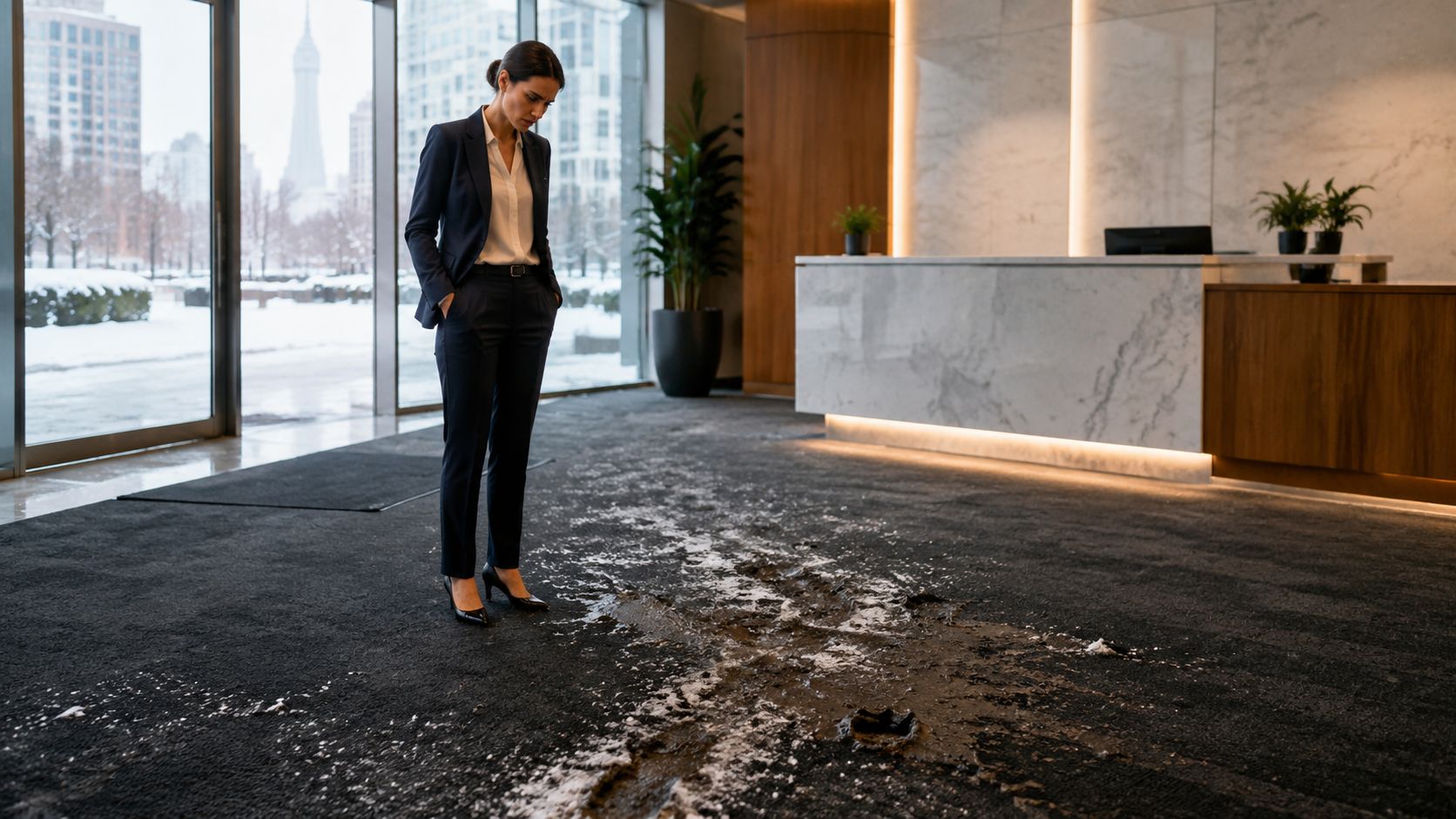
For Toronto offices, the value case is straightforward. The Canadian Janitorial Services market is projected to reach $9.4 billion in 2026, with 40,874 businesses and a 6.1% CAGR in the number of businesses from 2021 to 2026 (IBISWorld). That scale matters because carpet care sits inside a large, recurring maintenance economy, not a one-off fix.
Practical rule: if carpet cleaning is being debated only as a cosmetic expense, the office is probably already paying for wear in a worse way.
The business outcome is usually one of three things. First, longer carpet life because embedded grit gets removed before it cuts fibres. Second, a cleaner interior environment because dust and soil do not keep cycling through the space. Third, a better chance of staying inside warranty requirements and replacement budgets instead of forcing an early capital spend.
The office manager's clean answer is simple. Carpet cleaning is part of asset preservation, and the budget belongs with operations because it protects a floor that works every day.
The Cost of Ownership Behind the Cleaning Budget
A quoted price per visit only covers the labour line. Toronto office managers need to look at total cost of carpet ownership, which includes routine cleaning, slower wear, replacement timing, and the cost of disruption when a floor has to be replaced early. Carpet is not a one-time purchase. It is an operating asset that either gets maintained or gets expensive.
A 2,000-square-foot office carpet area priced at the GTA commercial cleaning range of $0.15 to $0.40 per square foot works out to roughly $300 to $800 per visit (pricing guide). Ontario commercial guides place carpet cleaning in a similar per-square-foot range, and the budget pressure usually comes from the work that sits around the cleaning itself, not the base visit.
What the budget is really buying
Soil does not stay on the surface. It gets pushed into the pile, then down toward the backing, where it speeds up visible wear and makes the carpet look older sooner. Toronto-focused commercial guidance says regular professional cleaning can extend carpet life by 40% to 60% in most commercial applications, and gives an ROI example where preventing just one sick day per employee annually could save a 50-employee business about $15,000 per year.
That does not mean every office will see the same savings. It does mean the decision belongs in a capital-preservation plan, because the core question is how much replacement you delay and how much disruption you avoid.
| Cost Driver | Effect on Price | Typical Toronto Impact |
|---|
| Area size | Larger areas increase total labour time | More square footage usually means more staging, more equipment movement, and a longer visit |
| Soil load | Heavier buildup needs more agitation and extraction passes | Salt, grit, and tracked-in dirt push labour up because the cleaning has to work harder |
| Access timing | After-hours work can add coordination and security costs | Evening or early-morning access often means extra scheduling with building staff |
| Add-ons | Stain treatment or protective coatings increase the invoice | Spot work, deodorizing, and protectant applications are usually billed separately |
| Drying pressure | Faster return-to-service requirements can change the method | A low-moisture approach or faster extraction setup can cost more than a standard clean |
The right budget question is not whether cleaning looks cheap. It is whether the schedule delays replacement enough to justify itself, keeps warranty expectations intact, and limits the hidden cost of a dirty floor in a working office. In a Toronto building with winter salt and constant traffic, that is the better test. For offices that need a lower-moisture option between major cleanings, a steam carpet cleaning service can fit into that maintenance plan when the timing and fibre type call for it.
Main Commercial Cleaning Methods Explained
Toronto office carpets fail for different reasons, so the cleaning method has to match the problem. If you use one method for every space, you waste money in some zones and leave wear in others. The key decision is whether the floor needs restoration, routine upkeep, or a low-moisture pass because the space cannot stay offline for long.
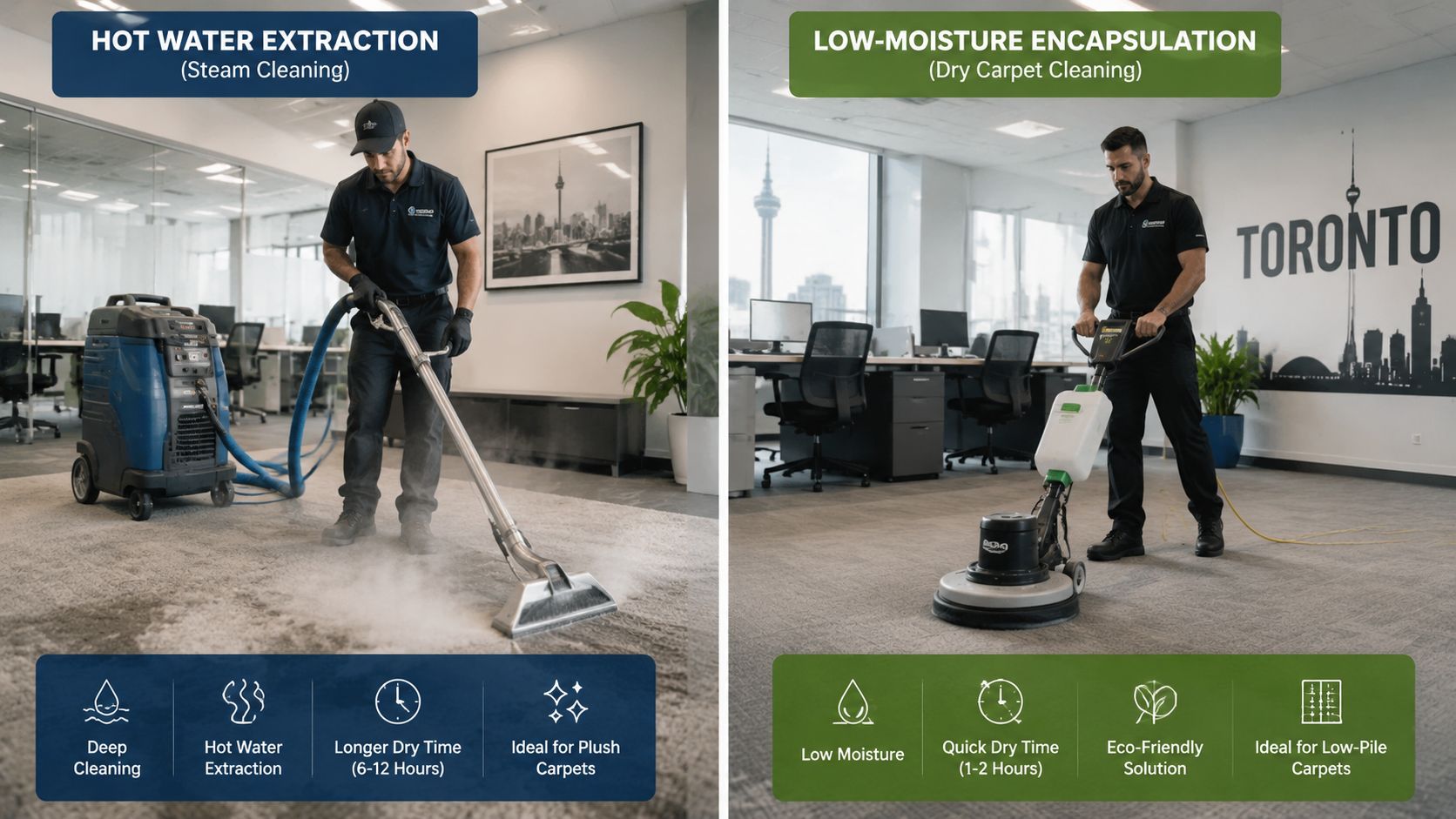
The cleanest way to choose is to separate deep restoration from interim maintenance. Toronto commercial guidance treats hot water extraction as the preferred restorative method because it removes embedded particles that grind into fibres, while interim low-moisture care helps keep pile distortion under control between deep cleans (Toronto commercial guidance).
Hot Water Extraction
This is the reset step. Heated water and strong extraction pull out deeper soil, which is why manufacturers and IICRC-aligned guidance favour it once the carpet has been carrying traffic for months. Use it when the goal is actual soil removal and a longer service life, not just a cleaner look.
For offices that need a lower-moisture option between major cleanings, a steam carpet cleaning service can fit into that maintenance plan when the timing and fibre type call for it.
Encapsulation
Encapsulation is a low-moisture maintenance method. It belongs between deep cleans, especially where the office needs faster dry times and the carpet is still in decent condition. Use it for regular upkeep and appearance control, not as a substitute for a full restorative clean.
Dry Compound Cleaning
Dry compound cleaning belongs in moisture-sensitive areas. It is niche, not universal, and it makes sense when carpet construction, timing, or building restrictions make wet work a poor fit. If a vendor recommends it for every area, the buyer should ask why.
Bonnet Cleaning
Bonnet cleaning is a surface-oriented option, best understood as an emergency or appearance-management tool. It can help with visible soil patterns, but it does not replace extraction. If it gets used alone too often, embedded grime stays in the pile and the carpet wears faster.
A good vendor should explain method choice by traffic, not by habit.
The buyer's rule is simple. Extraction is for restoration, encapsulation is for interim care, dry compound is for special conditions, and bonnet cleaning is for limited surface work. Any proposal that treats all four as equivalent should be read carefully.
Recommended Cleaning Frequency by Traffic Zone
A single universal schedule is lazy facility management. A lobby that sees hundreds of shoes a day shouldn't be treated like a private office, and a meeting room used twice a week doesn't need the same rhythm as an elevator bank. The schedule has to follow traffic, not the calendar.
Toronto commercial sources serving the GTA note that corporate offices generally need professional carpet cleaning every 6 to 12 months, with high-traffic areas needing more frequent service, and many warranties requiring hot water extraction at set intervals to stay valid (frequency guidance). That is the baseline, not the finish line.
A practical zone-by-zone rhythm
- Lobbies and elevator banks: vacuum daily, extract on the shortest interval the warranty allows.
- Main corridors: vacuum daily or near-daily, then use scheduled interim maintenance between extraction cycles.
- Workstations: vacuum several times a week, with extraction tied to traffic and visible soil loading.
- Executive suites: vacuum weekly if use is light, then clean before staining becomes permanent.
- Meeting rooms: vacuum after heavy use periods, then extract on a moderate cycle if the room sees frequent client traffic.
The point isn't to create more work. The point is to keep grit from compacting into the pile, because once that happens the carpet wears faster and looks worse even after cleaning. Toronto winter makes this worse, so many offices should pull at least one cleaning cycle forward during the slush season instead of waiting for a standard date on the calendar.
Office cleaning services should already be coordinating this rhythm with vacuuming, spill response, and hallway attention. If they aren't, the extraction schedule is probably already too relaxed.
Toronto-Specific Factors That Change the Plan
Toronto carpet care has its own stress profile. Winter road salt, slush, and freeze-thaw conditions put a harsher load on entrance carpet than a generic national plan usually assumes, especially in downtown buildings where people pass through in steady waves. That's why local experience matters more than a polished proposal.
The salt issue is not just cosmetic. Grit works like sandpaper once it gets tracked inside, and the freeze-thaw cycle drives debris deeper into the pile, which makes proper extraction more important in winter than in milder months. High-rise buildings add another layer of pressure because pedestrian density at entrance points and lift lobbies raises the wear rate.
What changes in the operating plan
- Entrance matting has to be serious: small mats don't hold enough debris for a Toronto winter.
- Lobby cleaning needs tighter timing: the dirtiest months justify earlier extraction.
- Allergen control matters more in warmer months: when windows open and HVAC loads change, indoor air quality goals need more attention.
- Staffing and access need coordination: if cleaners can't work around peak traffic, the dirt stays in place longer.
The practical consequence is that a vendor who treats Toronto like any other city can under-scope the job. Office managers should ask how the building handles salt capture, where mats stop, and how often the entrance zone gets attention when weather turns ugly.
Ontario office cleanliness guidance is a useful reminder that local operating conditions shape cleaning load. In Toronto, that load is heavily seasonal, and the plan should admit it.
How to Evaluate a Toronto Carpet Cleaning Vendor
A Toronto office manager usually finds out too late that the cheap quote was never cheap. The true cost shows up later in earlier replacement, more stain complaints, more wear in traffic lanes, and more disruption when spills or odours force extra attention. Judge the vendor on the process they describe, the evidence they provide, and how well their plan fits the building's traffic, salt load, and warranty requirements.
Scorecard for the quote review
| Criterion | What to Ask | Red Flag |
|---|
| Certification | Ask whether technicians follow recognised industry training and site procedures | No clear standards or training answer |
| Insurance and compliance | Ask for proof of insurance and WHMIS-aware handling | Evasive paperwork answers |
| Pricing clarity | Ask how the quote handles area size, access, and add-ons | Vague lump-sum pricing with no breakdown |
| Sample clean | Ask whether a free sample clean is available | Refusal to demonstrate results |
| Quality assurance | Ask how the work is checked after completion | No documented QA process |
| Emergency response | Ask how spill calls are handled after hours | No 24/7 support path |
A Toronto office should expect a vendor to explain the method, not just the price. If the proposal does not say why one cleaning process is being chosen over another, the buyer is being asked to accept a guess, and that guess can cost more than the cleaning bill.
Commercial cleaning services should be judged against the same standard no matter who provides them. A Toronto office should expect the vendor to explain the method, and to offer a price-match guarantee, free sample cleans, and 24/7 support if those commitments are part of the proposal. Those details matter because they show how the contractor handles pressure, not just how they write a quote.
Avoid this mistake: choosing the cheapest quote before asking what method is being used and whether the building's traffic profile matches it.
The better quote is the one that makes future maintenance predictable. If the vendor cannot explain that in plain language, keep shopping.
Day-to-Day Maintenance Between Professional Visits
Professional cleaning only works when the daily routine backs it up. If cleaners leave soil at the door, let spills sit, or vacuum with poor technique, the carpet wears faster no matter how good the quarterly extraction looks on paper. Daily maintenance is where the schedule either holds or fails.
The routine that should actually run
- Entrance mats: keep them large enough to catch grit before it spreads into the office.
- Vacuuming: do high-traffic zones daily, then reduce frequency only where the carpet gets little use.
- Spill response: treat every spill quickly, because delay turns a small incident into a permanent stain.
- Traffic lane rotation: move furniture and adjust cleaning passes so the same lines don't wear first.
A practical facility rule is to treat spill response as urgent, not optional. Over-wetting spots, using the wrong vacuum height, or letting a spill sit too long all shorten carpet life in ways that are obvious only later.
Simple standard: the carpet should be back under control within the same shift, not at the end of the week.
This is also where the cleaner's instructions need to be plain. “Vacuum the corridors daily” is usable. “Keep the office tidy” is not. If the team can't repeat the routine without guessing, the routine is too vague to protect the floor.
Putting the Plan Together for Your Office
The right plan is boring in the best way. It means the next 12 months are already scheduled, the floor team knows who handles daily matting and vacuuming, and the vendor quotes are being compared against the same checklist instead of against sales language. That is how office managers keep carpet spend inside control.
For broader maintenance planning, commercial building maintenance insights from PWC are useful because they treat cleaning as part of the building's upkeep system, not a standalone task. That mindset fits carpet care in Toronto offices, where the decision is really about protecting assets over time.
The action list is short. Get two or three quotes, ask for a sample clean, and block out the extraction dates before the calendar fills up. Then assign one person to own daily matting and vacuum checks, because no schedule survives without a named owner.
Arelli Cleaning provides commercial office and carpet cleaning in Toronto, including scheduled maintenance, steam cleaning, and support for high-traffic areas. Office managers comparing providers should use the checklist above, then visit Arelli Cleaning to review service coverage and request quotes alongside at least one or two other options.








.webp)