A busy fitness centre can change character within minutes. Members move from treadmills and weight machines to showers and change rooms, while a class ends, another begins, and moisture collects around wet areas. A reliable commercial cleaning strategy for fitness centres and gyms must follow that movement rather than treat the building as one undifferentiated space.
Commercial cleaning is a planned service that combines routine janitorial work with scheduled disinfection, floor care, washroom maintenance, moisture control, inspections, and documentation. Routine janitorial work usually handles recurring visible cleanliness. A gym cleaning system must also manage equipment contact points, class turnover, wet-area sanitation, product dwell time, staff safety, and evidence that required tasks were completed.
The direct answer is a layered schedule: clean high-touch equipment during use, reset rooms between classes, service high-risk zones daily, rotate deeper work by zone, and verify every task. Health Canada guidance requires operators to follow product labels, including contact time, ventilation, and any protective equipment requirements (Health Canada's cleaning and disinfecting guidance). WHMIS procedures and applicable local public-health requirements also belong in the operating plan.
Key takeaways
- Touch points need targeted attention, not indiscriminate spraying.
- Washrooms, change rooms, showers, and wet zones need frequency based on sanitary conditions and use.
- Fast class resets work only when supplies, roles, checklists, and inspection steps are ready.
- Floor safety depends on spill response, correct products, moisture control, and documentation.
- A provider should explain scope, training, product records, quality assurance, and reporting before service begins.
A useful decision framework matches cleaning frequency to traffic, moisture, surface type, and class turnover. High-contact surfaces and shared equipment need attention during operating hours. Washrooms and wet areas need repeated inspection and cleaning as conditions require. Low-touch surfaces can follow a planned rotation, provided staff reassess visible soil, odour, damage, and occupancy patterns.
Table of Contents
4. Allergen and Biofilm Removal Programs5. Real-Time Equipment Sanitation During Operating Hours8-Point Gym Cleaning Strategy Comparison
1. High-Touch Surface Disinfection Protocols
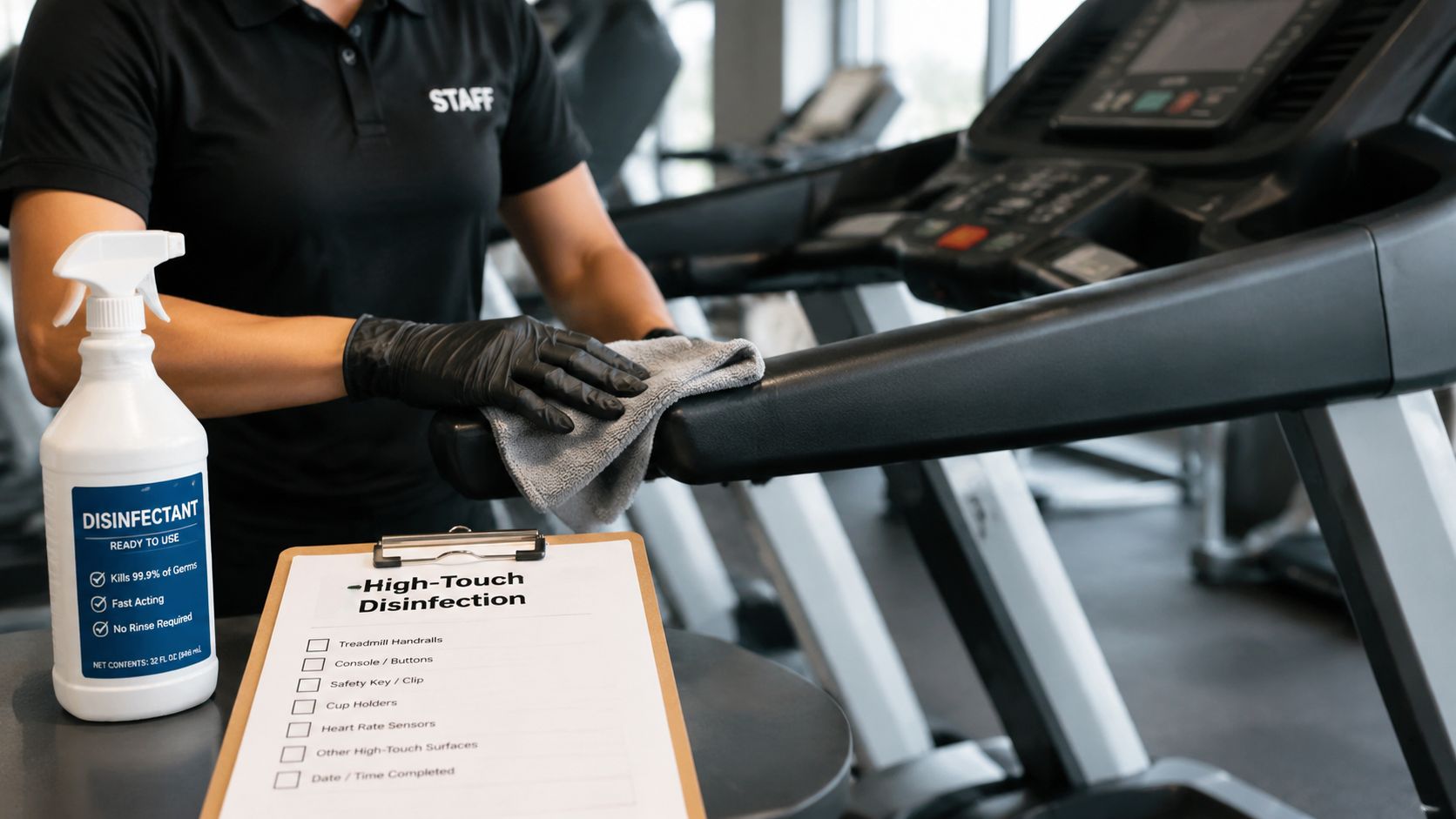
A member moves from reception to a treadmill, adjusts the incline, opens a locker, and joins a class. Each contact leaves a different cleaning requirement. Start with a facility-specific map covering equipment handles, treadmill rails, adjustment pins, door handles, handrails, reception counters, light switches, keypads, and shared accessories. Public Health Ontario lists chair arms, tabletops, elevator buttons, toilet handles, light switches, handrails, and keypads as common high-touch surfaces in shared facilities, with cleaning and disinfection recommended at least daily and more often in outbreak areas (Public Health Ontario's environmental-cleaning resource).
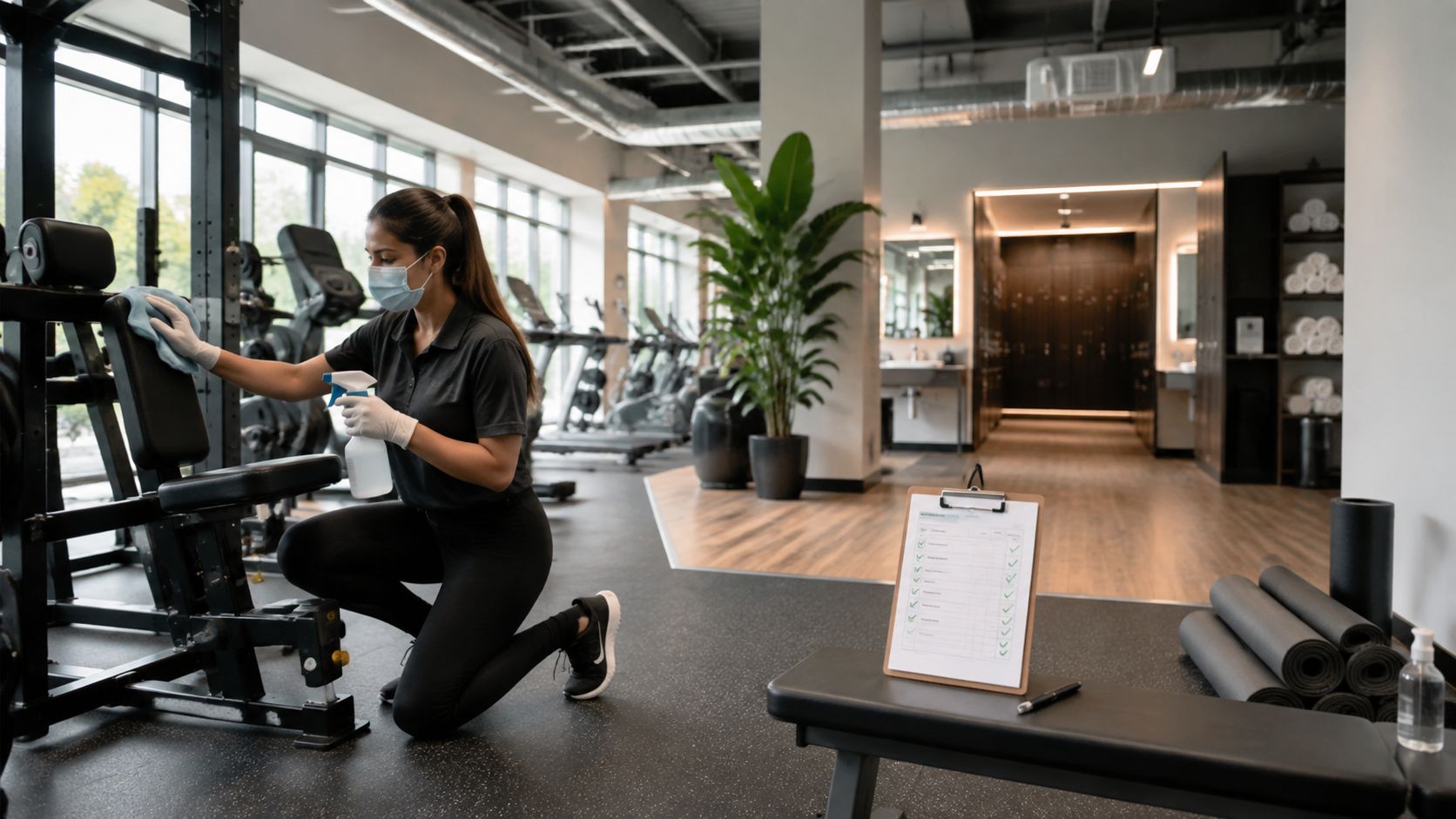
Assign every touchpoint to a route, a responsible person, and a verification method. Remove visible soil when the product directions require it, then apply an appropriate disinfectant and keep the surface wet for the stated contact time. Staff using disinfectant wipes for gym equipment should still follow the label. A fast wipe that dries too soon may leave the surface looking clean without completing disinfection.
Build the route around member movement
Schedule checks according to use. Inspect reception and entry points early, equipment handles and adjustment controls during active periods, and doors, washroom fixtures, and change-room touchpoints during planned rounds. Detailed disinfection service guidance can help define a separate procedure for high-contact surfaces.
- Map the facility: Mark rails, switches, counters, washroom fixtures, shared tools, and equipment controls.
- Assign ownership: Give each route to a daytime attendant, janitorial worker, supervisor, or contractor.
- Choose compatible materials: Use microfiber cloths and products suited to each equipment surface to limit residue and damage.
- Verify completion: Record the area, time, product, and initials on a route card or digital log.
- Revise the map: Add missed touchpoints after complaints, inspections, or layout changes.
Practical rule: The product label controls application. Staff should not shorten contact time because a class is about to start.
Checklists support accountability when supervisors compare them with conditions, product records, and spot inspections. A signature alone does not prove that the route was completed.
2. Electrostatic Disinfection Technology
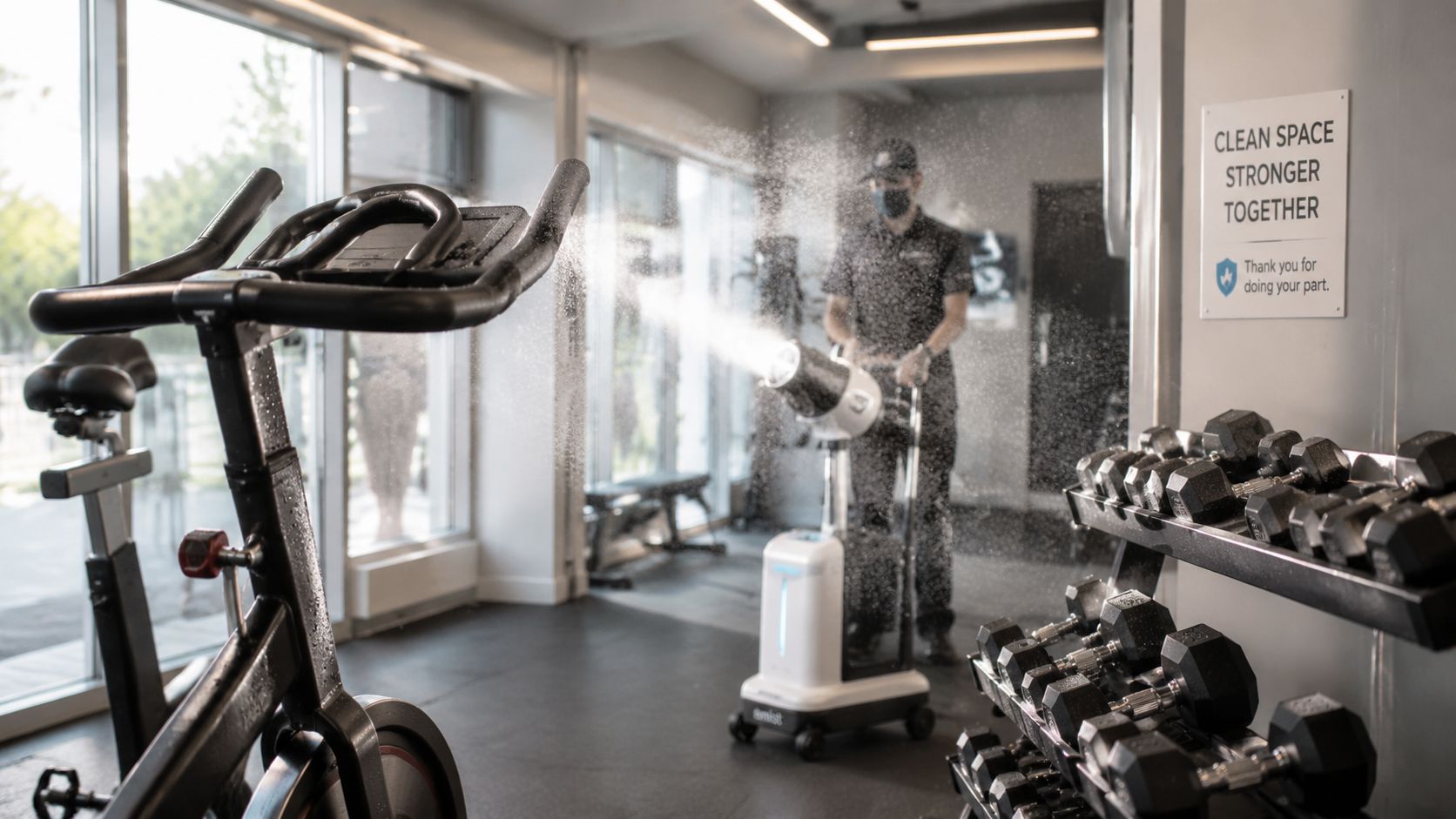
Electrostatic spraying can extend coverage across large, irregular surfaces by applying electrically charged droplets that are drawn toward exposed areas. This can suit equipment frames, locker-room fixtures, and structures with awkward angles. It does not remove visible soil, replace direct wiping of touchpoints, or override the disinfectant label.
The operating decision is whether broader coverage justifies the added control work. Spraying may save time across open areas, yet overspray can reach electronics, flooring, personal belongings, or materials that do not tolerate the product. Before treatment, staff need training on the equipment, a cleared treatment zone, protection for sensitive items, required ventilation, and a re-entry process that respects contact time.
Set clear conditions for use
Use the method during overnight or other off-hours periods when a facility has large floor areas, locker rooms, or limited daytime access. Keep daytime staff focused on direct equipment cleaning and touchpoint disinfection. The deep disinfection service information provides a reference for separating broader treatments from recurring surface work.
A supervisor can approve each treatment against this short control check:
- Product verification: Confirm that the disinfectant is approved for the intended use and relevant pathogens.
- Area preparation: Remove people, loose items, food, personal equipment, and anything vulnerable to moisture.
- Equipment training: Keep manufacturer instructions and staff training records available.
- Application control: Set spray distance, coverage expectations, and surfaces that must remain untreated.
- Re-entry control: Follow label requirements for contact time, drying, ventilation, and safe occupancy.
- Batch documentation: Record the product, batch information where applicable, operator, area, and treatment time.
A written stop point prevents rushed reopening. Staff should not release the area until the label conditions are met and the supervisor has confirmed that sensitive surfaces remain protected.
Use plain signage for members. State that electrostatic treatment supports the wider cleaning system and does not remove the need for ordinary daytime cleaning.
Before purchasing equipment, identify the actual constraint: coverage, labour availability, difficult geometry, or missed visible-soil removal. If the problem is poor equipment wipe-downs or slow class turnover, a sprayer adds cost without correcting the workflow.
3. Zoned Deep Cleaning Rotation Schedule
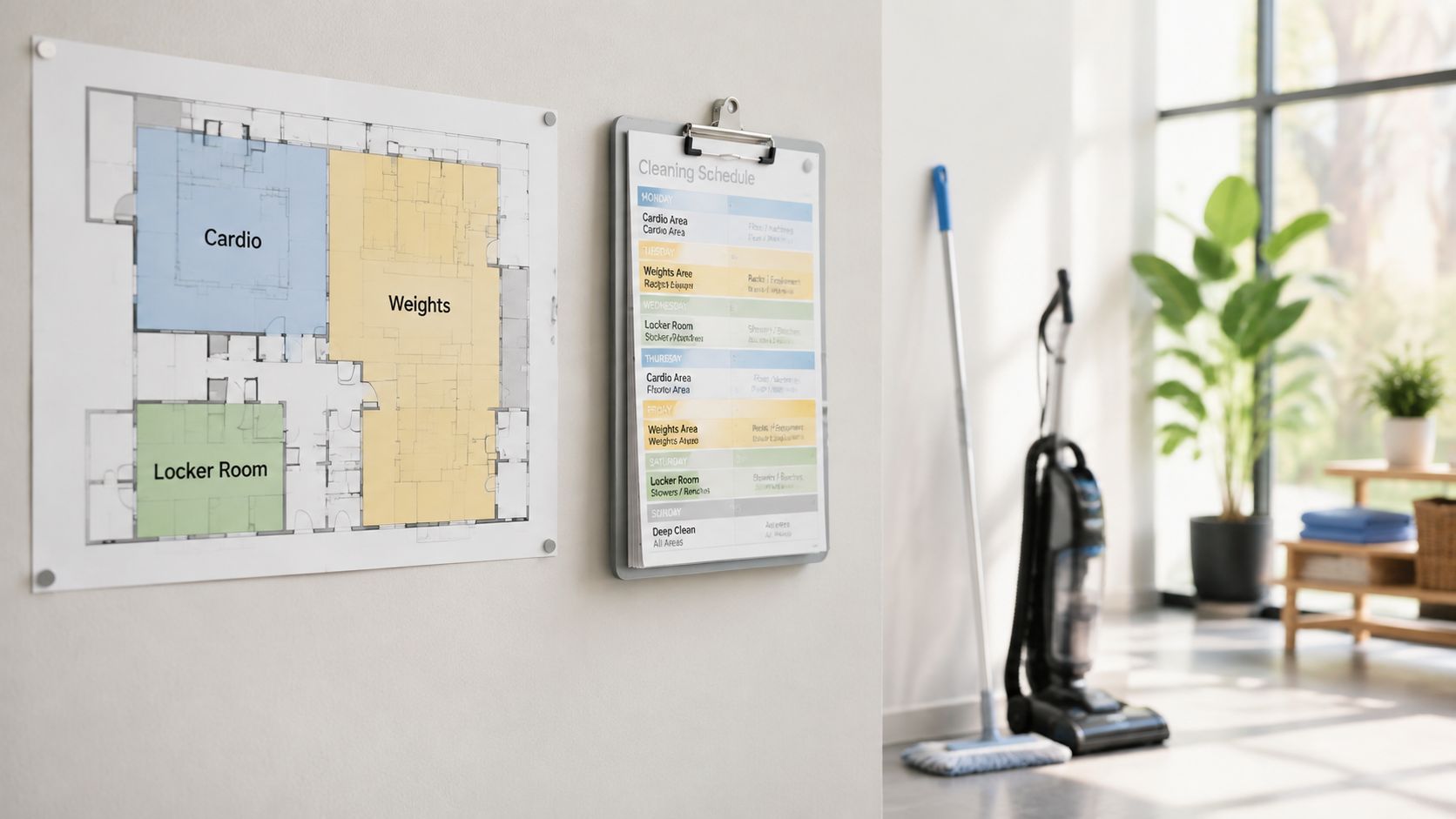
A floor plan becomes a practical cleaning tool when staff divide it into working zones. Cardio equipment, free weights, functional training areas, studios, reception, washrooms, change rooms, showers, and storage have different surfaces, traffic patterns, moisture exposure, and access limits. The schedule should reflect those differences rather than assign every room the same task frequency.
Ontario's reopening framework made documented sanitation an operational responsibility. Toronto guidance directed gym and fitness operators to sanitize shared equipment after each use, clean high-touch surfaces frequently, and maintain cleaning logs. Ontario Regulation 263/20 also requires washrooms, locker rooms, change rooms, showers, and public-use equipment to be cleaned and disinfected as frequently as necessary to maintain sanitary conditions.
Build the rotation around risk and access
A zone's assigned deep-clean date controls detail work, not basic safety. Staff must act sooner if an area becomes visibly dirty, wet, odorous, or unsafe. Detail tasks may include moving equipment, cleaning edges, treating grout, reaching behind fixtures, and checking surfaces that routine rounds miss.
Each zone card should answer five practical questions:
- Boundary: Which rooms, machines, fixtures, and storage points are included?
- Surface method: Which product and tool suit rubber flooring, metal, upholstery, tile, glass, or sealed surfaces?
- Risk trigger: What requires immediate action, such as bodily-fluid contamination, visible soil, standing water, or persistent odour?
- Completion standard: What must staff see before release, including dry floors, clear drains, clean touchpoints, and returned equipment?
- Verification: Who checks the work, and where is completion recorded?
A small facility may manage this with colour-coded paper cards. A multi-site operator may need digital records for timestamps, missed-task alerts, photographs, and issue escalation. In either case, a supervisor still needs to inspect the space. Records support accountability, but they do not confirm that a neglected corner is clean.
Review the rotation when attendance, programming, or room use changes. A lightly used reception area may need less detail work than a busy functional-training zone. Showers and change rooms should be scheduled according to sanitary conditions, not administrative convenience. A commercial gym cleaning service designed for the facility can help set up and maintain this system.
4. Allergen and Biofilm Removal Programs
A damp locker-room corner can look clean while residue remains around grout, drains, sauna benches, mats, equipment seams, and poorly ventilated surfaces. Sweat, skin cells, dust, cleaning residue, and moisture can combine into biofilm, a layer of microorganisms and organic material attached to a surface. Removing it usually requires mechanical action and chemistry suited to the material.
Begin with a moisture and soil inspection. Look for a slimy feel, discolouration, recurring buildup, musty odour, damaged sealant, blocked drainage, or surfaces that stay damp after normal use. These findings indicate a maintenance problem. Fragrance or a single spray will not correct the source.
Use this decision sequence during wet-zone detail work:
- Inspect: Check showers, drains, steam rooms, saunas, and change rooms for residue and standing moisture.
- Select: Confirm that an enzyme-based or specialized product is compatible with the surface, then follow its label.
- Agitate: Brush or otherwise work the residue loose before rinsing. Mechanical action often determines whether the treatment succeeds.
- Dry: Remove remaining moisture and confirm that the area can dry between use periods.
- Escalate: Persistent dampness may require plumbing, drainage, sealant, or HVAC attention.
Ventilation and worker protection belong in the work instruction. Staff should use the protective equipment required by the product and WHMIS documentation, record the location, condition, product, dwell time, corrective action, and follow-up inspection, then have a supervisor verify the result.
Steam cleaning may suit selected detail tasks, but uncontrolled heat or moisture can affect adhesives, electronics, painted finishes, and vulnerable flooring. The steam-cleaning service information can help determine whether specialized equipment fits the facility's maintenance plan.
Allergen control extends beyond visible biofilm. Remove dust, keep ventilation components clean, dry mats thoroughly, and launder or replace absorbent materials as required. Testing can support a documented concern, while routine inspection and moisture correction remain the operating foundation.
5. Real-Time Equipment Sanitation During Operating Hours
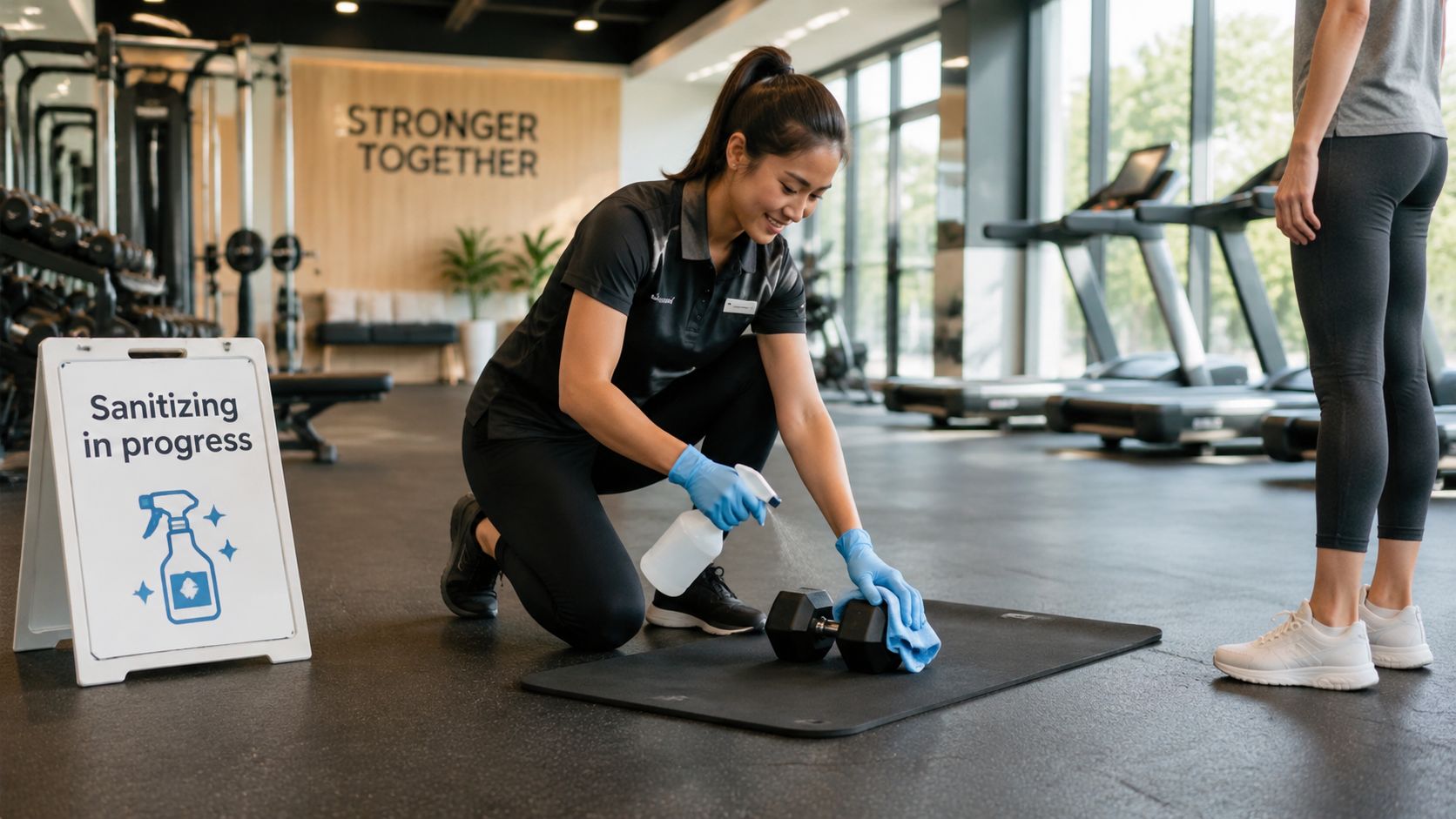
The opening shift cannot carry a gym through a full day of shared equipment use. Members handle grips, benches, mats, adjustment controls, screens, rails, and accessories throughout operating hours. Canadian occupational-health guidance recommends increased routine cleaning, cleaning shared work areas between users or shifts, and disinfecting equipment between users (Canadian Centre for Occupational Health and Safety gym guidance).
Real-time sanitation needs assigned coverage. A circulating attendant can spot visible soil, replenish cloths and product, respond to incidents, and keep stations ready between uses. Labour is the trade-off, so base coverage on occupancy, peak periods, and class schedules rather than staffing every hour equally. During quieter periods, the same employee may combine sanitation with inspection or supply checks.
Set the route before the busy period begins. Define zones such as cardio, selectorized equipment, free weights, functional areas, and shared accessories. A simple zone board shows who is responsible and prevents two attendants from overlooking the same station. Lightweight bottles, suitable cloths, and safe carrying methods reduce fatigue. Rotation limits repetitive strain.
Use an SOP card that staff can follow without interpretation:
- Opening check: Verify product identity, dilution where applicable, cloths, PPE, signage, and waste containers.
- Between-use response: Remove visible soil, apply the product correctly, observe its contact time, and leave the surface dry enough for the next user.
- Equipment protection: Keep liquid away from screens, ports, controls, bearings, and electrical openings.
- Escalation: Isolate and report damaged upholstery, rust, loose components, spills, bodily-fluid contamination, or product incompatibility.
- Handoff: Record missed areas, shortages, incidents, and equipment requiring maintenance.
Place member-use supplies where people naturally finish a set. Clear instructions and trainer reminders improve participation, while staff should correct missed cleaning without shaming members. Member-led cleaning extends coverage, but it does not replace staff inspection.
Supervisors should check whether attendants are cleaning or merely patrolling. Review the log against peak-use periods, then adjust zone coverage, supply points, or staffing. For equipment-specific handling, consult the guidance on sanitizing gym machines.
6. Floor Care and Slip-Hazard Prevention Protocol
A clean-looking gym floor can still be unsafe. Sweat, chalk, rubber debris, drinks, shower water, outdoor footwear, and cleaning residue affect traction in different ways. Treat slip prevention as an operating control, not a cosmetic task.
Start by identifying each surface: rubber flooring, resilient sheet goods, sealed concrete, tile, wood, carpet, and athletic surfaces have different limits for water, agitation, pH, and finish products. Use the manufacturer's care instructions to choose routine cleaners and restoration methods. Test unfamiliar treatments in a discreet area before applying them across the facility.
Set the response before the spill
A spill during operating hours requires immediate action. The assigned staff member should isolate the area, place warning signage, remove the liquid, clean the affected surface, dry it, and verify traction before reopening the space. Signage controls access, but it does not confirm that the floor is safe.
Protect traction before appearance.
Wet zones require a separate inspection routine. Check shower floors, pool decks, mats, grout, drains, and thresholds for standing water, damaged edges, poor drainage, and moisture migrating into dry areas. Ontario public-spa requirements provide a water-chemistry benchmark for facilities with hot tubs or spa areas, including free available chlorine or total bromine maintained at 5 to 10 mg/L, pH between 7.2 and 7.8, and total alkalinity not less than 80 mg/L (Ontario public-spa regulation). Dry gym floors do not use those chemical controls. They depend on soil removal, correct drying, visual checks, and timely repairs.
Use this schedule as an SOP-ready baseline:
- During operating hours: Respond to spills immediately, inspect high-traffic transitions, and keep wet-zone access controlled until dry.
- At closing: Remove loose soil, clean the floor by surface type, inspect edges and seams, and record defects.
- During scheduled restoration: Plan stripping, sealing, refinishing, or other intensive work for closure or low occupancy. Review strip and wax service information before assigning restorative work.
- After incidents: Record the location, condition, response, staff member, and required follow-up.
- At supervisor review: Check recurring slip points, product buildup, damaged flooring, and whether corrective maintenance was completed.
Do not apply finish merely because a floor looks dull. Excess product can build up, complicate future cleaning, and reduce traction. Restore only when the surface condition, manufacturer guidance, and operating schedule support the work.
7. Odour Control and Ventilation Integration
A recurring smell points to a system problem, not a missed wipe. Sweat residue, damp textiles, drains, biofilm, mould, stagnant air, full waste containers, or contaminated HVAC components can all contribute. Air freshener may cover the odour temporarily while leaving the moisture or soil source untouched.
Start with a short odour audit. Record the location, time, strength, damp surfaces, recent cleaning, and any change when fans or ventilation operate. Check locker rooms, shower and floor drains, mats, laundry holding areas, waste points, storage rooms, and mechanical spaces. A pattern that returns after cleaning requires maintenance review.
Match the response to the source
Moisture control comes first. Dry exercise areas and wet zones need different cleaning methods, and facilities with spa areas should maintain applicable water-testing records. A musty smell near a drain calls for drain inspection and cleaning. A sour smell from stored mats calls for drying, cleaning, and improved air circulation. Persistent odour after these actions should be escalated rather than assigned to repeated surface wiping.
Gym activities create different air and soil demands across strength training, group fitness, personal training, cardiovascular training, yoga, and indoor sports, as described in federal occupational guidance for gyms and fitness clubs. Divide the facility by zone, then assign checks according to moisture, occupancy, and odour risk.
Use this decision sequence:
- Locate: Identify the room, surface, drain, textile, waste point, or mechanical area producing the smell.
- Remove the source: Clean compatible drain surfaces, remove waste, wash soiled materials, and dry damp areas.
- Control moisture: Store mats and absorbent items with airflow. Check rooms that remain humid or wet.
- Verify ventilation: Confirm fan operation, filter service, and HVAC maintenance with the building team.
- Escalate defects: Refer leaks, mould concerns, drainage faults, and odours that persist after cleaning to qualified maintenance personnel.
- Record the result: Note the action taken, responsible party, follow-up date, and whether the odour returned.
Cleaning staff can address many surface and drain conditions. Property management may control ventilation performance and building repairs. Assigning ownership prevents repeated cleaning of a source that remains unresolved.
8. Post-Class and Post-Event Rapid Turnaround Cleaning
A class ends, the next group is waiting, and the room still contains used mats, damp spots, discarded bottles, and equipment left out of position. A rapid reset should restore safe operation without reducing cleaning to hurried wiping. Staff need supplies ready at the point of use, room-specific instructions, assigned responsibilities, and a final inspection.
Prioritise what the session changed: shared equipment, handlebars, benches, controls, mats, visible soil, waste, and floor hazards. A short gap is not the right time for every intensive task. Schedule deeper work through the daily, weekly, or zoned rotation plan.
Build the reset around room risk
Post a waterproof checklist inside the storage cabinet or keep it on a clipboard. Numbered actions make the sequence clear when turnover time is tight:
- Clear equipment: Remove used towels, bottles, waste, and personal items.
- Check contact points: Wipe shared handles, controls, seats, mats, and adjustment surfaces.
- Follow product directions: Apply sufficient product and observe its required contact time.
- Inspect the floor: Remove sweat, chalk, water, debris, and trip hazards.
- Reset the room: Return equipment, replenish supplies, and confirm ventilation.
- Verify readiness: A designated staff member completes the final visual inspection.
The checklist must match the room. A spin studio, weight area, and yoga room have different equipment, surfaces, and reset risks. Instructors should know which actions fit within the available gap and which require a longer closure.
Store product labels, PPE, cloths, waste bags, and signage safely in the relevant room or zone. Pre-staging reduces walking and protects the time needed for product contact. If the timetable leaves insufficient time, change the reset design, select an approved product suited to the task, or extend the interval between sessions. Staff should not shorten the required contact time to reopen the room faster.
Record readiness on a reset board, then verify it physically. The fitness centre cleaning checklist offers a useful reference for adapting room-specific SOPs. For events, add a named supervisor and a completion time so unresolved hazards are handed over rather than concealed by a quick room changeover.
8-Point Gym Cleaning Strategy Comparison
| Strategy | Implementation Complexity | Resource Requirements | Expected Outcomes | Ideal Use Cases | Key Advantages |
|---|
| High-Touch Surface Disinfection Protocols | Low–Moderate: scheduled cycles and staff training | Moderate labour, Health Canada/EPA disinfectants, documentation tools | Reduced pathogen transmission; compliance; visible cleanliness | Gyms with high-touch equipment and steady foot traffic | Targeted risk reduction; scalable; audit trails |
| Electrostatic Disinfection Technology | Moderate–High: equipment setup, operator certification, safety procedures | High upfront equipment cost, hospital-grade disinfectants, trained operators | Rapid, comprehensive 3D coverage; large-area reduction of pathogens | Large facilities, overnight deep cleans, locker rooms/showers | Fast coverage; reaches crevices; reduces labour time |
| Zoned Deep Cleaning Rotation Schedule | Moderate: mapping, scheduling, and coordination | Planned labour cycles, zone-specific tools/equipment, checklists | Regular intensive cleaning with minimal full closures; even cost distribution | Multi-zone facilities seeking ongoing maintenance (cardio, weights, locker rooms) | Minimizes downtime; targeted attention; predictable scheduling |
| Allergen and Biofilm Removal Programs | High: specialised protocols, testing and certification | Enzyme/proteolytic cleaners, antifungals, HEPA filtration, certified staff | Improved indoor air quality; reduced mold/biofilm and related complaints | Facilities with pools, saunas, damp locker rooms or chronic moisture issues | Addresses hidden contamination; protects infrastructure and health |
| Real-Time Equipment Sanitation During Operating Hours | Moderate–High: staffing, real-time coordination and training | Additional full-/part-time staff, portable sanitizers, PPE, tracking tools | Continuous reduction of surface contamination; increased member confidence | Premium gyms, boutique studios, peak-hour high-traffic facilities | Immediate turnover cleaning; visible hygiene commitment; catches maintenance issues |
| Floor Care and Slip-Hazard Prevention Protocol | Moderate: varied techniques per flooring; periodic closures for refinishing | Specialized equipment (polishers, pressure washers), coatings, trained staff | Fewer slip-and-fall incidents; extended flooring life; regulatory compliance | Facilities with mixed floors and wet zones (entrances, showers, pool decks) | Liability reduction; asset preservation; ADA/accessibility support |
| Odour Control and Ventilation Integration | High: HVAC audits, system upgrades and integrated treatments | HVAC maintenance/upgrades, enzymatic odour eliminators, humidity control, monitoring | Elimination of root odour causes; improved air quality and reduced complaints | Locker rooms, shower-heavy facilities, spaces with persistent odours | Treats causes not masks; reduces airborne pathogens; long-term improvement |
| Post-Class and Post-Event Rapid Turnaround Cleaning | Moderate: tight workflows, well-practiced checklists | Dedicated turnaround staff, pre-staged supplies, quick-drying disinfectants, communication tools | Short between-class downtime; maintained hygiene; higher class throughput | Studios and facilities with back-to-back classes or frequent events | Enables more sessions; consistent quick resets; accountability via checklists |
Turn the Strategy Into a Working Cleaning System
The eight strategies work as a system only when the facility turns them into assigned actions. Start with a floor map. Mark high-touch points, wet areas, equipment groups, class studios, washrooms, change rooms, storage, waste points, and areas where staff have reported odour, residue, or recurring spills.
Next, classify each area by touch risk, moisture risk, surface type, occupancy, and turnover pressure. High-touch equipment needs recurring attention during use. Washrooms, locker rooms, change rooms, and showers need cleaning and disinfection as frequently as necessary to maintain sanitary conditions. High-touch surfaces should be cleaned and disinfected at least daily and whenever visibly dirty, with greater frequency when local conditions require it (Toronto guidance for recreational amenities).
A working schedule should distinguish between:
- Operating-hour tasks: Equipment touchpoints, visible spills, shared accessories, room resets, washroom checks, and supply replenishment.
- Daily tasks: Floors, high-touch surfaces, washrooms, change rooms, showers, waste, reception, and condition inspections.
- Rotational tasks: Edges, equipment bases, grout, storage, vents, detailed fixture cleaning, and zone-specific restoration.
- Corrective tasks: Moisture defects, odours, damaged flooring, blocked drains, mould concerns, and bodily-fluid incidents.
- Verification tasks: Supervisor inspections, log review, product checks, incident records, and member-feedback review.
Every disinfectant requires label verification. Health Canada notes that products may require protective equipment, ventilation, and enough contact time to deactivate a virus (Health Canada cleaning and disinfecting requirements). Staff should know where safety data sheets are kept, how WHMIS information is communicated, what to do after exposure, and who can authorize a product change.
Sample SOP-ready actions
Equipment SOP
- Remove visible soil using the approved method.
- Apply the approved product to the compatible surface.
- Keep the surface wet for the label contact time.
- Protect screens, ports, controls, and electrical openings.
- Record the route or complete the digital task.
- Escalate damage, residue, odour, or contamination.
Shower and change-room SOP
- Inspect drains, grout, fixtures, benches, floors, and waste.
- Remove hair, soil, and standing water.
- Clean before disinfecting when the label requires it.
- Use required PPE and ventilation.
- Check dryness, odour, and slip hazards.
- Record defects for maintenance follow-up.
Floor SOP
- Isolate spills immediately.
- Place warning signage.
- Use the surface-specific product.
- Remove residue and dry the area.
- Inspect transitions, edges, and wet-zone thresholds.
- Log incidents and recurring trouble spots.
Post-class SOP
- Clear waste and used materials.
- Clean shared equipment and touchpoints.
- Inspect floors and room layout.
- Replenish supplies.
- Complete the final readiness check.
- Record exceptions before the next class.
How to evaluate a cleaning provider
A provider comparison should focus on operational evidence, not polished promises. The facility manager should ask:
- Scope: Are equipment, washrooms, showers, change rooms, floors, studios, reception, waste, and corrective work listed separately?
- Staffing: Who works during operating hours, who covers absences, and who performs supervision?
- Products: Will the provider supply product names, approval information, safety data sheets, dilution instructions, and contact times?
- Training: How are staff trained in equipment compatibility, PPE, WHMIS, spills, bodily-fluid incidents, and wet-floor controls?
- Quality assurance: What does the supervisor inspect, how often, and how are deficiencies corrected?
- Reporting: Will the facility receive task logs, incident reports, supply alerts, and issue escalation?
- Insurance: Can the provider show current insurance and explain responsibility for damage or incidents?
- Communication: Who responds to urgent requests, schedule changes, missed tasks, and member-facing concerns?
What should be avoided is equally clear. Avoid a proposal that says “deep cleaning” without defining rooms, surfaces, methods, frequency, and completion standards. Avoid a provider that won't explain dwell time, PPE, product compatibility, or inspection procedures. Avoid selecting solely on the lowest quote when the scope excludes the labour needed for class resets, wet-area checks, and documentation.
Frequently asked questions
How often should a gym be cleaned?
A gym needs recurring cleaning throughout operating hours, daily cleaning of key surfaces and amenities, and scheduled rotational detail work. The exact frequency should follow traffic, touch, moisture, visible soil, class turnover, and sanitary conditions, not a fixed template.
Why does disinfectant dwell time matter?
Dwell time is the period the surface must remain wet for the product to work as directed. Health Canada guidance treats the product label, including contact time and ventilation requirements, as an operational requirement rather than an optional suggestion (Health Canada's disinfecting guidance).
When should locker rooms and showers receive deep cleaning?
They should receive routine cleaning and disinfection as frequently as needed to maintain sanitary conditions. More intensive work should be scheduled when inspections identify residue, biofilm, odour, standing water, grout buildup, drainage problems, or recurring soil.
Who handles PPE and chemical safety?
The employer or contracting organization must define PPE responsibilities, provide the required training and equipment, maintain safety information, and ensure staff follow product labels and WHMIS procedures. The facility should confirm these responsibilities in the service agreement.
What belongs on a gym cleaning checklist?
A checklist should identify the zone, surface or fixture, product, tool, contact time, PPE, completion time, staff initials, inspection step, and escalation requirement. It should also include room-specific actions for equipment, washrooms, showers, floors, waste, spills, and class resets.
Where do gym odours usually originate?
Common sources include damp mats, drains, shower grout, waste, sweat residue, poorly dried surfaces, biofilm, ventilation problems, and building moisture defects. Air freshener may conceal the smell temporarily, but it doesn't correct the source.
How are gym cleaning costs driven?
Costs are influenced by facility size, operating hours, number of zones, class turnover, wet areas, equipment density, floor types, required staffing, specialized treatments, supply responsibility, reporting, and emergency response. A clear scope makes quotes more comparable than a vague square-foot description.
What should a gym ask before hiring a cleaning provider?
It should ask for a zone-specific scope, staffing plan, product documentation, training records, PPE procedures, quality-assurance process, communication plan, insurance details, references where appropriate, and a clear process for missed work or urgent contamination.
Further reading
For service-area planning, review Arelli Cleaning's locations. Relevant internal resources include commercial gym cleaning services, detailed disinfection and sanitizing, deep disinfection services, and specialty floor care.
External references include Canadian Centre for Occupational Health and Safety gym guidance, Public Health Ontario environmental-cleaning guidance, Ontario Regulation 263/20, and Health Canada's cleaning and disinfecting guidance.
The next practical step is to complete the zone map, adapt the SOP actions to the facility, and request two or three quotes using the same written scope. Ask informed questions about products, dwell time, PPE, staffing, inspection, documentation, and emergency response. Arelli Cleaning can be included as one option in that comparison when a facility is evaluating recurring gym cleaning, disinfection, floor care, and flexible commercial service arrangements.
Arelli Cleaning provides gym and commercial cleaning services that can include routine upkeep, high-contact disinfection, deep disinfection, restroom sanitizing, floor care, carpet cleaning, power washing, and related specialty work. Visit Arelli Cleaning to discuss a facility-specific cleaning scope and request information for an informed comparison.









.webp)