A downtown tower can look spotless at 8:15 a.m., then start falling apart in small ways by lunch. Lobby glass shows fingerprints, elevator buttons get sticky, shared washrooms run out of detail between checks, and the evening team inherits tenant suites that need quiet access after staff have gone home. In a multi-tenant building, cleanliness is never just about appearance, because every common area shapes how tenants judge the whole property.
The cleaning plan has to fit the building, the tenants, and the season. Toronto adds its own complications, from winter salt and slush at the entrances to narrow service windows in occupied towers, so generic office cleaning checklists break down fast. The right approach is a building-specific control system, one that defines zones, frequencies, responsibilities, and escalation rules clearly enough to survive real-world use.
Table of Contents
Key Takeaways and Your Toronto Multi-Tenant Cleaning Checklist
What Makes Multi-Tenant Cleaning Different in Toronto
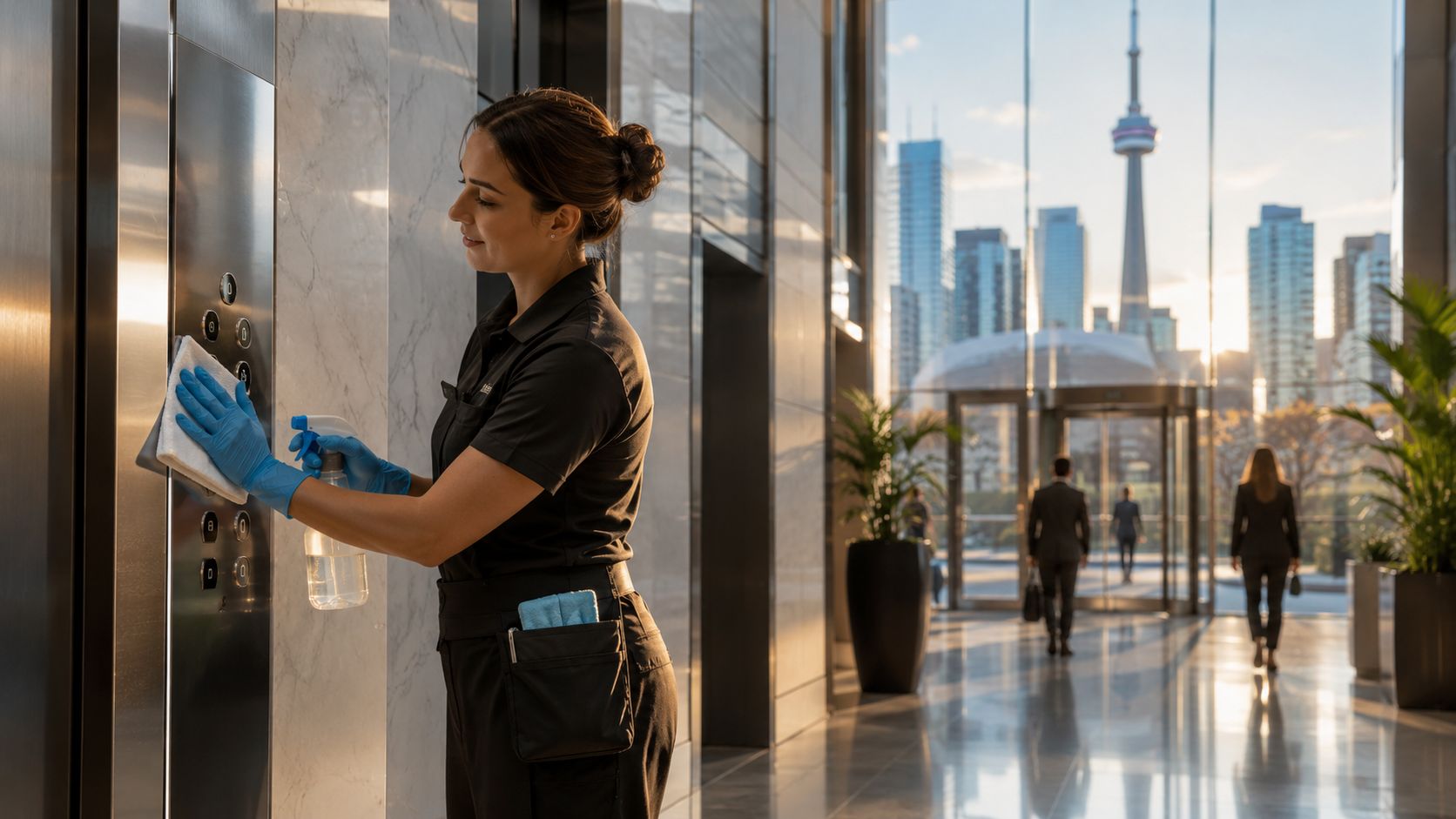
A single-tenant office can sometimes live on a tidy nightly reset. A multi-tenant tower can't. At 8:30 a.m., the lobby is handling arrivals, deliveries, and foot traffic from multiple businesses. By mid-day, elevator call buttons, washroom fixtures, shared pantry surfaces, and corridor touchpoints have all seen different users, and none of those users controls the schedule.
That's why multi-tenant cleaning is a coordination problem first. The cleaner isn't only removing soil, they're working around access limits, security procedures, tenant expectations, and shared reputational risk. One missed washroom check or a late lobby reset affects every occupant, even if only one tenant caused the traffic spike.
Practical rule: the building needs one cleaning standard for shared space, then separate service rules for tenant suites, special-use areas, and after-hours work.
A tower also needs a clear boundary between common areas and leased space. Toronto's building owner guidance for apartment buildings requires daily inspection of common areas and a written cleaning plan, and the minimum scope includes lobbies and entrances, hallways, stairwells, elevators, common-area washrooms, and garbage chute or compactor rooms, among others (Toronto Building Owner Handbook). That same logic translates well to office towers, because the building manager can't rely on one generic checklist when different floors and tenants have different patterns of use.
The market structure matters too. Ontario's janitorial services market is described as large and fragmented, with no dominant players, while the broader Canadian janitorial services market is projected to reach $8.9 billion in 2026 (Ontario cleaning market report). For Toronto property managers, that means there are usually multiple service models to compare, which is useful because the building should be buying a system, not just labour.
For a practical reference on missed-call workflows in another service setting, house cleaning missed call solutions can be useful as a process example. The principle is the same, response systems matter as much as the task itself. A building that can't route requests, complaints, and spill escalations cleanly will eventually pay for that gap in tenant frustration.
A useful local starting point is office cleaning in Toronto, because the service scope has to match the tower's occupancy pattern, not a broad national template.
Regulatory and Standards Toronto Buildings Must Follow
A Toronto tower stays in better shape when the cleaning contract separates legal minimums, building standards, and tenant preferences. Those layers often overlap in practice, but they are not interchangeable. The agreement should say which requirement is mandatory, which is a building standard, and which is a service preference.
WHMIS governs workplace hazard communication, so cleaning chemicals need proper handling, labels, and safety data sheets on site. A practical reference on 2026 WHMIS training for clinics shows why training and documentation matter anywhere chemicals are stored or used. In a tower, that is not just paperwork, it is a control point for staff safety, spill response, and after-hours access.
Green Seal's Commercial and Institutional Cleaning Services standard goes further by requiring a written cleaning plan for each building, with SOPs for product handling and tracking, equipment operation and maintenance, waste disposal, occupant communication, and schedules for routine, periodic, and maintenance tasks (Green Seal standard). That matters because a high-rise is not a flat checklist. Lobbies, elevators, washrooms, and tenant suites carry different soil loads, access limits, and sign-off requirements.
What should appear in the contract
A Toronto tower cleaning agreement should spell out:
- Scope boundaries, what counts as common area, tenant area, and special work.
- Cleaning frequency, not just “daily service” but zone-based service levels.
- Escalation rules, for spills, complaints, emergency clean-ups, and periodic deep cleaning.
- Product controls, including chemical handling, dilution, and storage.
- Documentation, such as logs, inspections, and proof of completed work.
BOMA Canada's green-cleaning template for tenant spaces also expects at least 50% of cleaning products, materials, and equipment, including dilution systems, to meet sustainability standards, with detailed SOPs and cleaning logs (BOMA Canada template). A building-specific approach still has to account for the Toronto service mix. A financial tenant with light foot traffic, a medical tenant with tighter hygiene expectations, and a food tenant with heavier soil loads should not be billed or serviced as if they generate the same demand. A local spec document points to the same 50% target for products, materials, and equipment, which makes procurement screening more concrete (Ontario spec document).
A cleaning proposal should describe what gets cleaned, how often, with what product class, by whom, and under what escalation rule.
That is the difference between compliance theatre and an operating system. In a dense Toronto tower, documented processes matter because one service failure can ripple across dozens of tenants before management even hears about it. The same contract should also state how shared-area costs are apportioned, because lobbies, washrooms, parking levels, and seasonal entrance mats do not serve every tenant equally. Winter makes that gap obvious. Salt, slush, and moisture land on floors and mats faster than a generic scope can absorb, so the contract needs a method for dealing with peak winter wear without pretending every tenant creates the same burden.
An internal reference point for those building out a broader hygiene programme is commercial disinfection and sanitizing, since disinfection protocols sit inside the larger cleaning plan, not outside it.
High-Touch Surfaces, Disinfection, and Indoor Air Quality
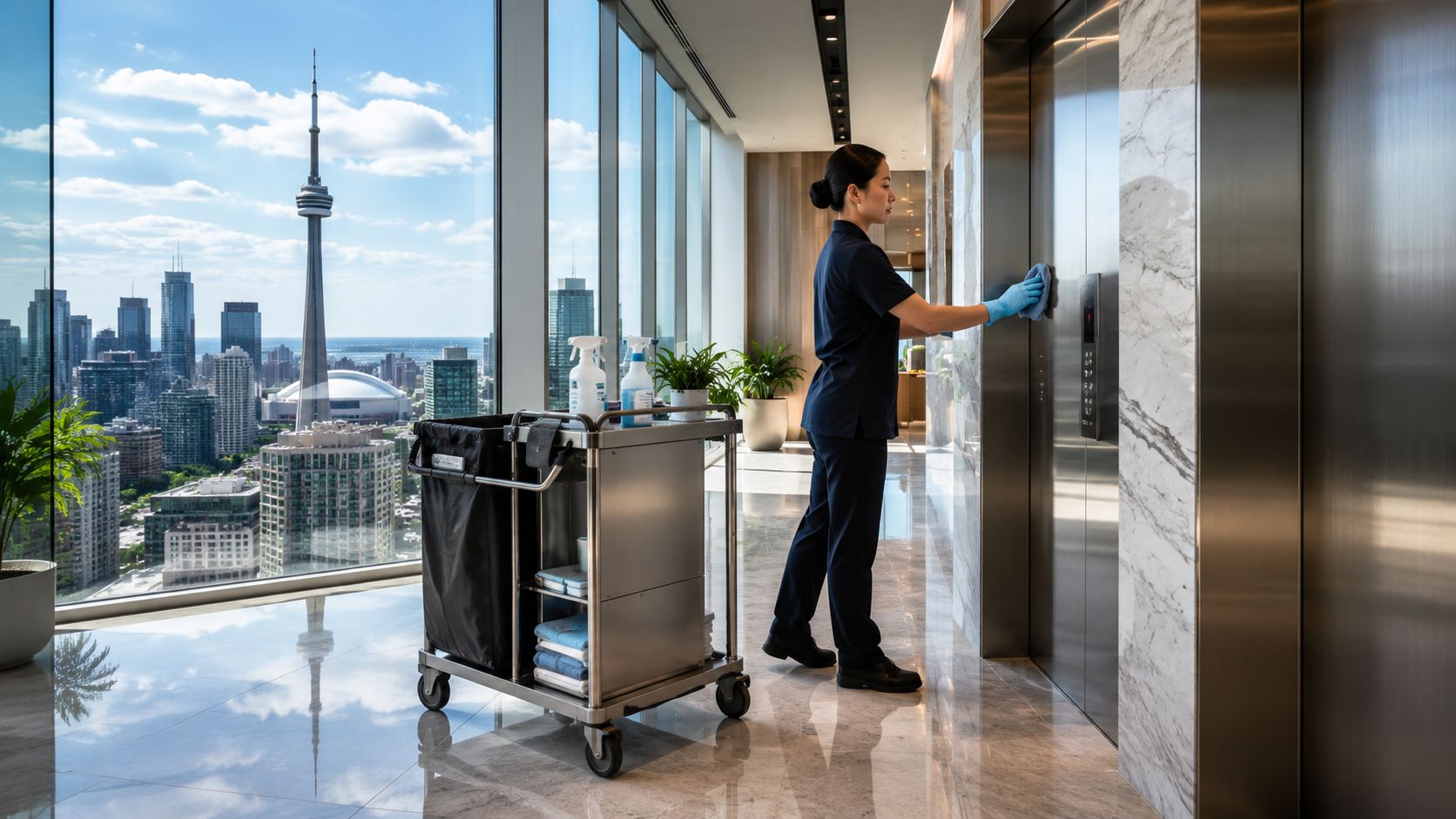
The first complaints in a tower usually come from the places everyone touches. Elevator buttons, door handles, intercom panels, stair railings, washroom fixtures, pantry counters, and reception touchpoints carry the heaviest service burden because they are used all day by different people. Floors still matter, but shared touchpoints shape how occupants judge the building much faster.
That makes the clean and disinfect distinction worth getting right. Cleaning removes soil and residue. Disinfecting adds a chemical step meant to reduce microorganisms on a properly cleaned surface, and that step only works when the product is used correctly and left for the right contact time. In occupied towers, cutting that process short burns product and still leaves complaints behind.
The equipment side matters just as much. Canadian specification documents for multi-tenant facilities call for vacuums capable of capturing 96% of particulates at 0.3 microns, with minimum 3-stage filtration, operation below 70 dBA, and HEPA filters or equivalent bags. The same source requires hot-water extraction equipment to dry carpets in under 24 hours, which helps reduce downtime and re-soiling in high-traffic areas.
Procurement filters that actually change outcomes
A tower manager can screen a proposal by asking whether the program includes:
- HEPA-class vacuuming, especially in lobbies, corridors, and tenant suites.
- Microfiber application methods, where hard-surface cleaners are applied to cloths rather than sprayed directly.
- Backflow prevention, so chemical dispensing stays controlled.
- No aerosol use, which reduces unnecessary airborne release.
- Low-emission product choices, especially where indoor air quality complaints are common.
Toronto-area sustainability guidance also sets a minimum target that 50% of cleaning products, materials, and equipment comply with third-party environmental standards such as UL EcoLogo, Green Seal, or EPA Safer Choice. In practice, that is not just an eco label. It usually means better dilution control, fewer harsh aerosol releases, and more predictable residue management in enclosed towers.
Useful test: if the cleaning method leaves streaks, heavy fragrance, or visible overspray, the process probably needs to be tightened.
For a Toronto office building, sterile-looking surfaces are the wrong target. Reducing re-cleaning cycles, lowering complaint volume, and keeping air quality acceptable in spaces sealed for much of the year gives a better operating result. The right chemistry and equipment can do that without making the building smell like a chemical aisle.
A helpful internal cross-reference is COVID-conscious cleaning, because the operational lesson remains the same, touchpoint control and product discipline are what hold the program together.
Scheduling, Frequencies, and Tenant Coordination Strategies
In a shared tower, the calendar is part of the cleaning system. If the crew cannot get into a space, the service standard does not matter. Toronto buildings usually give cleaning teams narrow windows because tenants occupy suites during the day, security controls access after hours, and loading or service corridors get busy at the same time everyone else is trying to leave.
That is why frequency should follow use patterns, not routine. Common areas usually need daily attention, busy washrooms often need twice-daily service with checks at least every 4 hours, and event-driven work should be triggered for move-ins, move-outs, renovations, and spill incidents. Mixed-use towers make this more obvious, because one floor may stay quiet while another sees constant traffic, and the busiest areas drive the complaint load. For scheduling discipline, Pebb's guidance on cleaning scheduling is a useful reminder that the team needs one visible plan, not a stack of separate assumptions.
Coordination tools that reduce friction
A workable schedule usually includes:
- Tenant notification boards, so occupants know when floors, corridors, or washrooms will be serviced.
- Lease addendum language, so access windows and cleaning expectations do not live in memory.
- Digital checklists, so work can be time-stamped and verified after the fact.
- Escalation paths, for after-hours spills, complaints, and urgent refreshes.
The actual scheduling tool matters less than the operating discipline behind it. If the crew, security desk, and property team are not looking at the same service window, the same disputes return every week.
Toronto service windows usually fail for practical reasons. Someone assumes the building will be empty later, but one tenant works late, another has a board meeting, and a third needs access to a shared kitchenette. The cleaner waits, rushes, or skips details. A written schedule prevents that drift, and it also gives property staff a record when a tenant asks why a corridor or washroom was not serviced on demand.
The schedule should also separate routine work from special work. Standard floor care, washroom service, waste removal, and touchpoint cleaning belong on repeat cycles, while carpet extraction, post-renovation cleanup, and after-hours restoration belong in a different scope. For those one-off or high-intensity needs, specialty cleaning services need their own approval path and timing rules, otherwise they distort the base contract and create arguments about what was included.
A good operational question is simple. Which spaces are cleaned on a clock, and which are cleaned on condition? The answer should be different for lobby tile, elevator thresholds, tenant washrooms, and suite interiors. Lobby finishes may need predictable attention because they absorb winter salt and moisture fast, while tenant interiors often need more flexible timing tied to occupancy and complaints. That distinction keeps the program controlled instead of reactive.
Service-Level Models and Toronto Pricing Considerations
A multi-tenant tower in Toronto costs less to run when the service model matches the building's actual load. A polished lobby with light traffic, a dense office stack with shared washrooms, and a property that takes winter salt at the doors all demand different levels of labor, access, and oversight. The wrong pricing structure usually shows up later as missed tasks, rushed cleaners, or surprise extras.
Common Service-Level Models for Toronto Multi-Tenant Buildings
| Service Model | Typical Best Fit | Pricing Logic |
|---|
| Full-service inclusive | Buildings that want one vendor to handle recurring common-area work, washroom service, and most standard tasks | Usually priced around the building's scope intensity, with staffing and frequency folded into a monthly or annual structure |
| À-la-carte with hourly add-ons | Smaller properties or buildings with very variable needs | Charges follow task time, so special work and spill response can expand the bill quickly |
| Hybrid base plus discretionary deep cleans | Towers with stable daily routines but periodic escalation needs | A fixed core scope covers routine work, then larger jobs are added when demand justifies them |
Toronto pricing is easier to read once the service scope is defined. Standard office cleaning in Toronto is reported at about $40 per hour, while broader commercial cleaning rates are commonly cited at $30 to $80 per hour or $0.15 to $0.25 per square foot for basic services. For larger properties, general janitorial work is often priced at $0.05 to $0.25 per square foot, and multi-tenant buildings commonly budget $2,000 to $5,000+ per month depending on size and frequency.
Those figures still need context. A quiet lobby, a tower with washrooms checked several times a day, and a building with medical or public-facing tenants should not be priced the same way. Access, occupancy pattern, and soil load drive cost more than area alone.
The lowest quote often hides thinner frequencies, weaker documentation, or a scope that expands after signing.
Winter makes the gap easier to see. Salt, slush, and meltwater push lobby floors, mats, elevators, and entrance thresholds out of tolerance faster than a summer-only budget assumes. A building that treats those areas like ordinary office space usually ends up paying more later, either in corrective work or in tenant complaints that force extra visits.
For specialty or occasional work, the scope has to be separate from the base contract. Specialty cleaning services belong in that conversation early, because post-renovation cleanup, carpet extraction, and restorative work can distort recurring pricing if they are left vague. The same is true of any deep clean that depends on after-hours access or extra disposal.
A disciplined buyer asks three practical questions. What is covered in routine service, what triggers extra billing, and how are peak-season demands handled? Shared-area costs also need a fair allocation method when tenants use the building differently, since a lobby-heavy ground-floor tenant and a quiet upper-floor office do not create the same cleaning burden. Those answers tell you more about a proposal than a low headline price ever will.
Choosing a Toronto Cleaning Vendor and Avoiding Common Pitfalls
A good vendor review starts with evidence, not promises. The first filter is training and safety. The cleaning team should have documented WHMIS training, SDS access, and procedures for chemical handling and spill response. After that, the manager should ask for insurance, WSIB coverage, and written SOPs aligned to a recognisable standard.
The next issue is transparency. If a proposal says “best practices” but doesn't say what gets done, how often, and by whom, the scope is already soft. If pricing is vague, it usually gets resolved later through change orders, ignored tasks, or strained service windows. That's rarely a good outcome for a multi-tenant tower.
What to ask and what to avoid
- Ask for a zone-based frequency table, then avoid proposals that only say “daily cleaning.”
- Ask how spills and complaints are escalated, then avoid teams that can't describe a same-day response path.
- Ask for sample logs or inspection records, then avoid any refusal to share proof of work.
- Ask how chemical storage and dilution are controlled, then avoid anyone who can't explain SDS access.
- Ask for comparable Toronto references, then avoid generic praise with no building context.
- Ask how after-hours access works, then avoid handshake arrangements that depend on memory.
A short trial clean is also useful before a long commitment. It gives the property team a chance to see communication, punctuality, finishing quality, and whether the crew understands shared-space sensitivity. Two or three quotes usually tell a clearer story than one polished presentation.
One option some Toronto teams may include in a shortlist is Arelli Cleaning. It offers office and commercial cleaning services, including flexible schedules and specialty work, which makes it relevant for buildings that need recurring common-area service plus occasional add-ons. The important part is not the brand name, it's whether the proposal matches the building's actual operating pattern.
A careful buyer should also watch for a contract that shifts responsibility for supplies, deep cleans, or touchpoint service without saying so plainly. That's where disputes start.
The Underserved Questions Cost Allocation and Winter Operations
Shared-area cleaning costs become contentious when a building mixes very different tenants. A standard office floor, a medical or dental suite, and a ground-floor public-facing tenant do not generate the same cleaning burden, even if they sit in the same tower. The fair answer is rarely one flat allocation.
Three chargeback models tend to make more sense than a blind split. Square-footage allocation works when usage is relatively even. Traffic weighting helps when one tenant's customers or patients create more lobby and washroom pressure. Shared-equivalent units can work when management needs a simplified method that still reflects different operating loads. The key is to define the logic in the SLA before the invoice cycle turns into a dispute.
Winter makes the issue sharper. Toronto's biggest hidden cleaning problem is often not germs, it's salt, slush, and moisture tracking. Entry mats saturate, threshold floors get abraded, elevator lobbies pick up residue, and finish damage starts showing up before anyone calls it a cleaning problem. More disinfecting won't fix that. Better mat rotation, faster entryway service, and floor-care adjustments will.
Winter controls that protect the building
- Escalated lobby service, especially during freeze-thaw periods.
- More frequent mat checks, so trapped moisture doesn't spread.
- Entry-floor attention, because grit damages finishes fast.
- Threshold and stairwell inspection, where tracking often starts.
- Clear billing language, so seasonal extras don't become surprise charges.
A useful internal reference on supplies and consumables is cleaning supplies, because product choice and replenishment strategy both affect service consistency. In winter, that consistency matters more than ever.
In Toronto, the question is often not whether a building is cleaning enough, but whether it is cleaning the right zones often enough for the season.
Most generic guides stop at “keep the lobby clean.” That's too vague for a tower with occupancy churn, mixed tenants, and harsh weather. The better approach is seasonal redesign, with written triggers for when entry service intensifies and how those costs are shared.
Key Takeaways and Your Toronto Multi-Tenant Cleaning Checklist
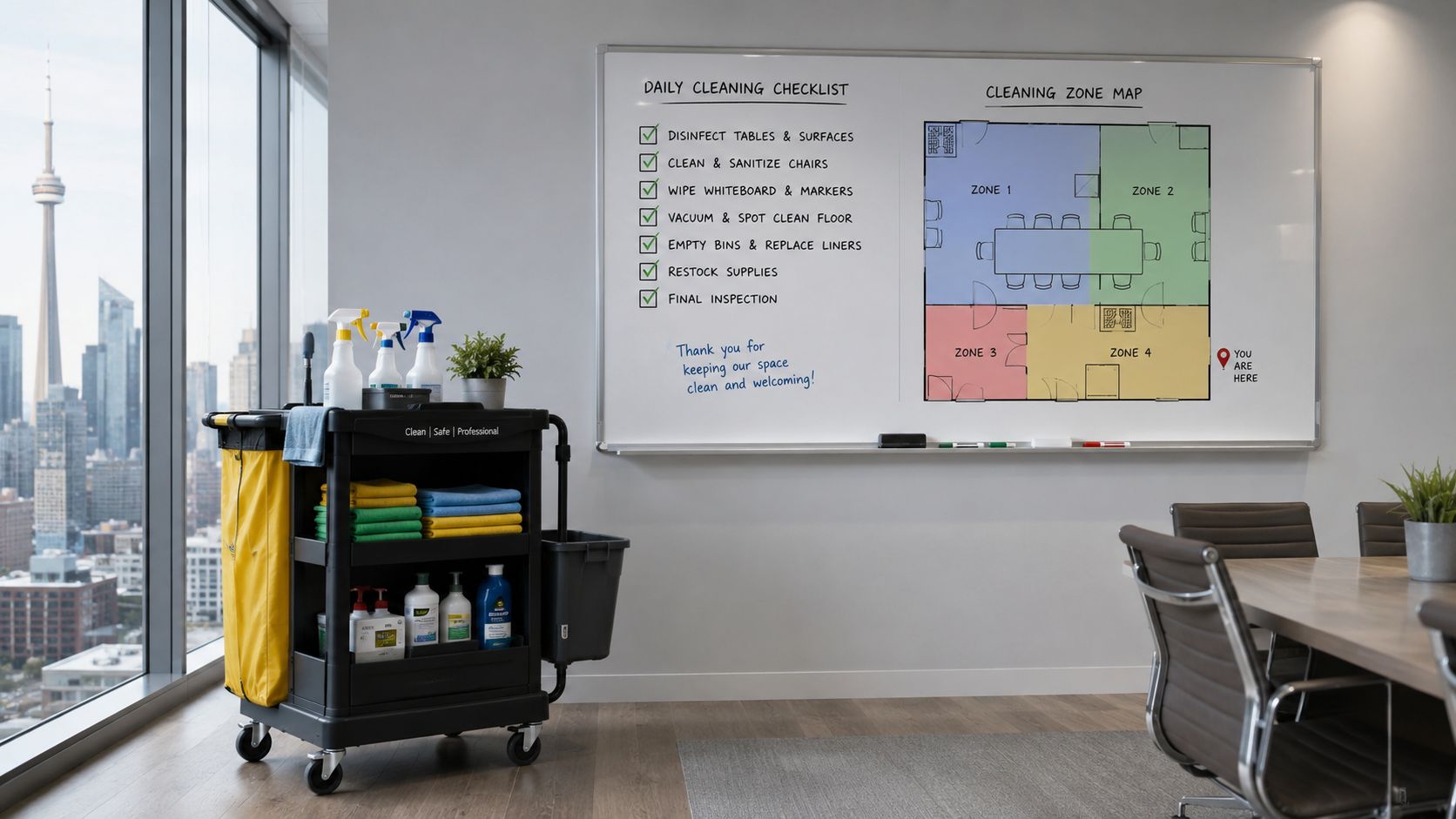
The clearest way to manage a multi-tenant tower is to treat cleaning as a building-specific control system. That means zone-based frequencies, written standards, documented training, and seasonal adjustments that reflect how Toronto buildings operate. It also means cost allocation should match use, not just square footage.
A practical checklist for the next contract review:
- Confirm WHMIS and SDS access, especially for chemicals stored or diluted on site.
- Verify the written cleaning plan, with common areas, tenant spaces, and special tasks separated.
- Check RentSafeTO-style cleanliness language, including inspection and recordkeeping expectations.
- Request zone-based frequency tables, not just a generic daily service promise.
- Ask for sample logs, so the building can verify what gets done and when.
- Clarify chargeback rules, especially for mixed-use or high-traffic tenants.
- Build a winter escalation clause, so entryways, mats, and thresholds get the extra attention they need.
- Get two to three quotes, then compare scope, not just price.
- Use a trial clean if possible, because execution tells the truth faster than a proposal.
This is also the right moment to keep the contract living, not static. Occupancy changes, tenant mix changes, and Toronto's weather changes the service pattern across the year. A good agreement leaves room for those shifts without turning every adjustment into a dispute.
Arelli Cleaning supports Toronto office and commercial cleaning with flexible scheduling, specialty services, and operational documentation that can fit shared-building needs. Property teams comparing cleaning options can visit Arelli Cleaning to review service areas, then use the checklist above to ask stronger questions and gather 2 to 3 quotes that reflect the building's real requirements.








.webp)