Safer Montessori school cleaning starts with removing dirt, choosing products suited to each surface, and sanitizing or disinfecting where the activity, contamination risk, and applicable guidance require it. Ontario schools should give particular attention to child-height shelves, shared learning materials, food-preparation areas, and objects children put in their mouths. Rather than relying on a “non-toxic” claim, use a written routine that controls product exposure, respects label directions, and clearly divides responsibilities between educators and cleaners.
Key takeaways
- Clean the classroom at children’s height, including shelf edges, floor-work areas, low handles, and shared materials.
- Treat wood, fabric, metal, and washable plastic differently; one spray is not suitable for every material.
- Keep children away from cleaning chemicals, wet surfaces, and materials awaiting treatment.
- Separate educator-led daytime hygiene from the cleaning contractor’s after-hours responsibilities.
- Compare written scopes, product procedures, and communication practices—not price alone.
What makes Montessori school cleaning different?
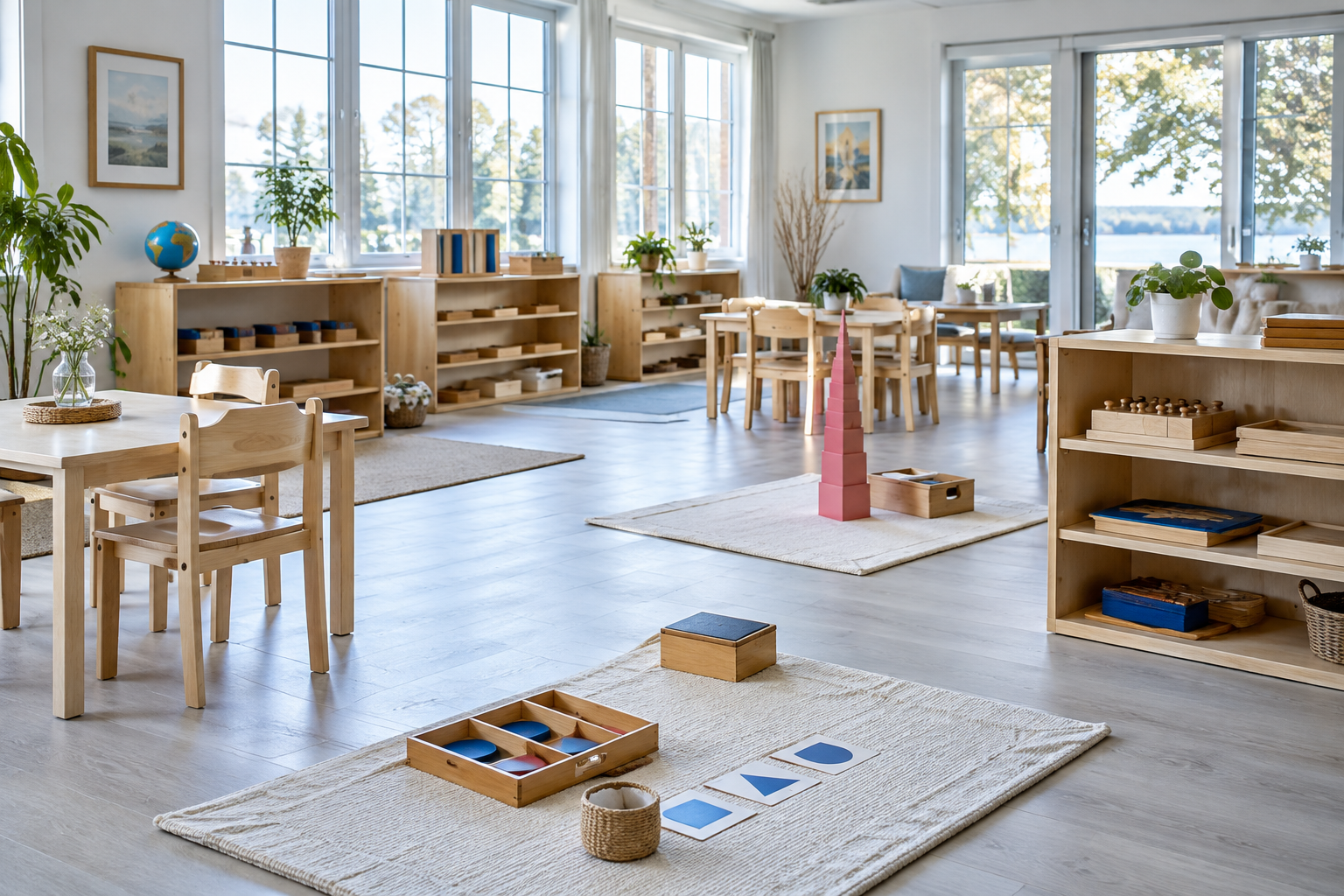
Montessori cleaning must protect a hands-on learning environment where children repeatedly handle materials, work on floors, and prepare food at accessible stations.
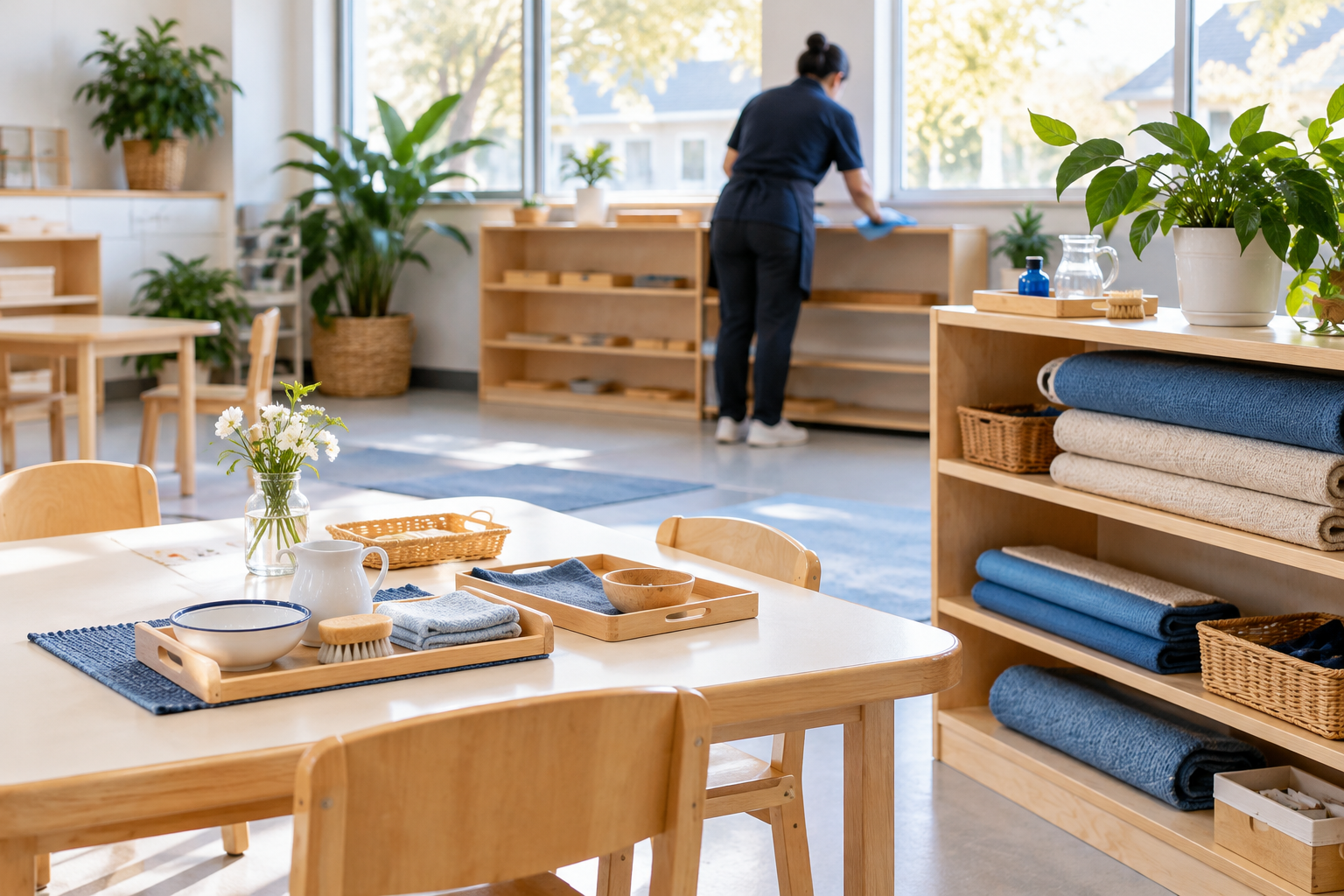
A classroom can look tidy from the doorway while still having sticky shelf lips, crumbs beneath practical-life trays, and soil embedded in floor mats. Children interact with these surfaces directly, so an adult-height inspection misses much of the cleaning workload.
The materials also need careful handling. Wooden cylinders, bead chains, fabric dressing frames, and laminated cards cannot automatically tolerate the same treatment as a washable tabletop. Moving them without a plan can disrupt the prepared environment or leave sets incomplete.
A useful school and education facility cleaning scope identifies child-accessible surfaces, material-care restrictions, and who may move each learning set. Ask the school’s classroom lead to explain the room before finalizing the checklist.
What does “non-toxic cleaning” mean in a Montessori classroom?
“Non-toxic” is not a reliable safety guarantee; a safer routine depends on product selection, exposure controls, and correct use.
A botanical scent or green-looking label does not establish that a product is appropriate around children. Fragrances, essential oils, and homemade mixtures may create sensitivities, leave residues, or damage classroom materials. A product marketed as natural is not automatically a suitable disinfectant.
What to check before approving products
- Intended use: Is it a cleaner, sanitizer, or disinfectant, and does that match the task?
- Surface compatibility: Can it be used on the finish, textile, or learning material involved?
- Directions: What dilution, contact time, ventilation, and rinsing instructions apply?
- Identification: For disinfectants, check for a Health Canada Drug Identification Number and appropriate label claims.
- Handling: Review labels and safety data sheets, maintain proper container labels, and secure storage away from children.
Prefer fragrance-free options where practical and appropriate, but do not mistake fragrance-free for hazard-free. Never mix cleaning products. Where labels permit, controlled application to a cloth can help limit unnecessary spray around classroom materials.
Sustainability also means accurate dispensing, washable cleaning tools with proper laundering, and avoiding unnecessary chemical use. It does not mean weakening required hygiene procedures.
How often should Montessori classrooms and shared materials be cleaned?
Schedule cleaning around actual use and contamination, with routine attention to busy shared surfaces and immediate action for spills or mouthed items.
The following checklist is a planning starting point, not a substitute for applicable Ontario requirements, local public health direction, or the school’s procedures. Increase attention when traffic, illness concerns, or messy activities change the workload.
| Area or item | Suggested cleaning trigger | Important handling note |
|---|---|---|
| Low shelves, handles, and shared tables | Each operating day and when visibly soiled | Include shelf lips, undersides, and reachable edges |
| Floor-work areas | Each operating day; respond promptly to spills | Return the area to use only when dry |
| Shared learning materials | A documented rotation based on use, plus contamination events | Follow manufacturer instructions and classroom priorities |
| Mouthed materials | Remove from circulation immediately | Clean and apply the required treatment before reuse |
| Food-preparation and eating surfaces | Before and after relevant activities | Follow food-contact cleaning, sanitizing, and rinsing directions |
| Washrooms and toileting areas | Routine cleaning plus checks during use | Keep tools separate from classroom and food-area tools |
| Fabric mats and washable textiles | Scheduled laundering and whenever soiled | Dry fully and follow care instructions |
| Entrances and boot areas | During wet weather and the routine clean | Remove grit and manage wet mats promptly |
Ontario winter conditions deserve their own adjustment. Salt, sand, and slush move from boot areas into places where children sit and unroll mats. Entrance care helps, but it does not replace cleaning the classroom floor.
How should wooden Montessori materials and floor mats be cleaned?
Clean Montessori materials according to their construction and manufacturer’s instructions, using the least aggressive compatible method that meets the hygiene need.
Avoid treating every shelf item as a washable toy. Saturating wood may affect its finish, while soaking laminated cards or dressing frames can damage components. If a required treatment is incompatible with an item, keep it out of use while the school determines a suitable alternative.
Wooden and mixed-material learning sets
Remove loose soil first, then use an approved method compatible with the finish. Keep pieces together, allow them to dry fully, and return them to their assigned locations. Do not routinely spray chemicals over stocked shelves.
Mouthed or contaminated objects
Provide a designated, child-inaccessible collection container for items awaiting cleaning. Educators should remove the item promptly and identify the contamination so the person handling it can follow the correct procedure. Do not simply wipe it and return it to circulation without checking the required treatment.
Rugs, mats, and fabric pieces
Vacuum floor-work areas and clean reusable mats according to their care instructions. Launder washable textiles when needed and dry them completely before storage. Periodic carpet or upholstery work can be discussed separately through specialty cleaning services, rather than assumed to be part of the nightly visit.

When is cleaning enough, and when is sanitizing or disinfecting needed?
Cleaning removes soil, while sanitizing and disinfecting serve different purposes and should be selected according to the surface, activity, and applicable procedures.
Food-contact surfaces may require sanitizing; washroom surfaces or contamination incidents may require disinfection. Mouthed objects need the treatment specified by the school’s applicable childcare or public health procedures. Neither a pleasant smell nor a quick wipe confirms that the necessary process is complete.
Remove soil before sanitizing or disinfecting unless the product label expressly allows a combined process for the conditions present. Respect the labelled contact time and keep children away during application and any required drying or rinsing period.
For food-contact surfaces and objects that may go into mouths, check whether the label permits that use and requires a potable-water rinse. Never assume a general-purpose disinfectant can be left on every classroom surface.
For vomit, blood, or other body-fluid incidents, isolate the area and use the school’s incident procedure with trained personnel. These situations should not be treated as routine classroom wiping.
What Ontario hygiene expectations should Montessori schools check?
Ontario Montessori schools should confirm the requirements that apply to their actual programs, because a licensed child care operation and a school-only program may have different obligations.
“Montessori” describes an educational approach; it does not establish the facility’s regulatory category. A site with younger children, toileting support, food preparation, or multiple programs needs a scope that reflects those activities.
Before approving a cleaning plan, confirm:
- Applicable child care licensing requirements, where relevant.
- Local public health guidance and any outbreak-related instructions.
- Food-handling and food-contact surface procedures.
- Safe chemical storage, staff training, and workplace safety responsibilities.
- Procedures for bodily fluids, mouthed materials, and cleaning records.
A contractor can support implementation, but the school remains responsible for determining which obligations apply. Build temporary changes into the plan so illness-related instructions reach educators and cleaners rather than staying in an administrator’s inbox.
What should a Montessori school cleaning contract include?
A useful contract names the areas, tasks, frequencies, exclusions, and responsible people, including the hand-off between educators and the cleaning crew.
Routine commercial cleaning may cover floors, washrooms, waste removal, and agreed shared surfaces. Detailed learning-material care should be discussed explicitly because it requires handling instructions and classroom coordination.
| Responsibility | Practical scope to confirm |
|---|---|
| Educators during the day | Remove mouthed items, manage activity-related hygiene, identify spills, and flag contamination |
| Cleaning crew | Complete agreed floor, washroom, touchpoint, waste, and surface tasks |
| School administration | Approve products, maintain procedures, arrange access, and resolve scope gaps |
| Separately assigned work | Material-by-material cleaning, textile laundering, extraction, high-level dusting, and incident response |
Set boundaries around occupied-room work. Children can participate in age-appropriate practical-life activities with school-approved materials, but should not handle contractor chemicals or replace required hygiene work.
Ask how concerns are reported and closed out. Arelli offers 24/7 client support and an app for reporting concerns and following up; its client care process gives administrators a route to flag missed areas without relying on a note left on a desk.
How much does Montessori school cleaning cost in Ontario?
Montessori school cleaning costs depend on the space, schedule, traffic, washrooms, flooring, and material-handling requirements—not just classroom count.
A room with open shelving, rugs, practical-life stations, and many shared objects may require a different scope from a similarly sized room with mostly clear desks. After-school programming can also narrow the available cleaning window.
Use the cleaning pricing guide to understand the main cost drivers, then request a site-specific assessment. Provide the contractor with:
- Cleanable square footage and room uses.
- Occupancy patterns and desired service frequency.
- Washroom and toileting-area details.
- Flooring types and washable textile responsibilities.
- Food-preparation activities and special material-care requirements.
- Access restrictions and periodic cleaning needs.
Compare proposals against the same written checklist. Arelli offers Price Match on comparable written quotes and no cancellation fees. Confirm what is included before deciding which proposal represents better value.
Frequently asked questions
These answers address common decisions Ontario Montessori administrators face when setting a cleaning scope.
Can we use vinegar instead of disinfectant?
Do not substitute vinegar where sanitizing or disinfection is required. Use a product suitable for the intended task and follow its label; homemade mixtures are not a dependable replacement for a required process.
Do all Montessori materials need disinfecting every day?
Not automatically: treatment should reflect use, contamination, material compatibility, and applicable guidance. Establish a documented routine, with immediate removal of mouthed or contaminated items and any additional measures required during illness concerns.
Can cleaners work while children are present?
Some work may be possible if the school can separate children from products, equipment, and wet surfaces. Schedule disruptive floor care and chemical applications outside occupied periods where practical, with clear rules for reopening the area.
Will cleaners put every material back correctly?
That should be agreed rather than assumed. Shelf photographs, handling instructions, and clearly assigned responsibilities help preserve the prepared environment and prevent incomplete sets from returning to use.
Are green cleaning products suitable for Montessori schools?
They can be, provided they suit the surface and meet the task’s requirements. Ask what environmental claims mean, then check directions, fragrance considerations, safe handling, and whether a separate sanitizer or disinfectant is needed.
How do we choose a Montessori cleaning company?
Ask the provider to explain how it handles child-height surfaces, delicate materials, mouthed items, and classroom access. A walkthrough using your actual checklist is more useful than a general promise of a thorough clean.
Get a free sample clean
A free 45-minute sample clean lets your team assess Arelli’s work before committing. Review your priorities for Montessori and education facility cleaning, choose an agreed sample area, and discuss material-handling boundaries with a local crew—not a franchise.
Book a free sample clean to build a practical cleaning scope around your classrooms, schedule, and hygiene procedures.