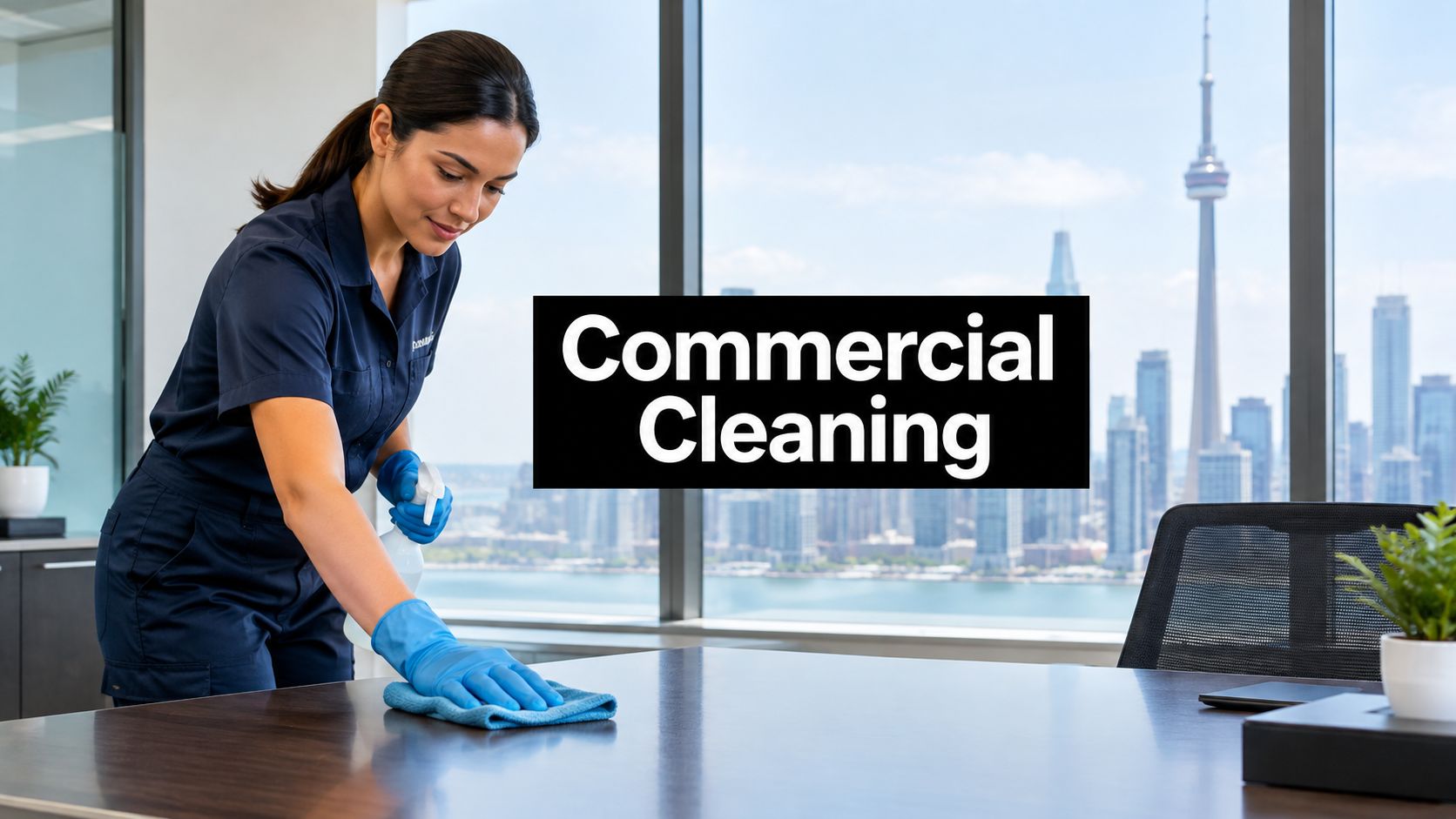
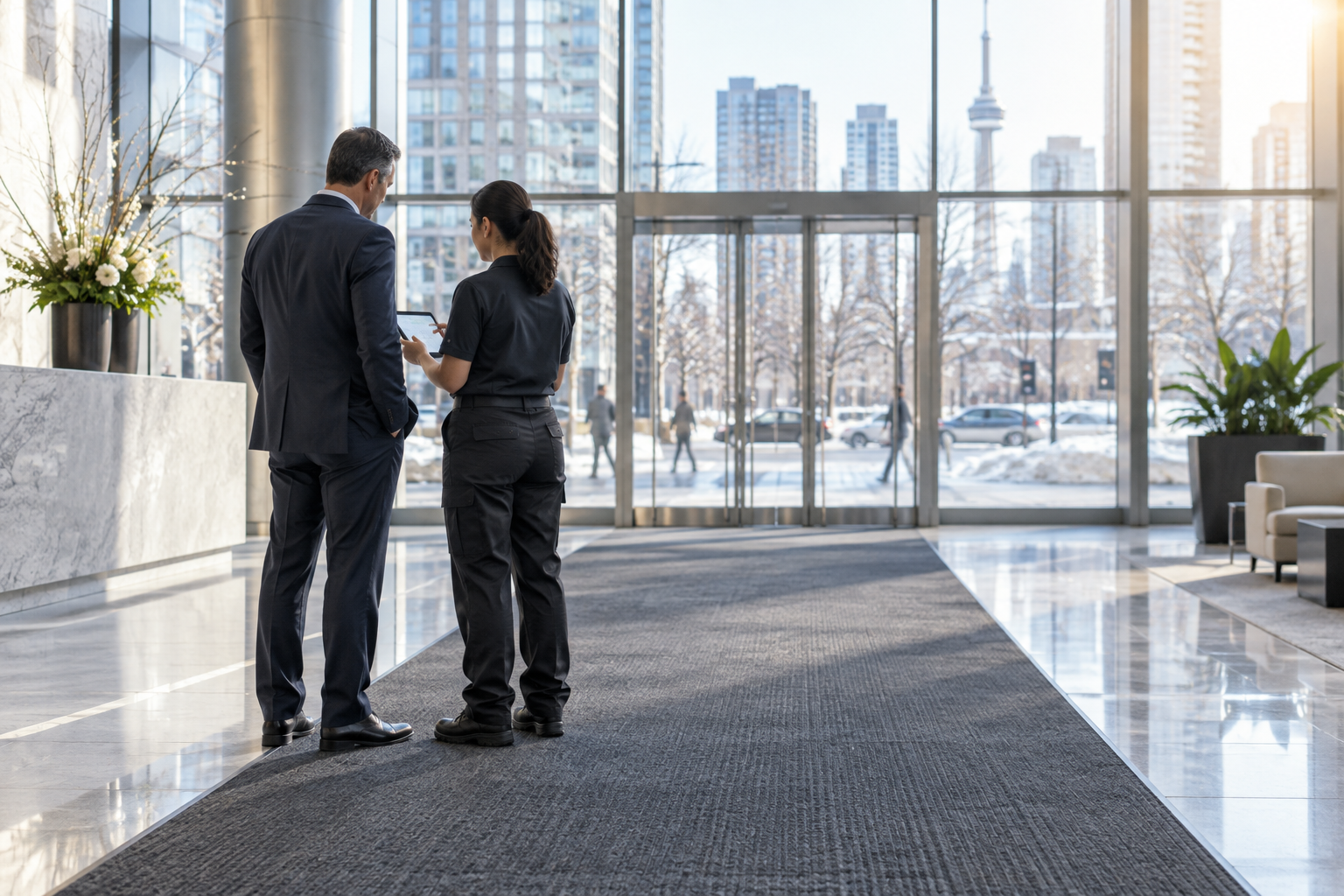
Commercial cleaning quality checks work best when Toronto facility managers inspect agreed tasks by area, record observable results, and assign every deficiency an owner and follow-up. Check busy entrances, washrooms and shared kitchens on occupied days, then use scheduled walkthroughs to assess less visible work. Adjust the process for winter salt, hybrid attendance and landlord–tenant responsibilities so you measure the cleaning service fairly and catch problems before they become recurring complaints.
Key takeaways
- Inspect against a written scope, not a general impression that the building looks clean.
- Separate cleaning defects from new mess, maintenance issues and tasks outside the contract.
- Give washrooms, entrances and shared food areas priority during occupied periods.
- Verify hygiene practices as well as appearance; a clean-looking surface does not prove disinfection.
- Record each issue, assign responsibility and confirm the correction before closing it.
What should a commercial cleaning quality check include?
A useful quality check covers appearance, hygiene procedures, supplies, floor condition and completion of the agreed cleaning tasks.
A polished reception desk can distract from an empty soap dispenser or debris behind a washroom door. Walk the same route each time so highly visible areas do not receive all the attention while awkward corners escape inspection.
For each area, establish what an acceptable result looks like. “Kitchen cleaned” is vague. “Sink free of food debris, counters free of sticky residue, bins emptied and floor edges clear” gives both the inspector and crew something concrete to assess.
Your commercial cleaning service scope should identify:
- Areas and surfaces included in routine visits.
- Tasks performed periodically rather than every visit.
- Exclusions, restricted spaces and sensitive equipment.
- Responsibility for consumables and restocking.
- Access arrangements and service windows.
- How urgent concerns and repeat deficiencies are reported.
Keep the inspection checklist aligned with that scope. If expectations change, update the service agreement rather than quietly adding new tasks to the inspection sheet.
How should Toronto buildings adapt their cleaning inspections?
Toronto inspections should account for winter entrance conditions, mixed-use building boundaries and the access constraints of busy commercial properties.
In a downtown office tower, a complaint about a dirty lobby may concern a landlord-managed space rather than the tenant’s cleaning contract. In a street-level retail unit, the business may control its entrance but not the adjoining common corridor. Document those boundaries before an issue starts moving between contractors.
Where a building connects to the PATH, inspect that entrance as well as the street entrance. Different routes can create different traffic patterns, especially when weather changes how occupants enter the building.
Build local conditions into the checklist
- Winter salt and slush: Check mat saturation, tracked residue, slippery patches and flooring transitions. Surface appearance alone is not enough.
- Elevator and loading access: Note whether missed work followed an access problem, a locked service elevator or an unavailable loading area.
- Downtown construction: If nearby work is affecting entrances, document the increased dust or debris and review the scope.
- Hybrid office attendance: Inspect after the busiest on-site periods, not only on quiet work-from-home days.
For multi-tenant office buildings, keep a shared responsibility map showing who handles reception, lift lobbies, tenant kitchens, washrooms and waste movement. It prevents duplicated work and gaps between teams.
What should a practical cleaning inspection checklist look like?
A practical checklist pairs each area with a visible standard, an inspection trigger and a clear response when the standard is missed.
Use the table below as a starting point, then adapt it to occupancy, operating hours and the contracted scope. These are suggested inspection triggers, not a universal cleaning schedule.
| Area | What to check | Suggested inspection trigger | If the check fails |
|---|---|---|---|
| Street and connected entrances | Mats lying flat, moisture controlled, salt residue addressed, thresholds clear | Before opening and during wet or snowy conditions | Arrange prompt hazard control; review matting and coverage |
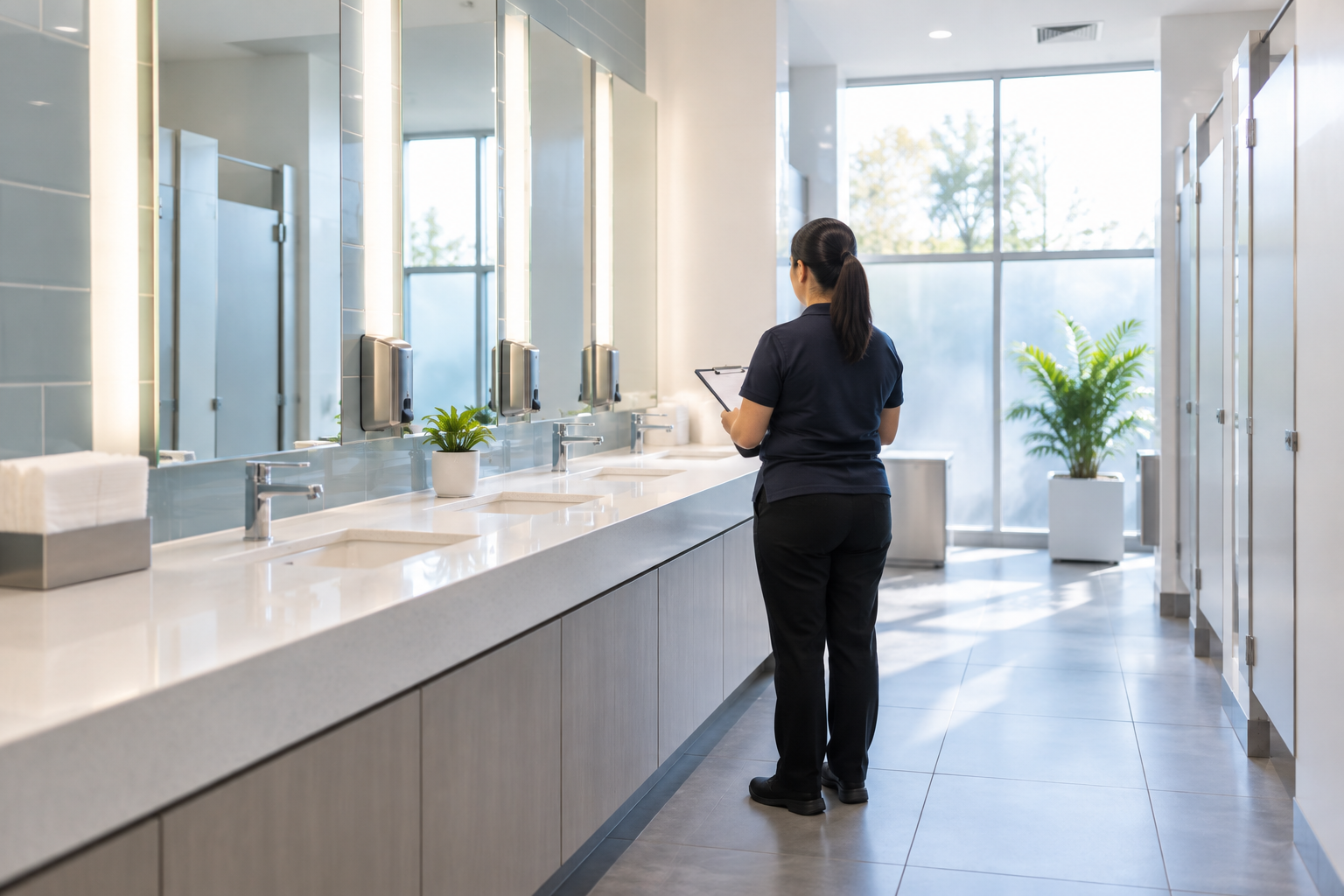
| Washrooms | Soap and paper available, fixtures visibly clean, bins controlled, no persistent odour | On occupied days and after busy periods | Restock or reclean; investigate plumbing if odour persists |
| Shared kitchens | No food debris or sticky residue, clean sinks, bins emptied, floor edges clear | After scheduled cleaning and around lunch use | Identify new mess versus missed work; assign the appropriate response |
| Meeting rooms | Clear tables, crumbs removed, touchpoints addressed as specified | After cleaning and before important bookings | Request a reset; confirm responsibility for room turnover |
| Work areas | Accessible surfaces dusted, bins serviced, floors clear of debris | After scheduled cleaning | Record missed areas without moving papers or personal belongings |
| Floors and stairs | No remaining debris, tacky residue or unattended wet areas | After floor care and during weather events | Control access where needed; review product and method |
| Waste collection points | No overflow, loose waste or obvious leakage | Around collection and scheduled cleaning | Confirm whether the issue concerns collection, sorting or cleaning |
| Periodic-detail areas | Vents, ledges, edges and other listed surfaces completed | Following the agreed periodic task | Compare against the task record and arrange correction |
Keep a short notes field beside each result. “Washroom unsatisfactory” is less useful than “soap dispenser empty beside the entrance; other dispensers stocked.”
How often should facility managers inspect cleaning quality?
Inspect high-use areas on occupied days and after significant weather or traffic events, with broader walkthroughs scheduled around the service agreement.
Cleaning frequency and inspection frequency are different. A washroom cleaned overnight may still need a daytime supply check. An entrance may need attention during a Toronto snowstorm even when the previous evening’s work was completed correctly.
Use two types of walkthrough:
- Post-service check: Assesses whether contracted work was completed before occupants substantially change conditions.
- Occupied-hours check: Assesses whether the building remains usable and whether daytime coverage is sufficient.
Record which type you performed. Otherwise, a lunch-hour spill can be misclassified as an overnight cleaning failure.
Walk through with the contractor during service start-up, after a scope change and when patterns emerge. Vary the inspection route and timing occasionally so a consistently quiet area does not become your only benchmark.
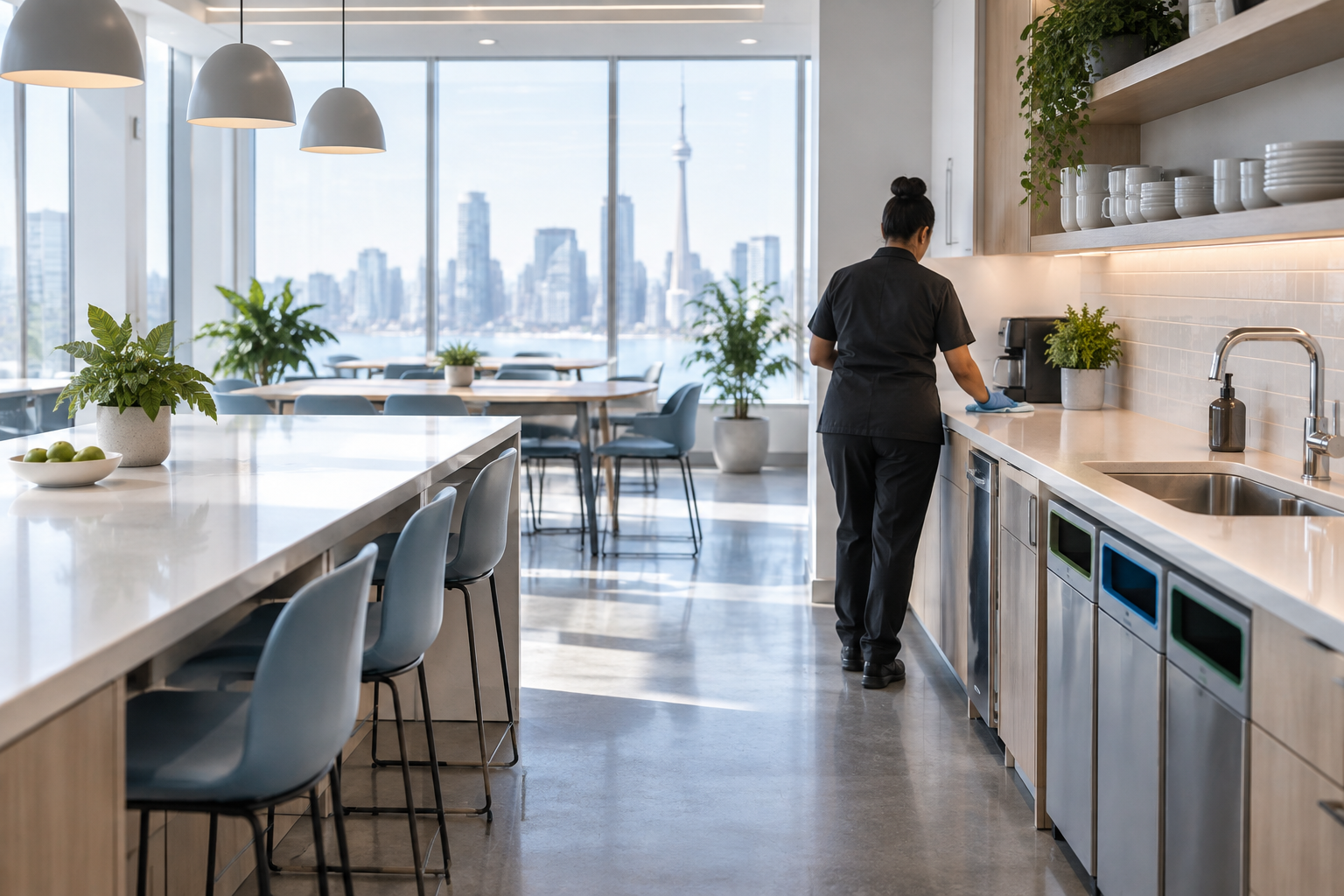
How can you verify hygiene without relying on appearance?
Verify hygiene by checking the cleaning process, product suitability and label directions rather than treating shine or fragrance as proof.
Cleaning removes dirt and residue; disinfection is a separate process intended to inactivate specified microorganisms when the product is used correctly. Not every office surface needs the same treatment, and disinfecting a visibly dirty surface without following label instructions may not deliver the intended result.
During a supervisor walkthrough, ask:
- Is visible soil removed as required before disinfection?
- Is the product suitable for the surface and intended use?
- For disinfectants, is a Health Canada Drug Identification Number present?
- Is the surface kept wet for the label’s required contact time?
- Are cloths and tools managed to avoid carrying contamination from washrooms into kitchens?
- Are dilution, storage and protective-equipment instructions followed?
A routine visual inspection cannot prove that a surface is pathogen-free. If a tenant requests testing, agree on the method, limitations and interpretation before treating results as a contractual standard. Healthcare tenants may also require a separate, setting-specific protocol beyond an ordinary office checklist.
How should cleaning deficiencies be recorded and resolved?
Record deficiencies with enough context to identify the problem, assign the right response and verify that the correction lasted.
Use plain-language status labels such as pass, attention required and urgent. A slippery entrance or missing washroom soap needs a different response from dust on a low-use ledge.
Each record should include:
- Location and observation time.
- The specific expected result that was missed.
- Whether the area had been used since cleaning.
- A photograph where appropriate.
- The responsible person and agreed response time.
- Confirmation of correction and any prevention step.
Avoid photographing confidential documents, visitor information or occupied washrooms. Capture the defect, not unrelated business activity.
Arelli’s client app supports reporting concerns and following up, while client care provides a route for ongoing service communication. Whatever reporting system you use, do not close a concern solely because someone acknowledged the message; confirm the result.
If the same issue returns, investigate access, equipment, instructions, staffing arrangements and scope before requesting another identical reclean.
How do quality expectations affect commercial cleaning costs in Toronto?
Quality expectations affect cost when they change the labour, visit frequency, equipment or specialist work needed to maintain the building.
Square footage is only part of the picture. Traffic, washroom count, flooring, service frequency and special requirements all influence the work. A busy street entrance collecting winter grit has different demands from a lightly used interior suite.
Distinguish between correcting an included task and purchasing additional coverage. A missed contracted kitchen clean is a service deficiency; repeated kitchen resets during the workday may require an added service.
Review the office cleaning pricing guide for cost considerations, and compare written proposals using the same areas, tasks and frequencies. Identify periodic work separately: services such as extraction or floor restoration may require a specialty cleaning scope rather than being assumed part of routine maintenance.
Arelli offers Price Match on comparable written quotes. Comparable scope matters more than a lower headline price that leaves essential tasks unspecified.
How do you assess green cleaning and choose a dependable provider?
Assess green cleaning through documented product choices and working practices, and choose a provider that can explain how it supervises and corrects its work.
“Green” is not a complete specification. Ask which products will be used, why they suit your surfaces, and how any environmental claims are supported. Low fragrance can help address occupant preferences, but neither fragrance-free nor natural automatically means harmless.
Look for controlled dilution, appropriate reusable tools, maintained equipment and procedures that avoid unnecessary product use. Waste handling should follow your building’s collection arrangements rather than assuming every Toronto commercial property has the same system.
When comparing Commercial Cleaning providers, ask to see an example inspection record and escalation process. Discuss how crews handle restricted access, peak attendance and winter weather adjustments.
Arelli uses local crews rather than a franchise model, serves 300+ Ontario businesses and offers 24/7 client support with no cancellation fees. Evaluate those service features alongside the proposed scope, communication process and sample-clean results.
Frequently asked questions
These answers address common practical decisions when setting up Toronto commercial cleaning quality checks.
Who should carry out cleaning inspections?
The contractor should supervise its own work, while a designated facility or office contact verifies results against the agreed scope. Joint walkthroughs help resolve disagreements about expectations and responsibility.
Should inspections happen before staff arrive?
Early checks are useful for assessing overnight work before normal use changes conditions. Daytime checks answer a different question: whether supplies, entrances and shared areas remain manageable during occupancy.
Is a smell a reliable sign that an area is clean?
No; fragrance does not prove soil removal or disinfection. Persistent odour may involve drains, leaks, ventilation or waste handling and should be investigated rather than covered with scent.
How should hybrid offices adjust their checklist?
Base priorities on actual attendance, meeting bookings and food-service activity rather than the nominal desk count. Keep essential checks in place on quieter days, while shifting attention towards peak-use periods.
What if the same cleaning problem keeps returning?
Treat recurrence as a process issue, not just another isolated complaint. Review the task instructions, available time, tools, access and inspection timing, then agree on a change and verify whether it works.
Can a sample clean replace a quality inspection programme?
No; it helps you assess selected tasks and discuss expectations before committing. Ongoing inspections are still needed to evaluate consistency through occupancy changes, seasonal conditions and routine service delivery.
Get a free sample clean
A free 45-minute sample clean lets you assess selected cleaning results before you commit. Bring your priority areas and inspection checklist so the conversation stays focused on your Toronto facility’s needs. Book a free sample clean with Arelli’s Cleaners Who Care® and build a practical scope around what your building actually requires.
Arelli service for this topic
Commercial Cleaning in Toronto